
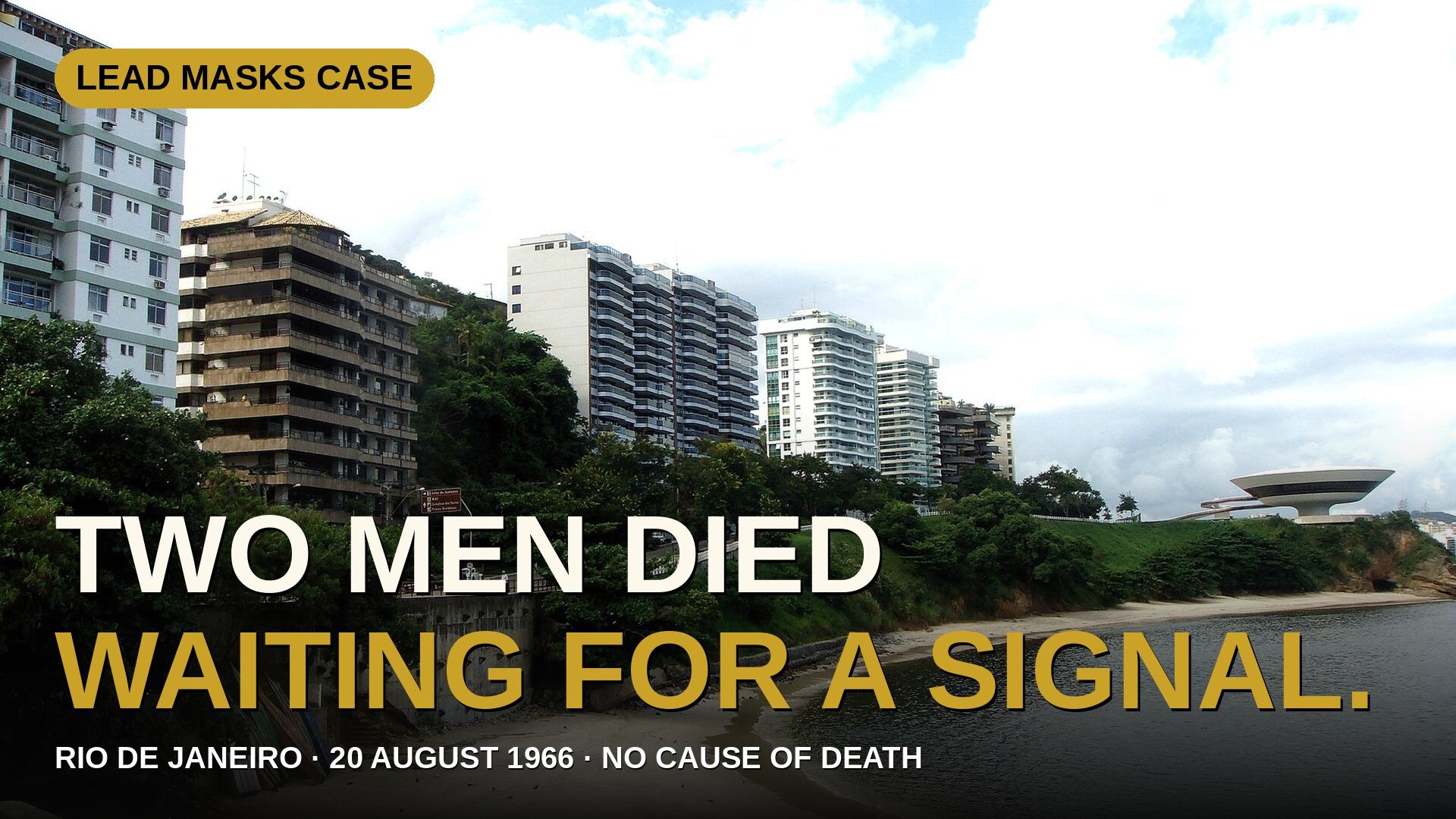
On 20 August 1966, a teenager flying a kite on Morro do Vintém, a scrub-covered hill above Niterói, found two men lying side by side in the grass.
Both wore formal suits. Over the suits were new waterproof coats, bought that same week. Over their eyes sat masks cut by hand from sheet lead, with no holes to see through.
There were no wounds. There was no sign of a struggle. Beside them sat an empty water bottle, two towels, and a small notebook that turned a strange scene into a lasting mystery.
Inside the notebook was a timetable. Be somewhere at half past four. Swallow capsules at half past six. Then protect your face and wait for a signal.
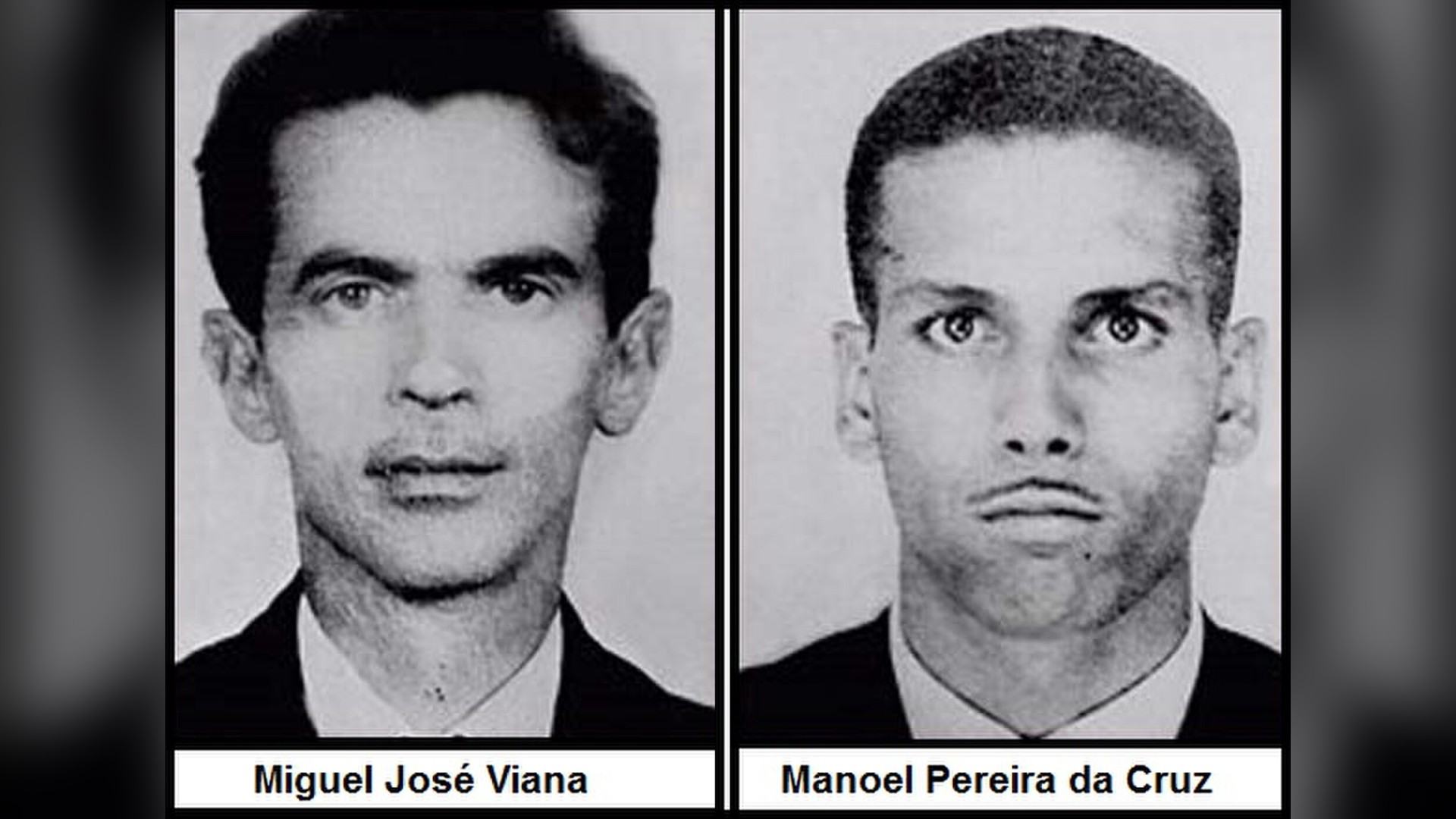
The men were Manoel Pereira da Cruz, 32, and Miguel José Viana, 34. They fixed radios and televisions for a living in Campos dos Goytacazes, hours away by bus.
They had told their families they were travelling to buy work materials and perhaps a car. They carried money for the trip. Most of that money was never accounted for.
On 17 August they reached Niterói at about half past two. Rain pushed them into a shop for matching raincoats. Then they bought a bottle of water at a local bar.
The woman who served them later remembered Miguel as very nervous. By about quarter past three, witnesses placed the two men walking up Vintém Hill.
A boy reportedly saw them sitting on the hill that evening. The next day he saw them lying down and assumed they were asleep. By Saturday, the smell told him otherwise.
Police and firefighters struggled up the rough ground the day after the report. What they found has been argued over ever since, because the scene explained nothing.
The Evidence
Start with the note, because everything else hangs off it. The Portuguese reads: “16:30 estar no local determinado. 18:30 ingerir cápsulas, após efeito proteger metais aguardar sinal mascara.”
In plain English: be at the agreed place at 16:30. At 18:30, swallow the capsules. After the effect, protect the metals, or the face, and wait for the signal, mask.
Translations differ on small points, and those points matter. Some versions read “protect face” where others read “protect metals.” The handwriting gave no certain author for the plan itself.
The masks were real, and crude. Each was a shaped piece of lead meant to cover the eyes only. Whoever made them expected something bright, or something worth shielding eyes from.
No capsules were found at the scene. If the men swallowed any, nobody ever learned what was inside them. That single gap sits under almost every theory of this case.
The suits and raincoats matter too. These men dressed carefully, prepared for rain, carried towels and water, and climbed in daylight to a known spot. This was planned, not panicked.
Then came the failure that froze the case. The autopsy found no injury that explained death, but it happened weeks later, when the bodies were badly decomposed.
Because of that delay, reliable toxicology was never done. As Wikipedia’s Lead masks case summary notes, the cause of death has never been determined.
So the evidence list is short and stubborn: a timetable, two lead eye shields, missing money, no wounds, and no test that could say what, if anything, they took.
The Theories

The men’s friend Elcio Gomes gave police the context most accounts still use. He said the three of them belonged to a circle of “scientific spiritualists.”
The circle tried to contact spirits, and in some tellings beings from Mars, using method as much as belief. Séances sat alongside experiments. A spiritualist book was found among Miguel’s things.
Gomes also linked the group to earlier incidents. Witnesses reported an orange object over Atafona beach that June, with a flash and an explosion fishermen felt out at sea.
Those beach reports were never proven, and retellings blur the dates and details. Treat them as reported, not established. What they show is what the men believed might happen.
On the UFO reading, the hill was a rendezvous. The capsules would open the mind, the masks would guard against a blinding arrival, and the signal would confirm contact.
On the spiritualist reading, the same kit fits a ritual instead. No craft was needed, only an expected manifestation, expected light, and two men following instructions to the letter.
A darker theory says a third person set them up. The men carried cash, most of it vanished, and the note was not clearly written by either of them in early reports.
On that reading, the capsules were poison or a strong drug, handed over by someone who took the money and left. It explains the cash. It names no proven culprit.
The overdose theory is simpler. Two experimenters took something stronger than they expected, lay down on a hill, and died while medicine lacked the test to prove it.
Each theory uses the same objects and reaches a different hill. That is the problem. The masks and note prove intention. They do not prove what arrived, or what killed them.
The Verdict

Strip the case back and two facts refuse to move. Two healthy working men climbed a hill with a written plan and protective masks, and medicine never established why they died.
Everything beyond that is inference. The spiritualist circle is documented through testimony. The orange object is reported, not verified. The robbery rests on missing money alone.
Cases like this one endure because the physical record is both rich and useless. Compare it with Brazil’s later Varginha incident, where witnesses again filled gaps officials left open.
Verdict: Unresolved. The men plainly expected an event at a set time, and took steps to protect their eyes from it. Whether that event was a spirit, a craft, a drug, or a trap, the record cannot say.
Frequently Asked Questions
Who were the two men in the lead masks case?
Manoel Pereira da Cruz, 32, and Miguel José Viana, 34, electronics technicians from Campos dos Goytacazes, Brazil, found dead on Vintém Hill on 20 August 1966.
What did the note beside them say?
It set times: be at the agreed place at 16:30, swallow capsules at 18:30, then protect the face or metals and await a signal, wearing the mask.
Why was no cause of death found?
The autopsy came weeks later, after heavy decomposition. No injury explained the deaths, and reliable toxicology testing was never carried out.
Were the lead masks meant to block a bright light?
That is the common reading. The masks covered only the eyes, which fits men expecting intense light, but nobody proved what they expected to see.
Was anyone ever charged over the deaths?
No. Police investigated the men’s spiritualist circle and the missing money, but no one was charged and the case was eventually archived unsolved.
Join the Conversation
A timetable, two masks, and no toxicology. If you had to pick one explanation and defend it, which would you choose: a ritual that went wrong, a drug, or a man who set them up?
Read Next
The Varginha Incident: Brazil’s Other Close Encounter
Frederick Valentich: The Pilot Who Vanished Mid-Call
