
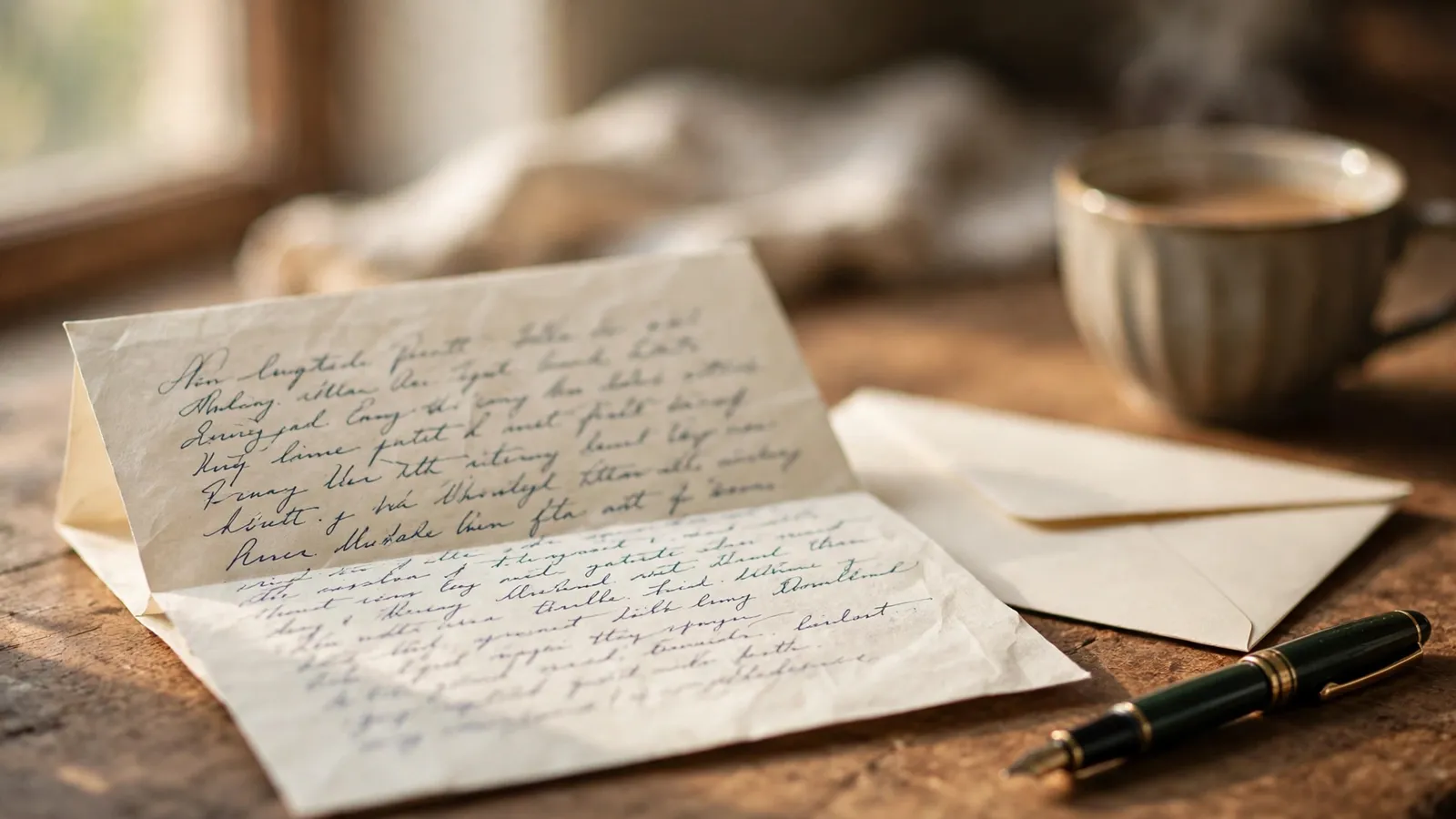
Think about the last message that genuinely moved you. Chances are it was not a text. Texts are brilliant at logistics — “running late,” “happy birthday!!,” a row of emojis — but when something really matters, many of us still reach for paper.
A handwritten letter feels heavier than the words inside it. It gets kept in drawers, re-read on bad days, and saved for decades, while a heartfelt text quietly sinks under a hundred newer notifications.
You have probably done it yourself: kept a card for years while deleting a thousand messages without a second thought, or felt a small lift at the sight of a handwritten envelope among the bills. That difference is not just nostalgia.
Psychology offers several real reasons why ink on paper lands differently in the mind than the same words glowing on a screen.
Contents
- You Can See the Effort
- It Exists in Only One Copy
- Writing by Hand Slows the Writer Down
- Gratitude Lands Harder Than the Sender Expects
- A Letter Becomes a Keepsake, Not a Notification
- When a Text Is Actually Better
- How to Write a Letter That Lands
- Frequently Asked Questions
- Conclusion
Imagine two messages with identical wording: “Thank you for everything you did for me this year. I don’t say it enough, but I notice, and I’m grateful.” One arrives as a text between a delivery notification and a meme.
The other arrives in an envelope, in handwriting you recognise before you read a single word. Almost everyone rates the second as more meaningful — yet the information is exactly the same.
What changes is everything around the words: the effort they took, the time they imply, the physical object they create, and the fact that they were made for one person only. The sections below unpack each of those ingredients, because each one does separate psychological work.

You Can See the Effort
A text message is nearly free to produce, and we all know it. A letter is visibly expensive: someone found paper, sat down, wrote slowly, maybe crossed something out, addressed an envelope and posted it.
Psychologists call our sensitivity to this the “effort heuristic” — we judge the value of things partly by how much effort we believe went into them.
In experiments by Kruger and colleagues (2004), people rated the exact same poem as better, and worth more money, when they believed the poet had spent 18 hours on it rather than four. A handwritten letter carries its effort on its face.
The recipient does not have to guess whether you cared; the smudged ink and uneven lines prove the time was spent, and the time itself becomes part of the message: you were worth an unhurried half hour.
It Exists in Only One Copy
A text is a copy of data. It can be forwarded, screenshotted, pasted into another chat, or sent — word for word — to six other people, and the recipient knows all of that. A handwritten letter is a one-off physical original.
The handwriting itself is unmistakably one person’s: the particular slant, the way they cross their t’s, the signature that no keyboard can reproduce. That uniqueness signals something messages struggle to: this was not broadcast, it was made, for you specifically.
It also carries small imperfections — a crossed-out word, a sentence squeezed in at the bottom — that read as honesty rather than carelessness. There was no delete key and no draft folder. What you are holding is what they actually thought, in the order they thought it.

Writing by Hand Slows the Writer Down
Handwriting is slow, and the slowness changes what gets written. Research by Mueller and Oppenheimer (2014) found that people writing by hand, unlike fast typists, could not transcribe word-for-word; they had to process ideas and reframe them in their own words as they went.
(Later replication attempts found this note-taking advantage to be smaller and less consistent, so treat it as suggestive rather than settled.) Applied to letters, the principle is easy to recognise: because you cannot easily delete a sentence on paper, you think before you write it.
Letters tend to skip the filler and go straight to the point that matters — the specific memory, the exact thing the person did, the feeling you have never said out loud. That thoughtfulness is something recipients can sense, even if they could not explain why.

Gratitude Lands Harder Than the Sender Expects
The strongest research here concerns gratitude. In experiments by Kumar and Epley (2018), people wrote letters of thanks to someone who had mattered in their lives, then predicted how the recipient would react.
They were wrong in a consistent, hopeful direction: they underestimated how surprised and how positive recipients would feel, and overestimated how awkward it would be. Recipients cared far less about elegant wording than writers feared — what moved them was the warmth of the gesture itself.
The finding held across several experiments, and the letters took only a few minutes to write.
Other work shows the effects ripple outward. Seligman and colleagues (2005) tested a “gratitude visit” — writing a letter of thanks and delivering it in person — and found it produced the largest boost in happiness and the largest drop in depressive symptoms of any exercise they tested, lasting about a month for the writer.
And Grant and Gino (2010) found that people who received a short written thank-you were considerably more likely to help again, mainly because being thanked made them feel socially valued.
A letter, in other words, does measurable good in both directions — which may be why December, a month built around reaching out, feels so loaded with meaning; it is no accident that cards and letters cluster in the season we explore in why December feels so emotional.

A Letter Becomes a Keepsake, Not a Notification
A text lives in a thread, buried within days under newer messages, one phone upgrade away from disappearing. A letter lives in the physical world. It can be pinned to a board, kept in a wallet, stored in the box of things someone would save from a fire.
This is the same attachment we feel toward many old objects — the subject of our piece on why we feel emotionally attached to old things — but a letter is special because the object is made of someone’s words and handwriting.
People re-read letters at turning points: before a big decision, after a loss, on the anniversary of something. Each re-reading happens in a new emotional context, so the letter keeps giving.
Finding a bundle of old family letters can even reshape how the past feels, much like the other ways childhood comes to feel like a different world as we grow older. No notification has ever done that.
When a Text Is Actually Better
Honesty matters here: letters are not always the right tool. A text wins on speed, and sometimes speed is the kind thing — the quick check-in after bad news, the “thinking of you” sent the moment it is true rather than next week.
Texts also win for people whose handwriting, health or circumstances make writing by hand genuinely hard, and a warm message sent beats a perfect letter never written.
And for some conversations, writing is not the point at all: when someone has shut down emotionally, what they may need first is presence, not prose — understanding why people go silent when they are hurt matters more than the medium. The real lesson is not “letters good, texts bad.”
It is that the effort and permanence of a letter make it the stronger instrument when the message is meant to last.
How to Write a Letter That Lands
The research points to a liberating conclusion: the wording matters far less than you fear, so the only real mistake is not sending one. Keep it simple. Name the specific thing the person did — “you drove two hours to sit with me at the hospital” beats “you’re always there for me.”
Say what it meant to you, plainly, in one or two sentences. Do not apologise for your handwriting; it is part of the evidence that a human wrote this. Write the way you talk, cross-outs and all.
And keep it short if short is honest: Kumar and Epley’s gratitude letters took minutes, and still landed far better than their writers expected. One page, sincerely meant, outperforms four pages of performance.
Frequently Asked Questions
Is there real research showing letters mean more than texts?
There is strong research on the ingredients: the effort heuristic (we value things more when they visibly took effort), and studies of gratitude letters showing recipients feel more positive and surprised than writers predict.
No single study has tested “letter versus text, same words” head-to-head, so the full claim is a well-supported explanation rather than one proven experiment.
What if my handwriting is terrible?
Send it anyway. In Kumar and Epley’s experiments, recipients responded to the warmth of the gesture, not the polish of the writing. Legible-enough and sincere beats beautiful and unsent, every time.
Are birthday and holiday cards as meaningful as full letters?
A card with two or three handwritten, specific sentences carries most of the same ingredients: visible effort, a physical original, something to keep. A signed name alone in a printed card carries far fewer of them.
Why do people keep old letters for so long?
Because a letter is both a message and an object — the person’s handwriting, the paper they touched, sometimes even the date and place written at the top. It becomes a piece of the relationship itself, and re-reading it at different ages gives it new meaning each time.
Is it ever too late to send a thank-you letter?
The gratitude research suggests no. Recipients in these studies were often thanked for things done long before, and their surprise was part of why the letters moved them. A late letter says the gratitude lasted — which is itself a powerful message.
Conclusion
A handwritten letter feels more meaningful than a text because almost everything about it works in the same direction. The effort is visible, and we instinctively value what costs effort. The object is unique, unreproducible and made for one person.
The slowness of writing produces more thoughtful words, and the paper survives to be re-read for years. Research on gratitude adds the final, encouraging twist: the letter you are hesitating over will almost certainly land better than you expect, and writing it will probably do you good too.
The envelope in the drawer is not old-fashioned. It is simply the strongest signal our everyday communication has.
