
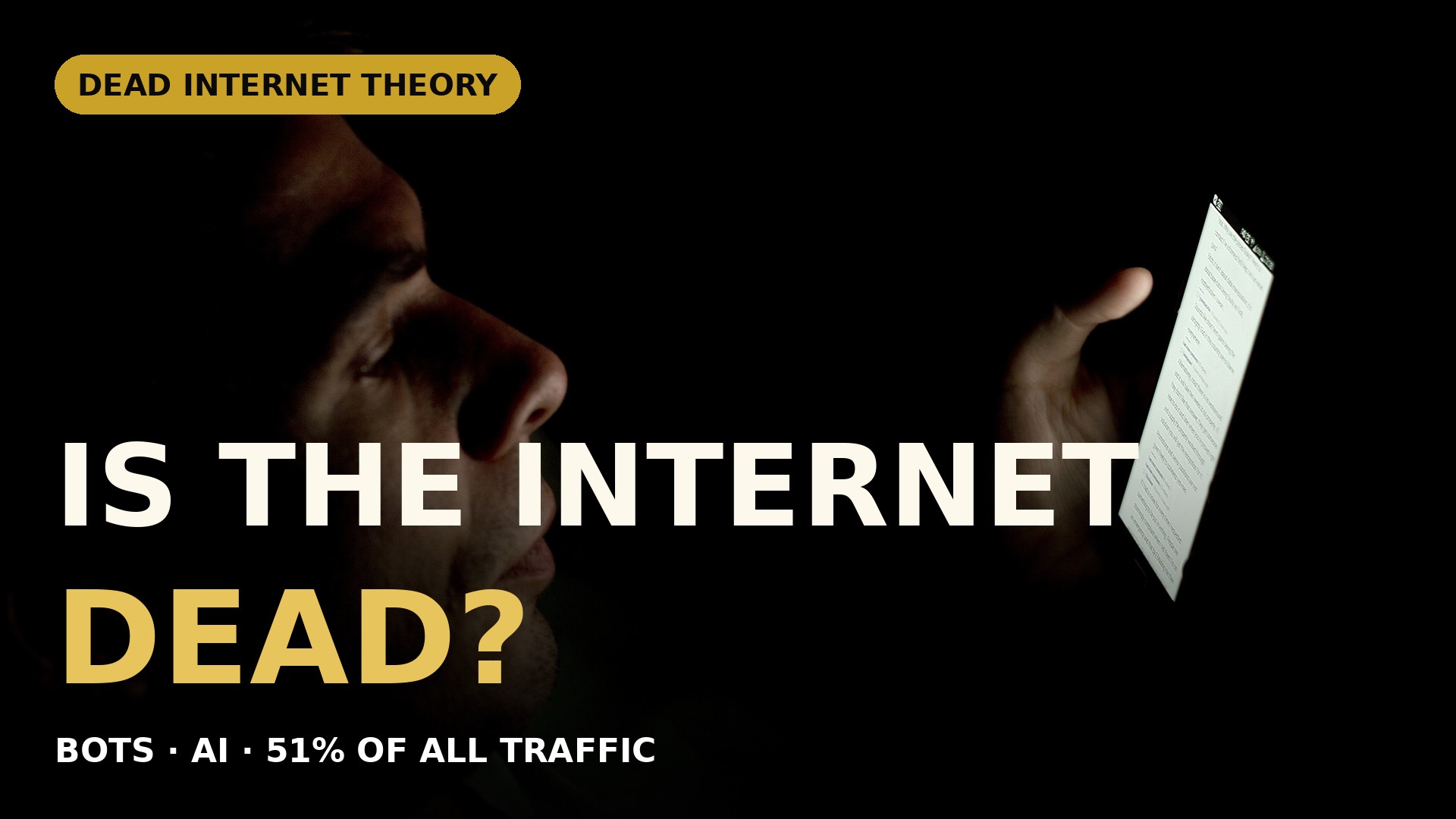
Scroll your feed for sixty seconds and count what you actually see.
An account with no face posts the same joke you saw last week. A comment thread fills up with replies that sound almost human, but not quite. A video of a person who may not exist tries to sell you something you never searched for.
That uneasy feeling has a name: the Dead Internet Theory. It claims the web you remember died years ago, and most of what replaced it is bots, generated content and algorithms talking to each other.
Some of that feeling is backed by hard data. Some of it is not. Sorting one from the other is where this gets interesting.
What Is the Dead Internet Theory?
The Dead Internet Theory took shape in forum posts in the late 2010s, then broke into the open in January 2021.
A user called IlluminatiPirate posted a long thread titled “Dead Internet Theory: Most Of The Internet Is Fake” on Agora Road’s Macintosh Cafe, a small forum devoted to esoteric and fringe topics. The post built on earlier threads on the same board and on Wizardchan.
Its core claim was blunt. The internet, it argued, died around 2016 or 2017.
Not in the sense that the cables stopped working. In the sense that real, messy human activity was quietly replaced.
According to the theory, most posts, comments, accounts and articles online are now created by automated systems. Algorithms then decide which of that material you see, so bots effectively write for other bots while real people watch from the edges.
The darker version goes further. It claims governments and large companies run this system on purpose, using fake accounts and curated feeds to shape what people think, buy and believe.
The Atlantic carried the idea to a mainstream audience in September 2021 with an article headlined “Maybe You Missed It, but the Internet ‘Died’ Five Years Ago.” From there it spread to YouTube, Reddit and X, where it has never really gone away.
Timing helped it. The theory landed just before generative AI exploded into public view, which made an old forum claim suddenly feel like a prediction.
The Dead Internet Theory and the Bot Problem: The Numbers Are Real


Here is the part supporters get right. Bot traffic is not a fringe problem, and it is not small.
Imperva’s Bad Bot Report is the most widely cited measurement of automated web traffic. Its 2025 edition, covering 2024, found that automated traffic accounted for 51% of all web traffic — passing human traffic for the first time in a decade.
Bad bots alone made up 37% of all traffic in 2024, up from 32% in 2023. These are the malicious kind: scrapers, credential-stuffing tools, fake account creators and systems built to inflate clicks or steal data.
The rest of the automated share is mostly “good” bots. Search engine crawlers, uptime monitors and feed fetchers do useful work, but they are still machines generating requests no human made.
Cloudflare, which sees a huge slice of global web requests through its own network, has reported a similar pattern in its traffic data: a large and growing share of requests comes from automated clients, including a fast-rising wave of AI crawlers harvesting pages to train models.
Social platforms have their own version of the problem. X, Instagram, Facebook and TikTok have all removed fake and inauthentic accounts by the millions in regular enforcement sweeps, and researchers keep finding networks of coordinated accounts posting identical or near-identical messages.
Some of those networks are commercial spam. Some push scams. A smaller number have been linked by platform investigators and governments to state-backed influence operations.
So if a comment section feels half-empty of real people, you are not imagining the traffic figures. On the raw numbers, roughly half the web’s activity now never involved a person at all.
That is a striking fact. It is not, on its own, proof of the theory — because traffic is not the same thing as the posts and videos a human actually reads.
The Rise of AI Content After ChatGPT

Whatever was true in 2016, the web changed sharply on 30 November 2022, when ChatGPT launched.
Within months, anyone could generate a passable article, product review, comment or social post in seconds. Content farms that once paid cheap human writers could now produce text at almost no cost.
The results are easy to spot once you know the signs. Search for a simple question and you may land on pages that repeat the question back at you, pad out obvious points, and say nothing checkable — written for a search algorithm, not a reader.
Social feeds filled with what users now call AI slop: surreal generated images, fake celebrity posts, and stories engineered purely to trigger outrage or amazement. Strange religious images generated by AI, for example, have racked up huge engagement on Facebook from accounts that appear to exist only to farm reactions.
Then came the AI influencers. Fully generated personas now front brand deals, post daily selfies and reply to fans, while the “person” in the photos does not exist at all.
Platforms and search engines have started pushing back, at least in public. Social networks now label some AI-generated posts, and Google says its ranking systems aim to reward original, first-hand content over mass-produced pages made mainly to manipulate search results.
Those fixes lag behind the flood. Labelling only works on content a platform detects, and detection is unreliable, especially for text. A generated article rewritten lightly by a human editor can pass most checks while adding nothing new to the record.
That gap between what can be made and what can be verified is the real change. Producing content used to take effort, and effort acted as a rough filter. That filter is now very weak.
Researchers have put numbers on the wider risk. A 2024 study in Nature by Ilia Shumailov and colleagues looked at what happens when AI models are trained on data generated by earlier AI models.
Their finding, called model collapse, was that the models gradually forget the rarer, more unusual parts of the original data. Outputs get blander, narrower and less accurate over generations.
In plain terms: if the web fills with generated material, and future AI learns mainly from that material, both the AI and the web get worse. The copy of a copy fades.
This is the strongest modern argument behind the theory. Not that a secret switch was flipped in 2016, but that an economic incentive — cheap content, endlessly produced — is slowly flooding the places people used to talk to each other.
We have seen a version of this before with fabricated viral stories, like the invented time-travel tale we fact-checked in the Elon Huck photo story, which spread widely despite there being no evidence behind it at all.
What the Dead Internet Theory Gets Wrong

Now the other side, because the full theory makes claims the evidence does not support.
Start with scale. Around five billion people use the internet, and global data use keeps climbing year after year.
Live video, gaming, video calls, messaging and streaming — the hardest content to fake at scale — make up a huge and growing share of what people actually do online.
Real communities are also easy to find if you look past the main feeds. Niche forums, group chats, local groups, hobby servers and comment sections full of specific, unglamorous, very human detail never went away. They just lost the algorithmic spotlight to louder, cheaper content.
The bot statistics need context too. A bot requesting a page a thousand times a second counts heavily in traffic data, but it does not mean a thousand fake people are talking to you.
Much automated traffic is machines fetching, indexing or attacking websites in the background, invisible in normal use.
There is also no evidence for the theory’s central plot: a coordinated decision, around 2016, to replace the human internet and hide the fact. No documents, no whistleblower, no insider account has ever backed that part up.
What the evidence does show is less tidy and more ordinary. Platforms reward engagement, engagement can be faked, and faking it is profitable.
Spam, scams and influence operations followed the money, as they always have — much like the viral theories we pulled apart in our fact-check of Disney conspiracy theories, where repetition online made weak claims look far stronger than they were.
The internet did not die. It got commercialised, automated and crowded — and the real voices became harder to hear over the noise.
The Verdict on the Dead Internet Theory
Verdict: Partly true on the data, unproven as a conspiracy.
The Dead Internet Theory is wrong about a secret, coordinated takeover, and there is no good evidence the web “died” in 2016 or 2017. Billions of real people are still here, creating and arguing and posting every day.
But the feeling behind the theory is not paranoia. Automated traffic really has passed the halfway mark, bad bots really are more than a third of web traffic, and generated content really is spreading through search results and social feeds.
The honest summary is this: the internet is not dead, but a growing share of it is not human — and telling the difference gets harder every year.
If you want the sharper end of that problem, our round-up of things science still can’t explain shows how quickly a good mystery can be buried under confident, content-free answers online.
Frequently Asked Questions
What is the Dead Internet Theory?
It is the claim that, since around 2016, most online activity and content has been created by bots and AI rather than real people, with algorithms controlling what users see.
Who started the Dead Internet Theory?
It spread from forum posts in the late 2010s and was popularised by a January 2021 thread by IlluminatiPirate on Agora Road’s Macintosh Cafe, then by coverage in The Atlantic.
How much of internet traffic is bots?
Imperva’s 2025 Bad Bot Report put automated traffic at 51% of all web traffic in 2024, with bad bots alone at 37%. Human traffic was 49%.
Is the Dead Internet Theory true?
Only in part. Bot traffic and AI content are real and growing, but there is no evidence of a coordinated plot, and billions of real users are still active online.
What is model collapse?
It is the process, described in a 2024 Nature study, where AI models trained on AI-generated data gradually lose quality and diversity, producing blander and less accurate results.
Join the Conversation
Do you think the Dead Internet Theory is a glitch in how we built the modern web, or just the latest name for spam getting louder?
How much of your own feed do you reckon is real people now? Let us know in the comments below.
Read Next
- The Dark Truth Behind Viral Disney Conspiracy Theories
- Elon Huck: Time-Travel Photo Found in a Tomb Opened in 1923!
- 10 Things Science Still Can’t Explain (Viral Mysteries)
- The Jensen Huang Scandal: Nvidia’s Board Moves to Oust CEO
