
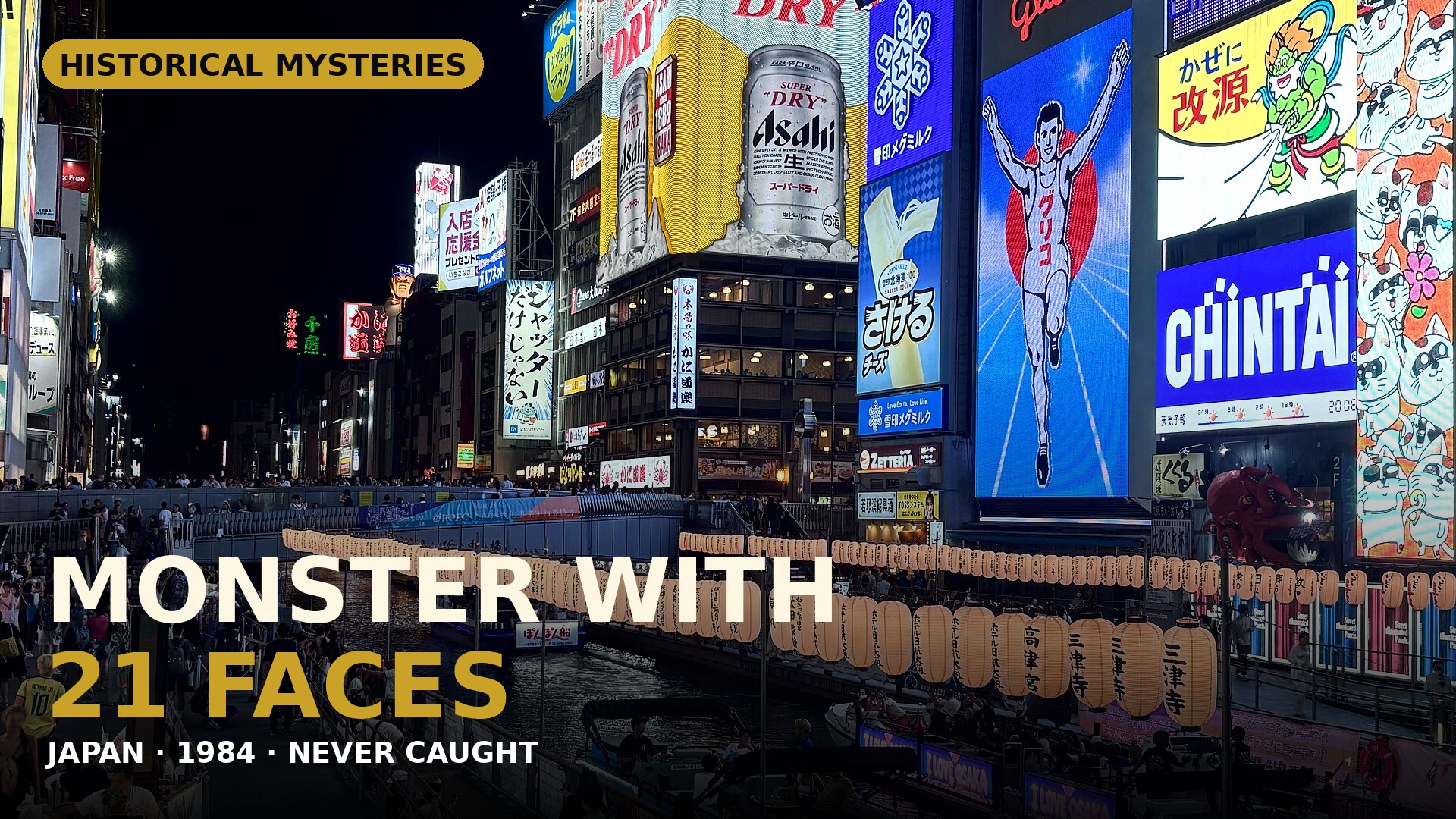
“We are the bad guys.” That, in effect, is how one of the strangest criminal campaigns in modern history announced itself to Japan.
Between March 1984 and August 1985, a person or group calling itself the Monster with 21 Faces kidnapped a company president, set fires, placed poisoned sweets on shop shelves, and mocked the police in letters published by national newspapers.
Nobody was ever charged. Nobody was ever identified. Seventeen months after it began, the campaign simply stopped.
This is the full story of the Monster with 21 Faces case, what investigators actually saw with their own eyes, and why a crime carried out in front of an entire country still has no ending.
The Monster with 21 Faces and the Kidnapping That Started It

At about 9pm on 18 March 1984, two masked men forced their way into a house in Nishinomiya, Japan. The house next door belonged to the mother of Katsuhisa Ezaki, president of Ezaki Glico, one of Japan’s biggest confectionery companies.
The men broke into the mother’s home first. They tied her up and took the key to her son’s house, which sat on the same property.
Inside Ezaki’s home, they tied up his wife and his eldest daughter and locked them in a bathroom. His two younger children were in another room and were left unharmed.
Ezaki himself was in the bath. The intruders dragged the 42-year-old executive out of his own home, still naked, and drove him away.
He was held in a warehouse in Ibaraki, Osaka. He had no idea who had taken him, and neither did anyone else.
A billion-yen demand
Around midnight, the kidnappers directed a Glico company director to a ransom note left in a public phone booth. The demand was enormous: one billion yen in cash, plus 100 kilograms of gold bullion.
At the exchange rates of the time, the cash alone was worth roughly 4.5 million US dollars. The note warned against involving the police.
Police were involved anyway, and a huge investigation began. It would grow into one of the largest in Japanese history, officially designated Metropolitan Designated Case 114.
Then the kidnappers lost their hostage. On 21 March, three days after he was taken, Ezaki worked himself free of his ropes and escaped from the warehouse on his own.
He could tell police almost nothing useful about his captors. The masks had done their job.
A failed kidnapping might have ended the story. Instead, losing Ezaki appears to have changed the group’s tactics, from one crime against one man to a campaign against whole companies. Cases like this, where the trail goes cold in public, sit alongside the mysterious deaths of people who knew too much in the files that refuse to close.
The Extortion Begins: Fires, Acid, and a New Target List
The threats against Glico did not stop with Ezaki’s escape. On 10 April 1984, vehicles in the car park of a Glico production building were set on fire.
Six days later, on 16 April, a plastic container of hydrochloric acid was found inside a Glico building in Ibaraki, with a threatening letter attached. The message was simple: the group could get inside.
On 8 April, a letter had already been sent to police. It opened by calling them fools and asked what they were doing with all their manpower.
The writer offered mocking hints. None of the group were among Ezaki’s relatives, none were in the local police, the car was grey, and the food bought for the hostage came from a named supermarket chain.
None of it helped. The letter ended by asking whether they should kidnap the head of the prefectural police too.
“We forgive Glico”
On 10 May, the signature appeared for the first time. Letters now arrived in the name of the Monster with 21 Faces, a villain borrowed from the detective novels of Edogawa Rampo, whose character is also translated as the Fiend with Twenty Faces.
The campaign ran for weeks. Then, on 26 June 1984, the group issued a message saying it forgave Glico, and the harassment of that company stopped.
It was not mercy. It was a change of target.
The Monster turned to Morinaga, another major confectionery company, and to food companies Marudai Ham and House Foods. Each received threats and demands under the same signature.
The fox-eyed man
Marudai agreed to pay 50 million yen. The drop was arranged for 28 June 1984, two days after the Glico campaign ended.
The plan was cinematic. A man posing as a Marudai employee would ride a train towards Kyoto and throw the money from the train when he saw a white flag planted by the tracks.
The man was an undercover police investigator. On the train, he noticed he was being watched.
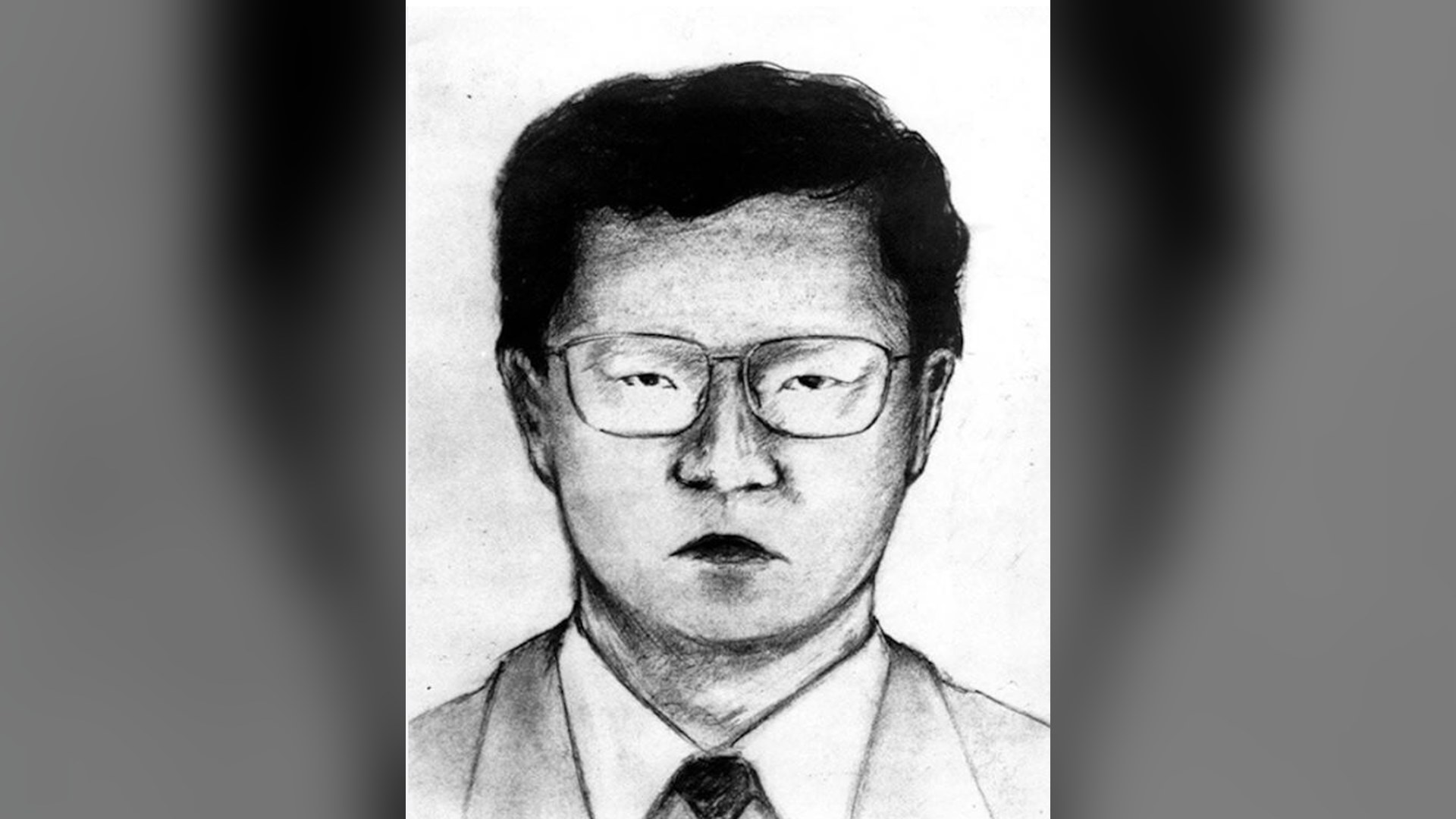
The watcher was large and well built, with short, permed hair and sunglasses. The detail that stuck was his eyes, described as being like those of a fox.
The white flag never appeared, so the money was never thrown. Both men got off at Kyoto, travelled back, and changed trains, with investigators trying to follow the suspect.
They lost him. The “fox-eyed man” became the closest thing police ever had to a face for the Monster, and he was seen again months later at another failed drop, near a rest stop on the Meishin Expressway, before slipping away a second time. A stolen van linked to that operation was later found abandoned near Kusatsu station, with a radio inside tuned to police frequencies.
The Poisoned Candy: The Threat That Terrified a Country

Extortion letters frighten executives. The next phase frightened everyone who bought sweets for their children.
In May 1984, the Monster claimed to have laced Glico products with potassium cyanide. Glico pulled its products from shelves across Japan at huge cost.
The reported loss ran to more than 21 million dollars, and about 450 part-time workers were laid off. Despite searches, no poisoned Glico product was ever confirmed.
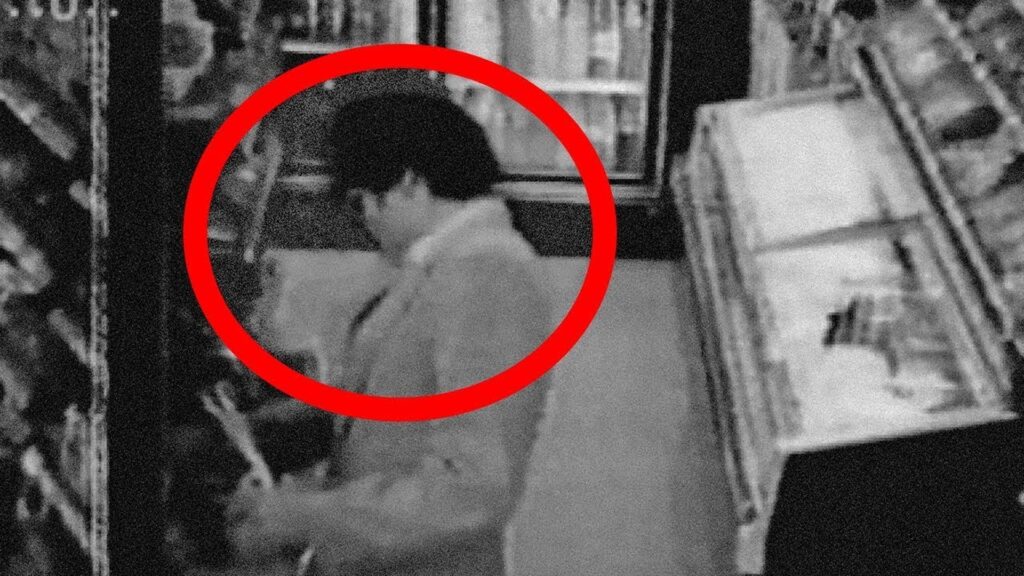
A man in a Yomiuri Giants baseball cap was also caught on a security camera appearing to place Glico chocolate on a shop shelf. Police released the image, but the man was never identified either.
Morinaga, October 1984
With Morinaga, the threat stopped being a claim. In October 1984, the group wrote to news agencies addressing “Moms of the Nation,” saying Morinaga sweets laced with cyanide had been placed in shops.
This time, they had. From 7 October, cyanide-laced Morinaga products began turning up in supermarkets and other stores.
Japan’s 1985 Police White Paper recorded 18 items found at 16 locations. Some carried handwritten warnings, words to the effect of: this contains poison, eat it and you will die.
Those warnings are the strangest detail in the whole case. Whoever placed the sweets labelled at least some of them, which suggests the goal was terror and leverage, not a body count.
The fact that matters most
State it plainly, because retellings often blur it: nobody was killed. No customer died, and no one is recorded as having been poisoned by the tampered products.
That does not make the crime smaller. Placing cyanide in food on public shelves is attempted mass poisoning, whatever the motive, and shoppers had no way of knowing which packs were safe.
Morinaga’s products were pulled, sales collapsed, and trust in packaged food across Japan took a lasting hit. Supermarkets changed how products were displayed and sealed, a legacy of the case that outlived the investigation itself.
The known facts end there. Whether the group ever intended anyone to eat the poison, or only ever meant to be believed, is unknown, because the group never explained itself beyond its letters.
The Taunting Letters of the Monster with 21 Faces

The letters are why this case is still famous. Most extortionists hide. The Monster performed.
Between April and December 1984 alone, the group sent around 15 messages to news organisations, on top of letters to companies and police stations. Newspapers printed them, which made the whole country an audience.
The tone was consistent: playful, contemptuous, and oddly intimate. Letters were written in hiragana, in an Osaka dialect, as if the writer wanted police to hear a local voice laughing at them.
One letter to police began by scolding them for lying, on the grounds that, as the saying goes in Japan, all crimes begin with a lie. Another offered helpful hints about how the group had entered a factory, naming the staff entrance and the model of typewriter used.
Some hints may have been true. Some were probably bait. Police had no reliable way to tell the difference, and chasing each one burned time and manpower.
A villain borrowed from fiction
The signature was a statement in itself. Edogawa Rampo’s Fiend with Twenty Faces was a master of disguise in popular detective stories, a villain who was always one identity ahead of pursuit.
By adding a face and signing as the Monster with 21 Faces, the writer cast the police as the heroes of a story they were losing. It was branding, decades before that word was used about crime.
The letters also show planning. Demands were delivered through newspapers, replies were requested through coded personal advertisements, and companies were played off against deadlines the group controlled.
In one exchange, Morinaga was told to answer through a missing-person advertisement in the Mainichi newspaper, using a set of agreed words. The company complied, in public, in code, for a criminal nobody could find.
What the letters do not tell us
For all their volume, the letters reveal no confirmed motive. Money was demanded repeatedly, yet no ransom drop ever succeeded, and the group kept escalating after failures instead of cutting its losses.
Theories have filled that gap ever since: stock manipulation, a grudge against the companies, organised crime, or a group that enjoyed the game itself. Each has been argued in books and documentaries, including links suggested to figures such as Manabu Miyazaki, a man investigated because he resembled the fox-eyed suspect.
None of it was ever proved in court, and no theory has produced a charge. Treat any confident claim about who the Monster was, or why they did it, as speculation. The letters, for all their taunting, never gave that secret away.
Why the Monster with 21 Faces Case Went Cold
By the summer of 1985, the investigation had consumed enormous resources and produced no arrest. The pressure landed hardest in Shiga Prefecture, where the failed expressway operation had taken place.
On 7 August 1985, Shiga police superintendent Yamamoto, who had been involved in the hunt, died by suicide, setting himself on fire. His death is recorded as a direct consequence of the failure to catch the group.
Five days later, on 12 August 1985, the Monster sent its final letter.
The last letter
The last message mocked the dead officer and named other senior officers, saying they were the ones who should have died. It complained that the police had failed for one year and five months, and urged them not to let bad guys like the writers get away with it.
Then the group announced it would stop tormenting the food companies. It kept that promise.
No further letters came. No further poisoned products were found. A campaign that had dominated Japanese news for 17 months ended with a farewell note, on the writers’ own terms.
Police kept investigating, and in January 1985 they had already released a composite sketch of the fox-eyed man, the most widely circulated image of the case. It produced no identification that led to an arrest.
The clock ran out
Japanese law set deadlines the investigators could not escape. The statute of limitations for Ezaki’s kidnapping expired in June 1995.
The statute for the attempted poisonings expired later, in February 2000. After those dates, even a confession could not have brought the central charges to court.
The fox-eyed man was never identified. The man in the baseball cap was never identified. The typewriter, the letters, the stolen van, and the composite sketch all led to the same place.
That is the verdict on this case, and it is not a satisfying one: Unresolved. A group committed kidnapping, arson, extortion, and attempted poisoning in front of the entire Japanese public, left dozens of letters, and was seen, twice, by the officers hunting it.
It was never caught. Stories of pursuits that end this way are rare, which is why this one belongs with our files on disappearances that remain unsolved and Cold War secrets that stayed buried.
Frequently Asked Questions
Who was the Monster with 21 Faces?
Nobody knows. The name was a signature used by a person or group in the 1984-85 Glico-Morinaga extortion case, and no one was ever charged.
Did anyone die from the poisoned candy?
No. Cyanide-laced Morinaga sweets were found on shelves, some with written warnings, but no deaths were recorded.
Was the fox-eyed man ever caught?
No. He was seen by undercover officers at two ransom drops and escaped both times. He was never identified.
How did the case end?
After Superintendent Yamamoto’s death in August 1985, the group sent a final letter and stopped. The legal time limits expired in 1995 and 2000.
Where did the name come from?
From fiction. It adapts the Fiend with Twenty Faces, a master-of-disguise villain in Edogawa Rampo’s detective novels.
Join the Conversation
Was the Monster a group in it for money that simply never managed to collect, or was the money never really the point? And how does a suspect get seen twice, at close range, and still vanish for good?
Tell us your theory in the comments below. Forty years on, it is still the argument Japan has never finished.
Read Next
- They Knew Too Much: 4 Chilling Conspiracy Deaths
- Aircraft Disappearances That Are Still Unsolved
- Insane Cold War Secrets That Were Kept Hidden
