

For most people, rain is an inconvenience: grey skies, wet shoes, cancelled plans. But for a sizeable minority, the first sound of rain on the window brings something closer to relief — even happiness. The picnic is off, the day has officially been cancelled, and instead of disappointment there is a strange, cosy lightness.
These people have a name — pluviophiles, lovers of rain — and their reaction is often treated as a quirky personality trait. Psychology suggests it is more interesting than that.
Rain changes what a day demands of you, what it sounds like, how it feels on your skin, and what you are allowed to do with it. For the right person, in the right life, those changes add up to a genuinely better day.
Contents
- First, the Honest Headline: Weather Barely Moves Mood
- Four Weather Personalities
- Rain as Permission to Stop
- The Sound of Rain Is Genuinely Soothing
- Relief From Heat, Glare and Noise
- The Negative Ion Question
- Making the Most of a Rainy Day
- Frequently Asked Questions
- Conclusion

First, the Honest Headline: Weather Barely Moves Mood
Any honest explanation has to start with an awkward fact: when researchers measure it properly, weather’s average effect on mood is small. In a widely cited 2008 study, Jaap Denissen and colleagues collected daily mood diaries from 1,233 people and matched them against real weather-station data.
Temperature, wind and sunlight did have small effects on negative mood, and sunlight influenced how tired people felt — but the overall effects were modest, and weather showed no reliable effect on positive mood at all.
Other work points the same way. Matthew Keller and colleagues reported in 2005 that weather’s psychological effects depend heavily on the season and on how much time people actually spend outside — and that hotter weather in summer was linked to lower mood, not higher.
So “rain makes people happy” is too simple a claim, and “sunshine makes everyone happy” is too. The better question is the one this article asks: given that the average effect is small, why does rain feel so good to the specific people it suits?
The answers are mostly about what rain changes around you, not what it does to your brain chemistry.
Four Weather Personalities
The average hides the interesting part, because people differ enormously in how they react to weather. In a 2011 study, Theo Klimstra and colleagues followed adolescents keeping daily mood diaries for 30 days, and replicated their findings in the teenagers’ mothers. Four distinct patterns emerged.
Summer Lovers felt better on warm, sunny days. The Unaffected — the largest group — barely responded to weather at all. Summer Haters felt worse when it was hot and sunny, and better when it was cooler and wetter.
And Rain Haters specifically disliked rainy days, whatever the temperature.
Notice what is missing: the researchers did not find a separate “rain lover” group.
People who light up when it rains most likely sit inside the Summer Hater pattern — for them, rain usually arrives with the cooler, dimmer, quieter conditions they prefer — plus some of the Unaffected, who enjoy rain for reasons of circumstance rather than temperament.
The study also found that mothers tended to fall into similar weather types as their children, which hints that our weather personalities may be partly learned at home, absorbed from years of watching how the adults around us greeted a grey sky.
It also means seasonal feelings are personal: just as December feels emotional for reasons that differ from person to person, there is no single “normal” way to feel about the weather.

Rain as Permission to Stop
Ask rain lovers what they actually love, and the answers are rarely about water. They are about cancellation. Rain calls off the outdoor plan, empties the park, quiets the street, and — crucially — lowers what the day expects of you.
Nobody is disappointed in you for staying in. Nobody expects productivity, sociability, or cheerfulness performed under a blue sky. The weather has made the decision, so you do not have to.
Psychologically, that is relief rather than joy: the removal of pressure, not the addition of pleasure. But the two feel very similar from the inside, especially for people whose ordinary days are overloaded with demands.
It connects closely to why some people feel happier being alone — for them, a rainy day delivers solitude and low expectations without any guilt or explanation. Think of the cancelled barbecue that quietly becomes soup, a blanket and a book. Nothing about the rain itself is delightful.
Everything about what it excuses is.

The Sound of Rain Is Genuinely Soothing
Then there is the sound. Rain is steady, predictable and broadband — a soft, continuous wash that masks the sudden noises, doors, voices and traffic, that normally startle the nervous system. It gives the ears one gentle thing to rest on instead of a hundred small interruptions.
There is laboratory support for the broader idea. In a 2010 study at Stockholm University, Jesper Alvarsson and colleagues gave 40 participants a stressful mental arithmetic task, then played them either nature sounds or environmental noise while measuring skin conductance, an index of the body’s stress activation.
Recovery was faster during the nature sounds than during the noise. Rain is arguably the most available nature sound of all — the one that comes to you, free, and plays for hours without repetition.
It is also the sound many people deliberately choose at night, which is one reason it pairs so naturally with the quiet-mind techniques in why your mind becomes so active when everything gets quiet at night.
A further explanation is learned association: rain is usually experienced from shelter — indoors, dry, safe — so over a lifetime the sound becomes a signal of being protected. That part is a plausible interpretation rather than a proven finding, but it fits the feeling remarkably well.

Relief From Heat, Glare and Noise
For Summer Haters especially, rain is physical relief. It drops the temperature, softens harsh light, settles dust, empties crowded spaces and turns the volume of the world down.
If bright, hot, busy days feel like a sensory demand — glare in your eyes, heat on your skin, people everywhere expecting energy — then a rainy day is the opposite sensory profile: dim, cool, quiet, slow.
This is consistent with Keller’s 2005 finding that in summer, hotter weather went with worse mood. In hot climates and heatwaves, rain can also bring the simple bodily pleasure of a body no longer working to cool itself down.
Happiness researchers would call much of this the removal of discomfort rather than a positive boost — but when discomfort is your daily baseline, its removal is not a small thing. It can feel like the day finally fits you.
The Negative Ion Question
No explanation of rain happiness is complete without the popular claim that rain — like waterfalls and thunderstorms — fills the air with negative ions that lift mood. It is a lovely idea. The evidence, however, is weak.
A 2013 review and meta-analysis by Vanessa Perez and colleagues in BMC Psychiatry gathered 33 studies of air ions and mood. Across them, no consistent effects were found on anxiety, general mood, relaxation, sleep or personal comfort.
A meta-analysis of a small set of depression studies did find lower depression ratings with negative ion exposure — strongest at high densities — but those were mostly clinical experiments, often involving people with seasonal depression, using ion levels far beyond anything a rain shower produces, and the authors themselves said more research was needed on whether the association is even biologically plausible.
So the honest verdict: negative ions are very unlikely to be why you feel good when it rains. The situational explanations — permission to stop, soothing sound, physical relief — are more than enough, and they have the advantage of matching what rain lovers actually report.
Making the Most of a Rainy Day
If you are one of the people rain suits, it is worth treating rainy days as a resource rather than an accident.
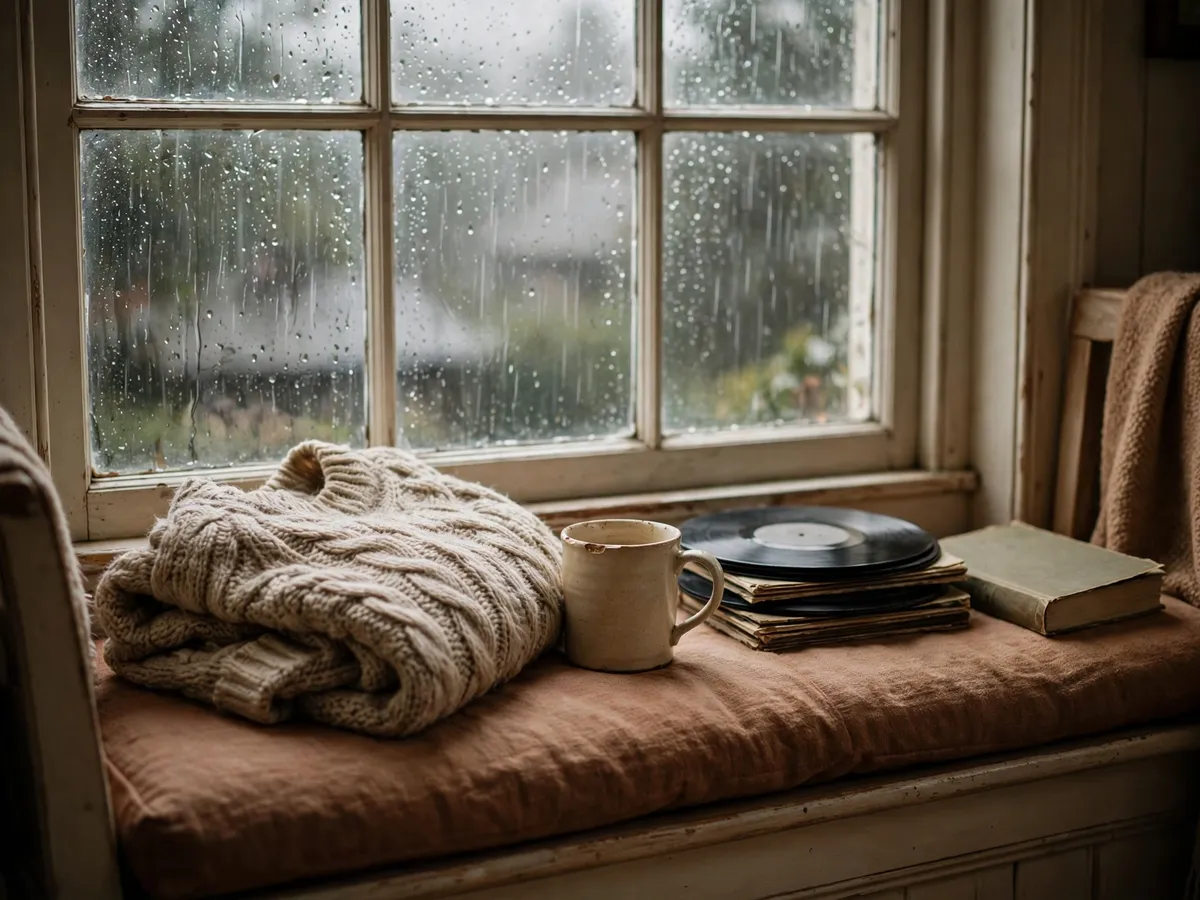
Keep a short list of low-demand pleasures reserved for wet weather — the long book, the slow-cooking recipe, the film you keep meaning to watch, the drawer that needs sorting while something good plays in the background. Reserving them gives the next rainy day a small sense of occasion.
Familiar, much-loved objects tend to feature heavily in these rituals, for the same reasons explored in why we get emotionally attached to old things — rainy days are when the old jumper, the chipped mug and the childhood film earn their keep.
If, on the other hand, rain reliably flattens your mood, the research suggests working with the mechanisms rather than the weather: get outside in whatever daylight there is, keep plans and social contact going in indoor form, and stay active, since it is often the cancelled activity, not the rain, that drags mood down.
And if low mood arrives with the darker seasons every year and seriously affects your life, that pattern is worth discussing with a doctor — seasonal depression is a recognised condition, and it is driven mainly by light, not by rain itself.
Frequently Asked Questions
What is a pluviophile?
A pluviophile is simply someone who finds joy, calm or comfort in rain. It is a description of a preference, not a diagnosis or a clinical category — and as the weather-personality research shows, it probably overlaps heavily with people whose mood improves in cooler, dimmer, quieter conditions.
Does rain actually change your brain chemistry?
There is no solid evidence that it does. The popular negative-ion explanation is not supported for everyday mood: a meta-analysis of 33 studies found no consistent effects on mood, anxiety or relaxation. Rain’s effects appear to work through situation, sensation and expectation rather than chemistry.
Why do I feel sleepy on rainy days?
Probably a combination of dimmer light (bright light is one of the body’s main alerting signals, so a dark day removes it), the steady, soporific sound of rain, cooler temperatures, and the fact that rainy days usually demand less of you. Sleepiness on a grey afternoon is a normal response, not a warning sign.
Can rainy weather cause depression?
For most people, no — measured effects of daily weather on mood are small, and most people are barely affected at all. However, some people do experience depression that follows a seasonal pattern, linked mainly to reduced daylight in winter. If your mood drops severely and predictably with the seasons, talk to a healthcare professional.
Conclusion
People who feel happier on rainy days are not imagining it, but the rain itself is probably not doing what they think.
The research says weather barely moves mood on average — what it moves is everything around the mood: the demands of the day, the noise, the heat, the light, and what you feel permitted to do.
For people whose lives are loud, hot, bright and overscheduled, a rainy day quietly removes all four pressures at once, and adds a soothing soundtrack besides. That is not a chemical mystery.
It is a day that finally matches the person living it — and there is nothing strange about feeling happy when the weather, for once, is on your side.
