
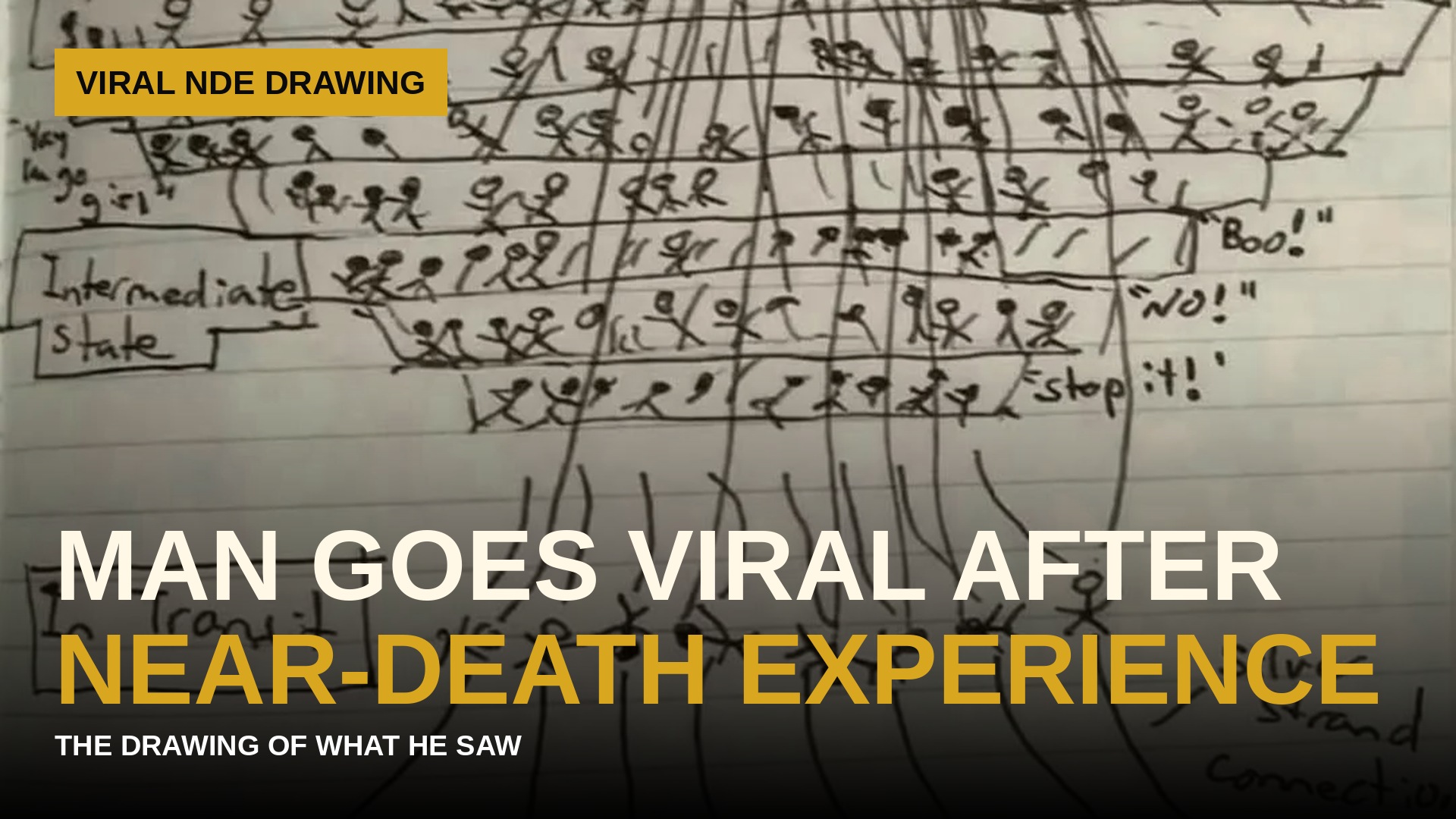
Everyone is arguing about the silver cord. Almost no one is asking who is sitting in the bleachers.
In March 2026, a hand-drawn sketch by a man named Yusuff Shakur began spreading across social media.
He said it showed what he saw during a near-death experience. The headline version was simple: a layered structure above Earth, thin silver strands, a glowing mass at the top, and his takeaway that everything is connected.
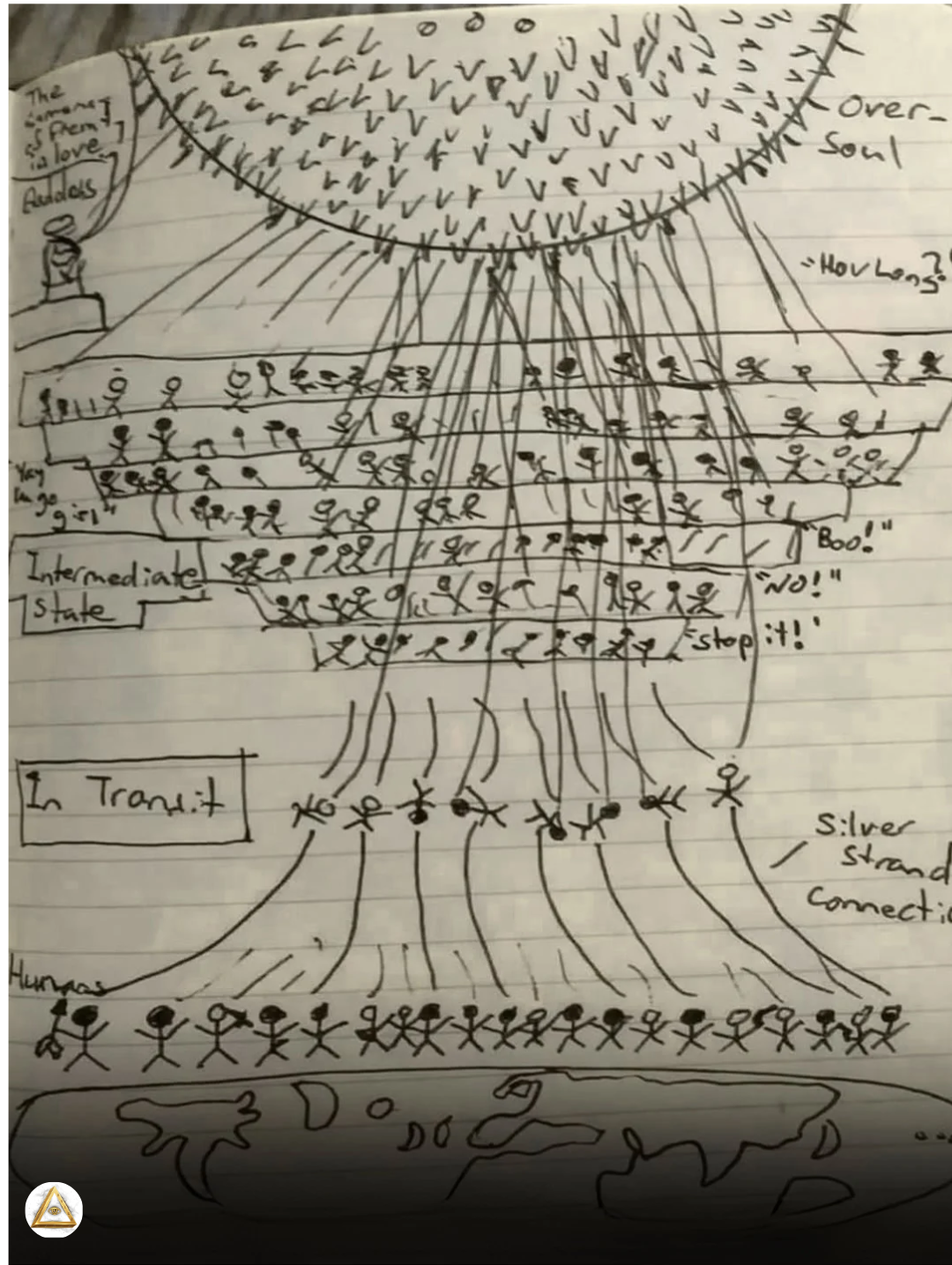
Most coverage stopped there. But look at the page itself, slowly, the way you would read a map. In the middle of the drawing, rows of tiny figures sit on tiered ledges, arranged like seats in a stadium. And they are not silent.
Beside them are words in quotation marks. On the left, someone cheers. On the right, someone yells “Boo!”, “No!” and “Stop it!”
So here is the question this article is about: if this is a map of the afterlife, why does it look like a sports arena, and who is the crowd watching?
A note before we start: this article separates what is physically on the page, what traditions say, and what is my interpretation. The drawing is one person’s account. It is not evidence about what happens after death.
Nine Clues on the Page
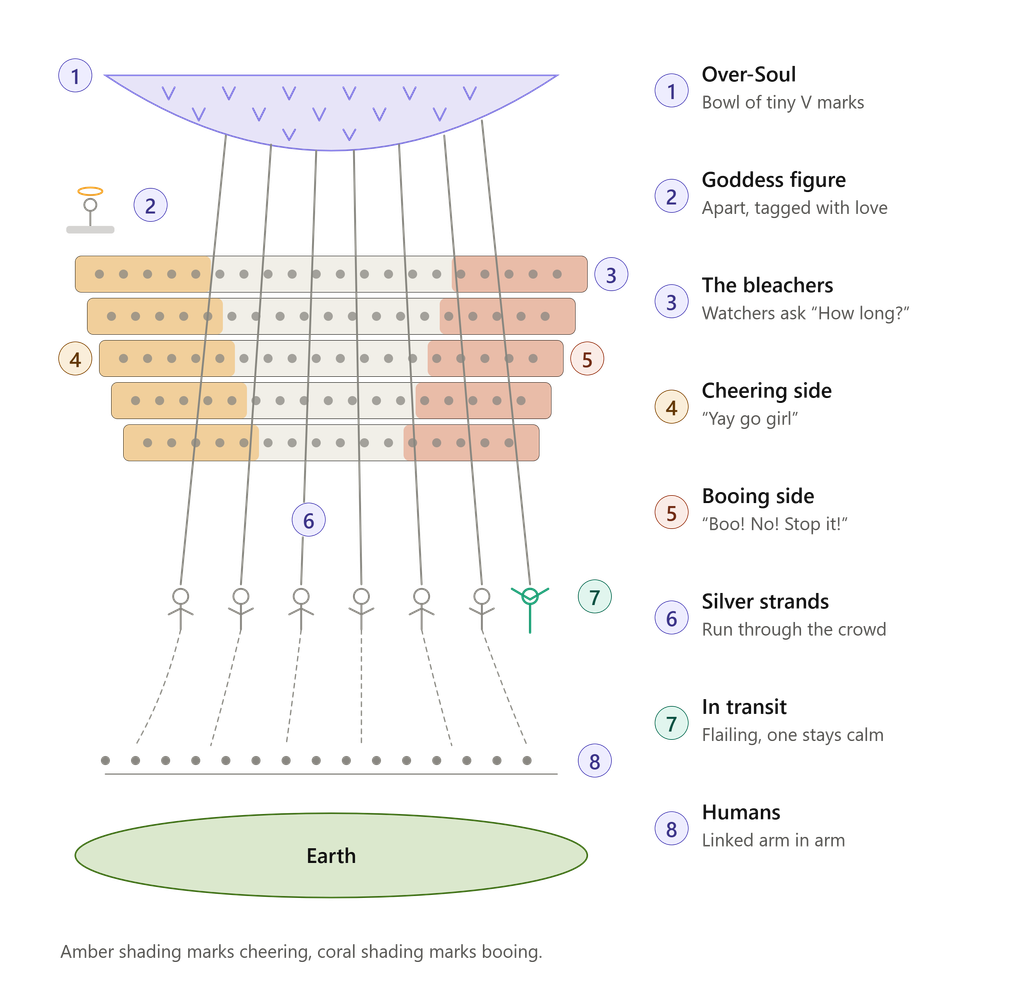
1. The middle layer is drawn as bleachers, not clouds. The “Intermediate State” is a stack of stepped rows packed with stick figures, widening toward the top like an amphitheater.
2. The crowd is split in two. On the left a cheer reads roughly “Yay go girl.” On the right come three separate shouts: “Boo!”, “No!” and “Stop it!” These are reactions to something happening, not the words of passive souls waiting in line.
3. A question hangs at the top right. A line in quotation marks asks “How long?!” Someone in this system is impatient or worried.
4. One figure sits apart. At the top left, a figure on a raised platform is labeled “Goddess,” with a note that appears to say something like “the someone of them is love.” It is outside the rows and outside the bowl.
5. The strands go through the audience, not around it. Every strand rising from the people in transit passes straight through the tiers.
6. The “In Transit” figures look like they are struggling, and one does not. Most have flailing limbs and some have solid black heads. The figure at the far right is upright, arms raised, calm.
7. The “Over-Soul” is a bowl, not a ball. It is a concave dish with a tick-marked rim, packed with hundreds of tiny downward-pointing V shapes that look like birds, arrows or seeds.
8. The strands are faint near Earth and strong near the top. The picture is shaped like a tree: roots on Earth, a trunk of strands, a canopy above.
9. The humans are holding on to each other. The people on the world-map oval are linked arm to arm, and at least one waves upward.
What the Crowd Might Mean (My Reading)
Put clues 1, 2, 3 and 5 together and the drawing stops looking like a ladder and starts looking like a theater. The living are on the stage. The strands are lines of attention running to the seats. And the seats are full of beings reacting in real time: cheering, protesting, asking how long it will last.
The usual afterlife map says: you travel up and are welcomed. This one adds: you are also being watched, and the watchers have opinions.
That can be read two ways. The comforting reading is that you are never alone, and some part of the stands shouts “Yay go girl.” The Goddess figure’s note about love suggests the system’s center is affection, not judgment. The unsettling reading is that the crowd is not unanimous. Some are saying “Stop it!” Perhaps they react to the same life differently, because a life contains both brave and harmful moments.
The drawing does not tell us which. That ambiguity is probably why it travels so well. Each viewer sees their own crowd.
Four Ancient Mirrors
The stadium idea sounds modern, but older traditions already hold pieces of it.
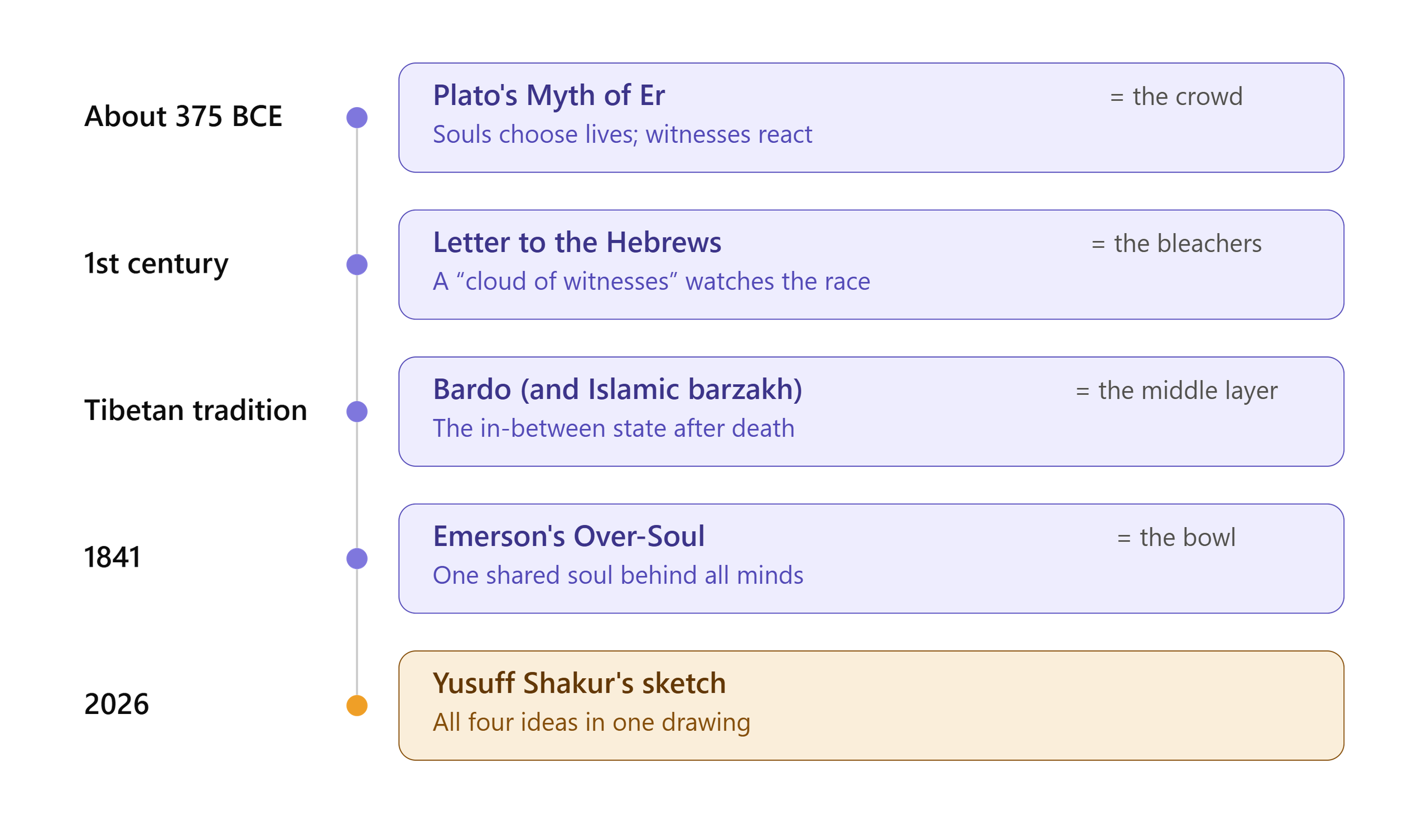
Plato’s Myth of Er (about 375 BCE).
In The Republic, a soldier named Er revives after apparent death and reports that souls choose their next lives in a meadow. Plato says onlookers found the sight pitiful, laughable and wondrous at once.
It is one of the earliest return-from-death stories in Western literature, and it features a scene of choosing watched by witnesses with mixed emotions. That is remarkably close to cheering and booing.
The Letter to the Hebrews.
The author tells readers they are surrounded by “so great a cloud of witnesses” and then uses the image of a race. Many scholars note the arena flavor. Shakur’s drawing may be an unusually literal illustration of that idea.
The Tibetan bardo and the Islamic barzakh.
“Intermediate State” is the standard English translation of bardo, the in-between state after death in the Tibetan Book of the Dead. Islamic thought has barzakh, the intermediate realm between death and resurrection. Two very different cultures built a concept for a waiting zone, which is exactly what the drawing labels its middle layer.
Emerson’s Over-Soul (1841).
Ralph Waldo Emerson wrote an essay called “The Over-Soul” about a shared universal soul from which individual minds draw. The label on Shakur’s bowl matches it exactly.
And the silver cord?
It appears in Ecclesiastes 12:6 and was developed heavily in 19th-century Theosophy and occult writing.
Psychologist Susan Blackmore, who had a vivid out-of-body episode herself, has noted that her silver cord matched traditional occult literature. The imagery people see often resembles the imagery they have already absorbed.
What Science Can Actually Say
A real 2026 study about NDE drawings.
Researchers published a paper in Frontiers in Psychology titled “The perceptual geometry and chromaticity of near-death experience spaces.” Fifty people with out-of-body or near-death experiences drew and annotated the space they perceived.
Instead of fifty unrelated pictures, the drawings sorted into four shapes: conical, elliptic arc, low-curvature elliptic arc and ellipsoidal.
Conical, tunnel-like spaces tended to be grey and early in the sequence, and the researchers noted that grey tunnel vision is also a known effect of low oxygen, low blood pressure and extreme stress.
Wider arcs were often described in vivid color, and ellipsoidal spaces as bubble-like, with pulsing light and a feeling of being embraced.
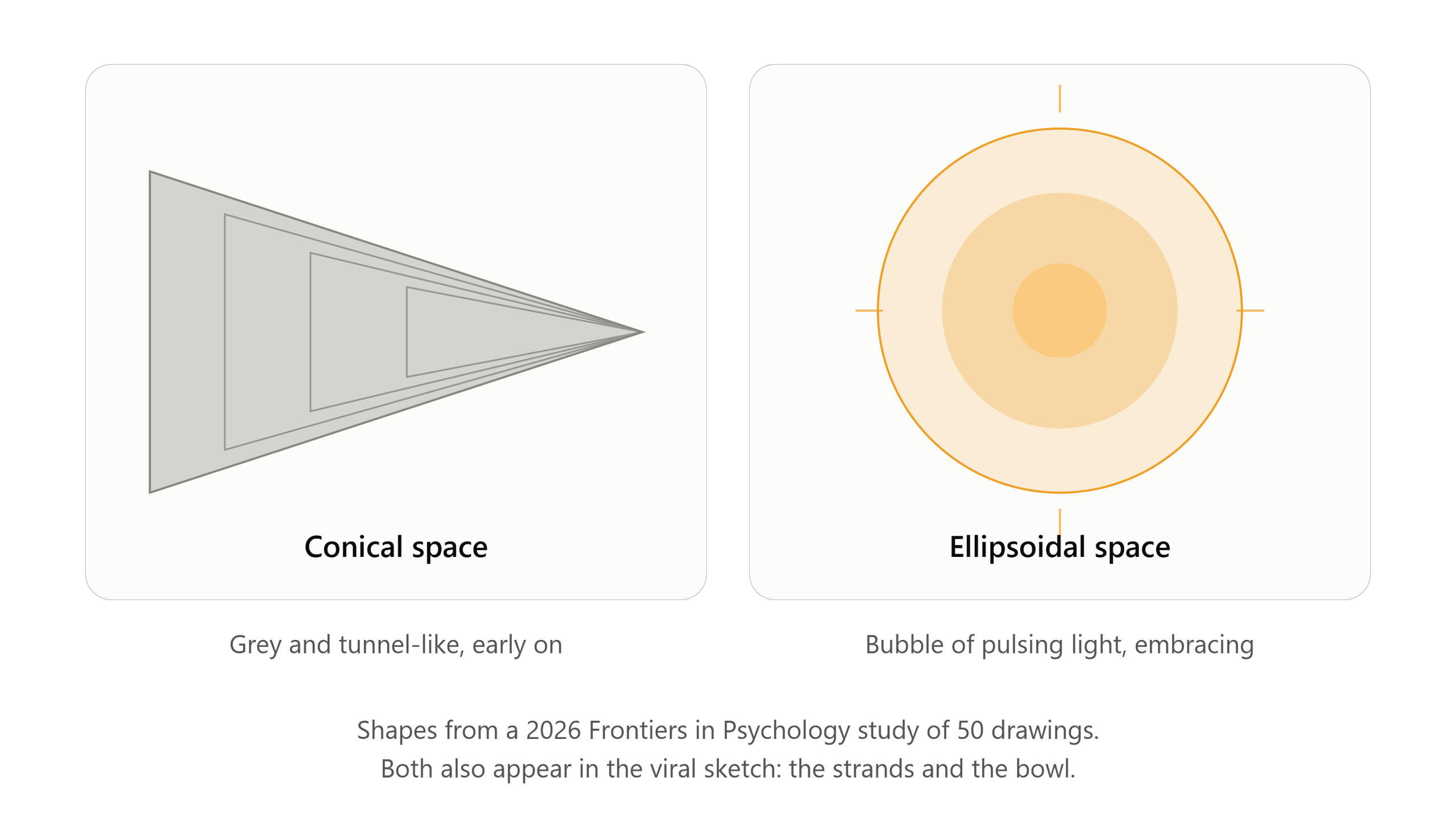
The overlap with Shakur’s sketch (my observation, not the study’s finding):
his drawing contains a cone (the strands funneling up from Earth) and a bowl or ellipsoid (the Over-Soul). That proves nothing about the afterlife. It suggests the drawing is not random, and that people reaching to draw an inner experience may converge on similar geometry.
The authors were careful about limits: the sample was small and self-selected, and memories were sometimes years old.
Dying-brain explanations.
Proposals include low oxygen, abnormal activity in brain regions that track where the body is, surges of stress chemistry, and memory processing under extreme conditions.
None is proven to explain a whole NDE. Researchers broadly accept that NDEs are real experiences. What they dispute is what those experiences are.
The AWARE study, accurately.
Led by Dr. Sam Parnia, it placed hidden images on shelves in resuscitation areas to test whether people could see them during cardiac arrest. Out of more than 2,000 arrests, only a small fraction of survivors could be interviewed, and none identified the hidden images.
One man accurately described an automated voice instructing the team, but that shows awareness around a few minutes of arrest, not a brain-free mind, because brain activity was not continuously monitored.
AWARE neither proved nor disproved survival. It showed that testing these claims is possible, and that results so far are thin.
Culture shapes the picture.
Tunnels and life reviews are common in Western accounts, while encounters with ancestors or local figures are more common elsewhere.
The core experience may be universal while the imagery is dressed in familiar symbols. A stadium of cheering and jeering figures may belong to a mind raised on arenas, scoreboards and crowds.
Three Ways to Read the Crowd
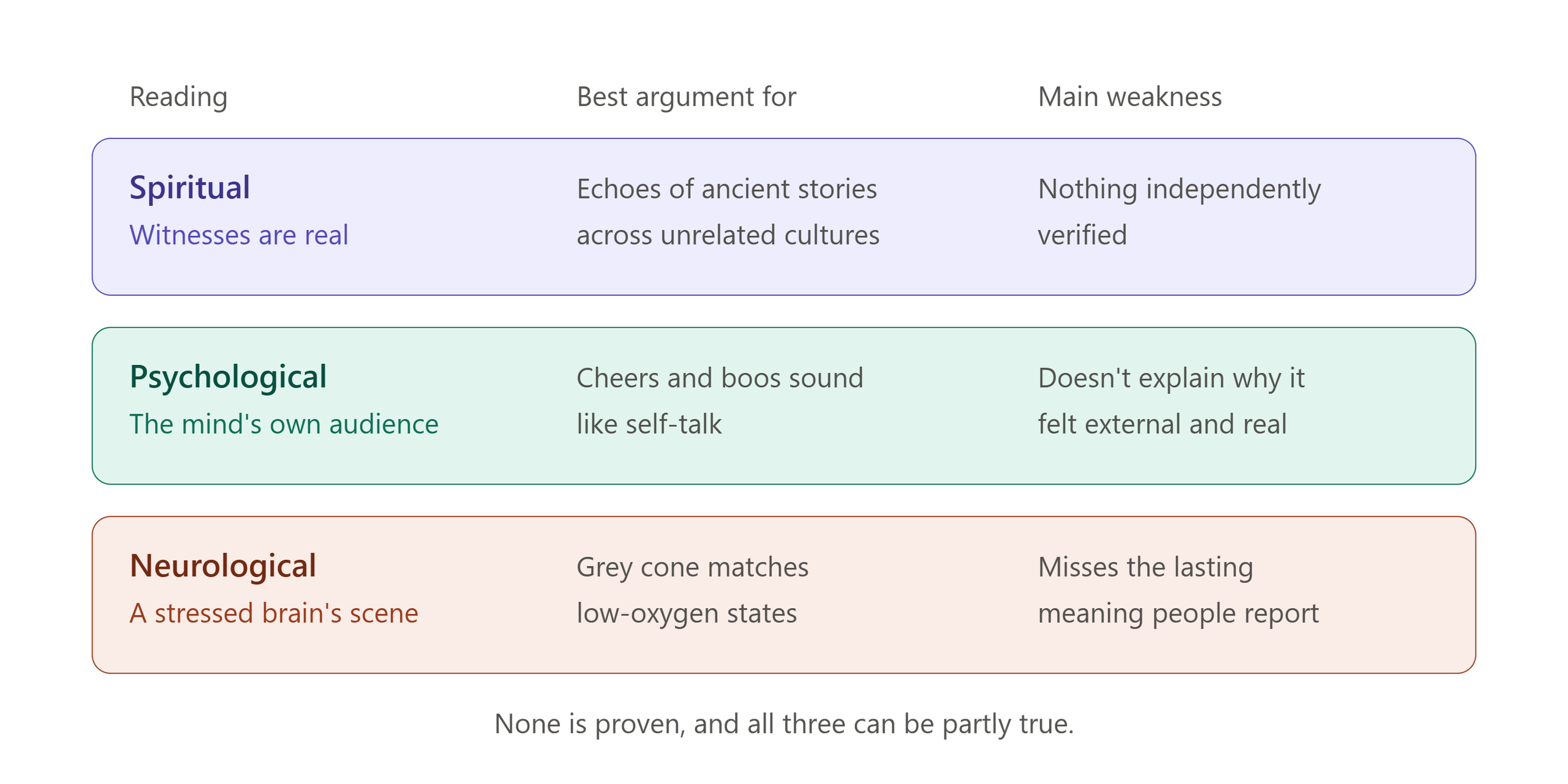
The spiritual reading:
a genuine glimpse of a layered reality in which unseen witnesses accompany human lives. Support: resemblance to ancient accounts across unrelated cultures. Weakness: shared human imagination can explain that, and nothing is independently verified.
The psychological reading:
the crowd is the mind’s own audience. We carry internal voices that cheer and criticize us, and we imagine being watched.
The cheers and boos in the drawing sound exactly like self-talk: “Yay go girl” versus “Stop it!” Support: it matches how minds work. Weakness: it does not explain why the experience felt external and real.
The neurological reading:
a stressed brain assembles visual, spatial and emotional signals into a story, as dreams do. Support: the cone and grey tunnel appear in low-oxygen states. Weakness: it does not account for the lasting meaning people attach to these experiences.
These are not mutually exclusive, and none is proven. The most responsible position is the one researchers keep returning to: these experiences are real as experiences, and their meaning is still open.
Frequently Asked Questions
Who made the viral near-death experience drawing?
It was shared by Yusuff Shakur, who says it depicts what he saw during a near-death experience. News coverage in March 2026 described a layered structure above Earth with a message that everything is connected.
What is the crowd in the drawing?
The tiered rows in the “Intermediate State” are drawn like stadium seating, with cheering and booing beside them. This article offers three readings: unseen witnesses, the mind’s internal voices, or a brain’s constructed scene.
What does “Intermediate State” mean?
It is the standard English translation of the Tibetan bardo, and parallels barzakh in Islamic thought: a realm between death and what follows.
What is the silver cord?
A symbolic cord said to connect body and spirit during out-of-body experiences and to be severed at death. It appears in Ecclesiastes 12:6 and in Theosophical and occult writing.
Does science say near-death experiences are real?
Researchers accept them as real experiences people have. Whether they reflect brain activity alone or something more is unresolved, and the AWARE study did not settle it.
Do near-death experiences have common shapes?
A 2026 Frontiers in Psychology study found that drawings from 50 people fell into a small set of shapes, including cones and ellipsoids. The sample was small and self-selected.
The Question the Drawing Leaves Behind
Yusuff Shakur did not claim to have all the answers. He drew what he saw and said the main thing he took from it was that everything is connected.
But the part of his drawing that keeps pulling me back is not the strands or the light. It is the little rows of people, some cheering and some shouting “Stop it!” Whether you read them as unseen witnesses, as the voices in your own head, or as a dying brain’s theater, they raise the same uncomfortable and useful question:
If someone, somewhere, were watching how you live, which section of the stands would you be giving the most to cheer about, and which the most to boo?
You do not need to settle the metaphysics to take that question seriously.
What did you notice in the drawing that no one has mentioned? Tell us in the comments.
Read Next
- 6 Terrifying Death Theories & Biblical Conspiracies
- The Pollock Twins: Sisters Who Remembered a Life Never Lived
