
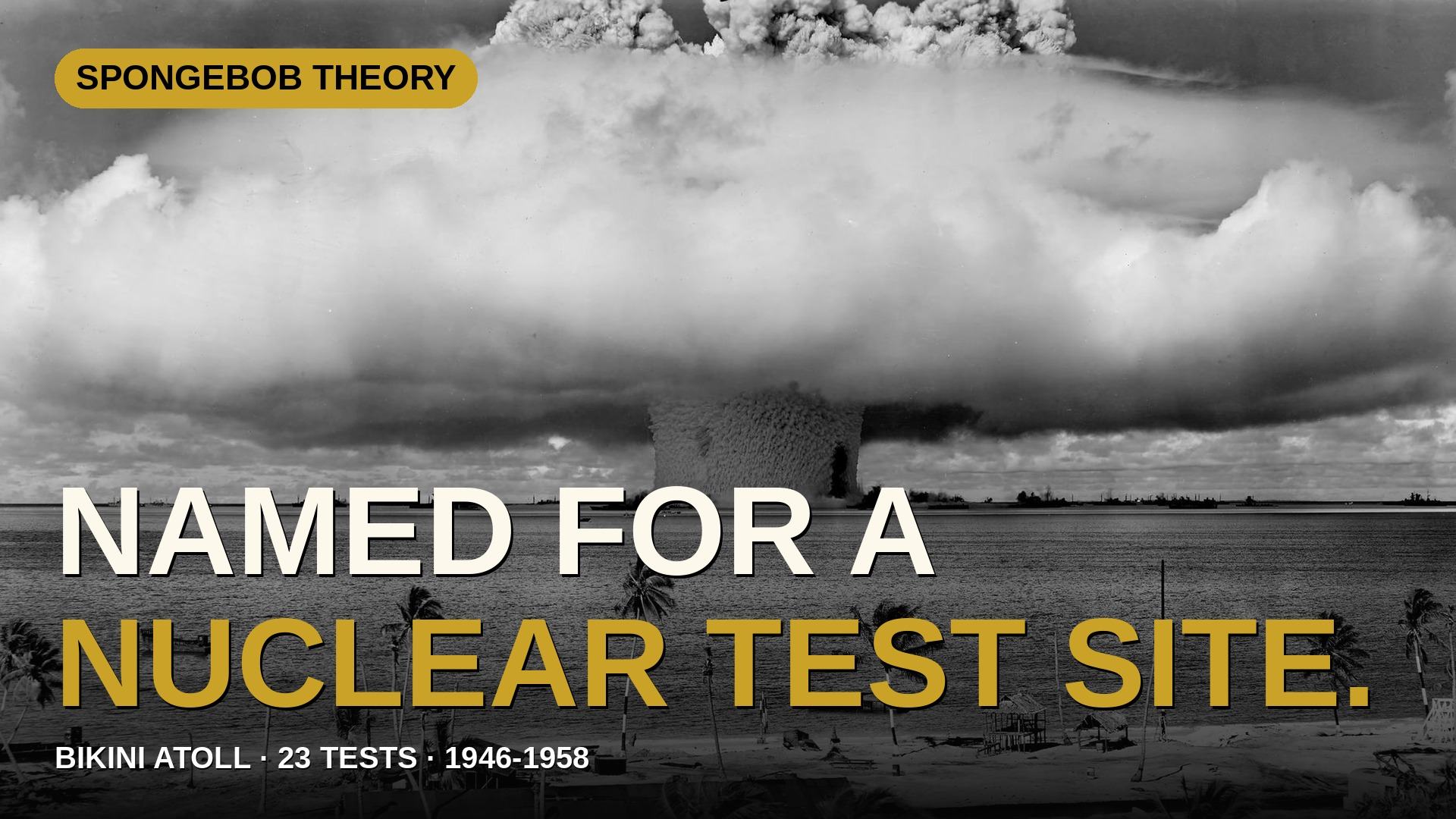
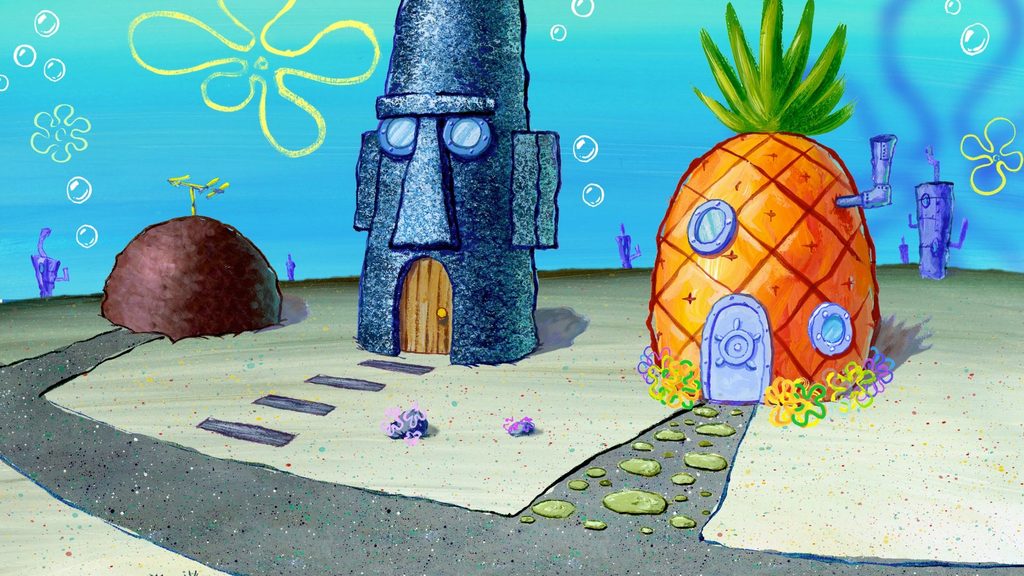
A talking sponge lives in a pineapple under the sea, in a town called Bikini Bottom. It is the silliest address in cartoons, and it is named after one of the darkest places on Earth.
Bikini Atoll, in the Marshall Islands, is where the United States detonated 23 nuclear weapons between 1946 and 1958. The town in the show sits, by name at least, directly underneath it.
So fans ask an obvious question. If the bombs really went off above that lagoon, is the show’s cast of talking sea creatures a joke about what the fallout left behind?
The name is real. The tests are real. The people who were moved off the atoll so the tests could happen are real. The mutation theory is where the record stops cooperating.
The theory has circulated for years in forums and fan videos, and in 2026 it surged again on TikTok and Snapchat, usually told as a secret the show’s makers never admitted.
The show first aired as a sneak peek on 1 May 1999, then officially premiered on 17 July 1999.
Here is what the documents, the test records and the people who actually worked on the show say, separated out one piece at a time.
Key Facts
- 23 nuclear weapons were detonated at Bikini Atoll between 1946 and 1958.
- 167 Bikinians were evacuated in March 1946, told the move was temporary.
- Castle Bravo, 1 March 1954, yielded 15 megatons, the largest US test ever.
- Creator Stephen Hillenburg taught marine biology in California.
- Voice actor Tom Kenny confirmed the Bikini Atoll name link in 2015.
The Real Bikini Atoll
Start with the place itself. Bikini is a ring of 23 small islands around a lagoon in the northern Marshall Islands, roughly halfway between Hawaii and Australia.
The Evacuation
In February 1946, Commodore Ben H. Wyatt, the US military governor of the Marshalls, arrived by seaplane and met the islanders after their Sunday church service.
Wyatt asked the 167 Bikinians to leave, temporarily, so America could test atomic bombs ‘for the good of mankind and to end all world wars.’
Their leader, King Juda, answered after long deliberation: ‘We will go believing that everything is in the hands of God.’
The 167 people, about 40 families, sailed on 7 March 1946 aboard a US Navy landing ship, LST-1108. Their outrigger canoes went aboard too.
They landed on Rongerik Atoll, about 200 kilometres east. Rongerik was uninhabited, one-sixth Bikini’s size, and local tradition held that evil spirits lived there.
The Navy left them food stores for only a few weeks. Rongerik’s coconut trees bore little fruit, its water was short, and fish from its lagoon caused poisoning.
Within two months the Bikinians were begging officials to take them home. By early 1948, after two years on Rongerik, they were close to starvation.
They were moved to tents beside a military runway on Kwajalein, where they lived for six months. Then, in November 1948, the group, now 184 people, moved again.
Their new home was Kili Island, a single island with no lagoon at all. The fishing life their culture was built on was gone.
The Tests
The testing started that first summer, and it was a huge operation. More than 90 target ships were anchored in the lagoon, and about 42,000 US personnel took part.
- Able, 1 July 1946: 23 kilotons, dropped from a B-29, bursting 520 feet up.
- Able missed its aim point by up to 2,000 feet and sank only five ships.
- Baker, 25 July 1946: 23 kilotons, detonated 90 feet underwater.
- Baker sank eight ships, including the aircraft carrier Saratoga.
- Charlie, planned third shot: cancelled, because Baker’s fleet could not be cleaned.
- Castle Bravo, 1 March 1954: 15 megatons, against about 6 predicted.
- Castle Romeo, March 1954: 11 megatons, fired from a barge.
- Castle Yankee, May 1954: 13.5 megatons, also fired from a barge.
- Redwing Cherokee, 20 May 1956: 3.8 megatons, an airdropped hydrogen bomb.
- Cherokee was the first US airdrop of a thermonuclear weapon.
- Redwing Tewa, 20 July 1956: 5 megatons, fired from a barge.
- Hardtack Fir, 11 May 1958: 1.36 megatons, among the last Bikini shots.
Baker threw a column of radioactive water over the target fleet and contaminated nearly all of it. Sailors scrubbed the ships for weeks and could not make them safe.
In total, 23 devices were detonated at Bikini by 1958, with a combined yield of about 77 megatons. That is more than 3,000 Baker bombs, from one small lagoon.
The Fallout
The worst day came on 1 March 1954. Castle Bravo, a hydrogen bomb codenamed Shrimp, was expected to yield about 6 megatons. It produced 15, because its designers had misjudged the fuel.
Within one second its fireball was about 7 kilometres across. The flash was visible on Kwajalein, more than 400 kilometres away, and the cloud climbed to 130,000 feet.
The blast vaporised three small islands. It left a crater roughly 2 kilometres wide and 250 feet deep, and it contaminated about 7,000 square miles of ocean.
About five hours later, white ash began falling on Rongelap Atoll, some 120 miles east. In places it settled an inch and a half deep, and children played in it like snow.
The Rongelap islanders were not evacuated for two days. Their average whole-body dose was later put at about 175 rads, and many suffered burns, nausea and hair loss.
Fallout also reached Utirik Atoll and the Japanese tuna boat Daigo Fukuryu Maru. Its 23 crewmen were dusted with ash, and radio operator Aikichi Kuboyama died that September.
US doctors then studied the exposed islanders under a classified programme, Project 4.1. It tracked their burns, blood counts and, over later years, thyroid disease.
Some Bikinians were allowed home in the 1970s, and about 100 were living there by 1972. They had to be evacuated again in September 1978, when caesium-137 levels in their bodies ran too high.
Tests in May 1978 had also found dangerous strontium-90 in the island’s well water.
The Timeline
- February 1946: Wyatt asks the Bikinians to leave.
- 7 March 1946: 167 islanders sail to Rongerik Atoll.
- July 1946: Crossroads fires Able and Baker in the lagoon.
- November 1948: the Bikinians, now 184, settle on Kili.
- 1 March 1954: Bravo spreads fallout over inhabited atolls.
- 1956 to 1958: Redwing and Hardtack fire the last Bikini tests.
- 22 July 1958: the last of the 23 Bikini detonations.
- September 1978: returnees are evacuated a second time.
The Theory
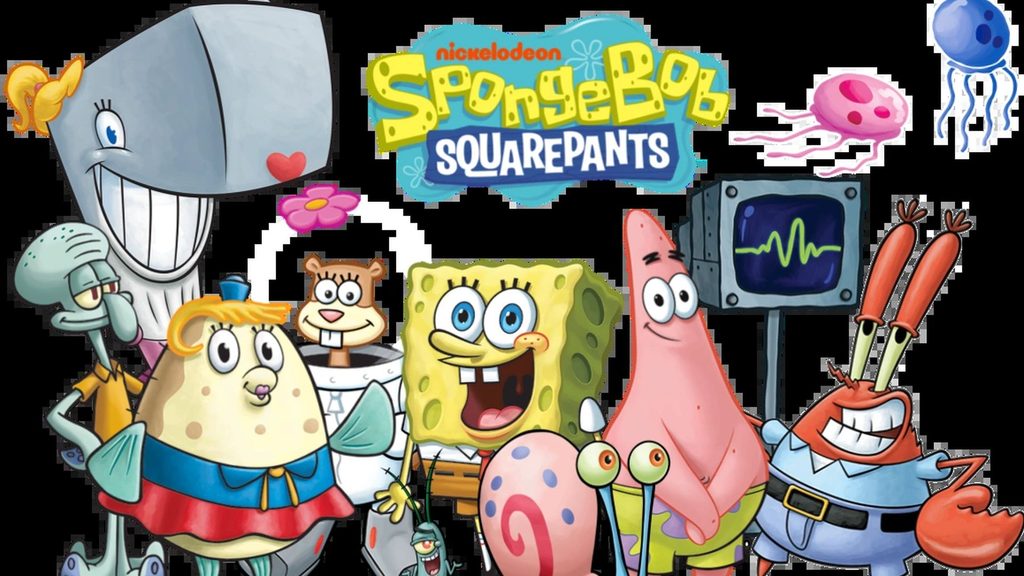
Against that history, the fan theory writes itself. Bikini Bottom, fans say, is the seabed under Bikini Atoll, and its residents are what the radiation made.
The Characters as ‘Evidence’
- SpongeBob: a sea sponge who talks, laughs and holds down a fry cook’s job.
- Patrick: a starfish of heroic laziness who lives under a rock.
- Squidward: an octopus who works a till and plays the clarinet, badly.
- Mr. Krabs: a crab whose whole personality is an obsession with money.
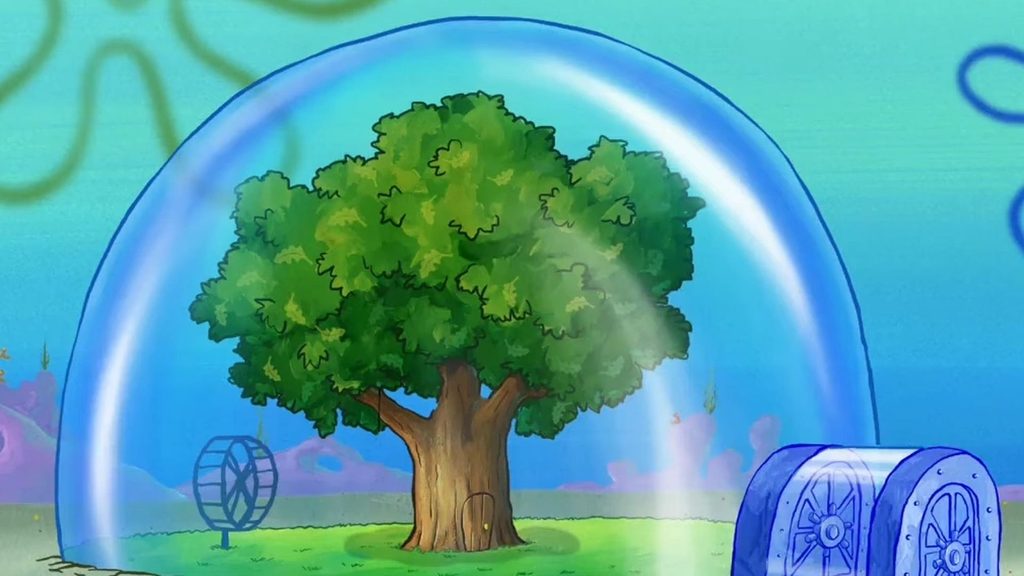
- Sandy Cheeks: a Texas squirrel living underwater in a suit and a glass dome.
Each oddity gets read as a symptom. Sandy’s suit becomes protective gear against fallout, and her air-filled dome becomes a decontamination unit.
The show’s mushroom-cloud explosion gags become references to the tests. Even the little island seen in the opening credits becomes ‘the atoll itself.’
It works like the readings in our look at celebrity clone conspiracy theories: one real detail, then everything else bent to fit it.
The Hillenburg Argument
The theory’s favourite credential is the creator. Stephen Hillenburg studied marine resources at Humboldt State, graduating in 1984, with art alongside it.
He then taught marine biology for three years at the Orange County Marine Institute in Dana Point, in California. Teaching, not research, was the job.
There, he wrote and drew an educational comic, The Intertidal Zone, to teach visiting children about tide-pool animals. Several of its characters grew, years later, into the cast of SpongeBob.
Its narrator was Bob the Sponge, a round, natural sea sponge in sunglasses. He looked nothing like the square character who later became famous.
Hillenburg explained the redesign himself in 2001. Only when he drew a square sponge, like a sink sponge, did the character fit: ‘that innocent, squeaky-clean’ quality he wanted.
In 1989 he left teaching for animation school at the California Institute of the Arts. From 1993 to 1996 he directed on Nickelodeon’s Rocko’s Modern Life.
He pitched the cast to Nickelodeon in 1997, and the show aired two years later.
So the argument runs: a marine biologist would know exactly what happened at Bikini. He chose the name anyway. Therefore the name must be the confession.
What Counts Against It
- No episode mentions radiation, fallout, mutations or the tests.
- The characters are never shown as damaged, or as odd for their world.
- Talking animals were a cartoon convention 60 years before SpongeBob.
- The cast began as teaching tools in a children’s tide-pool comic.
- The square sponge design came from a sink sponge, by Hillenburg’s own account.
It is a tidy chain, and every link in it is a guess. ‘Bikini Bottom’ is also a pun on the swimsuit, which was itself named after the atoll in July 1946.
That swimsuit has a date of its own. French designer Louis Réard launched it in Paris on 5 July 1946, four days after Able, modelled by dancer Micheline Bernardini.
Réard sold his 30 square inches of fabric as smaller than the world’s smallest bathing suit. The name was a headline joke about the bomb.
So the word ‘bikini’ reached Hillenburg carrying two meanings at once: the atoll, and the joke swimsuit built on the atoll’s fame. A pun needs no confession behind it.
The Official Word
The short version of this story, repeated in most roundups, is that the show’s team never said a word about the theory. That is not quite what the record shows.
Hillenburg himself, who died in 2018, left no statement endorsing the mutation idea. But in February 2015, HuffPost put the theory directly to Tom Kenny, the voice of SpongeBob.
Kenny confirmed the name link in plain words: ‘Bikini Bottom is kind of named after Bikini Atoll, you know, where they did nuclear testing decades ago.’
Then he rejected the theory itself: ‘I don’t think SpongeBob and his friends are mutations. They’re not mutations. They just live in their own world.’
Nine years later, the story flipped again. In a 2024 Esquire cast conversation, writer and Plankton voice Mr. Lawrence was asked about the atomic-testing idea and answered: ‘That is true! That is absolutely true.’
Lawrence described an early concept in which the human world above was gone and Bikini Bottom was what survived. That concept was dropped during the first season’s development, before the show settled into pure comedy.
Season 1 histories back that up. The series was at one stage set after a war that ravaged Earth, with Bikini Bottom the one surviving place.
So the cast has given both answers, a decade apart, in interviews that were partly playful. Neither man was describing a hidden plot that the finished show actually contains.
The Verdict
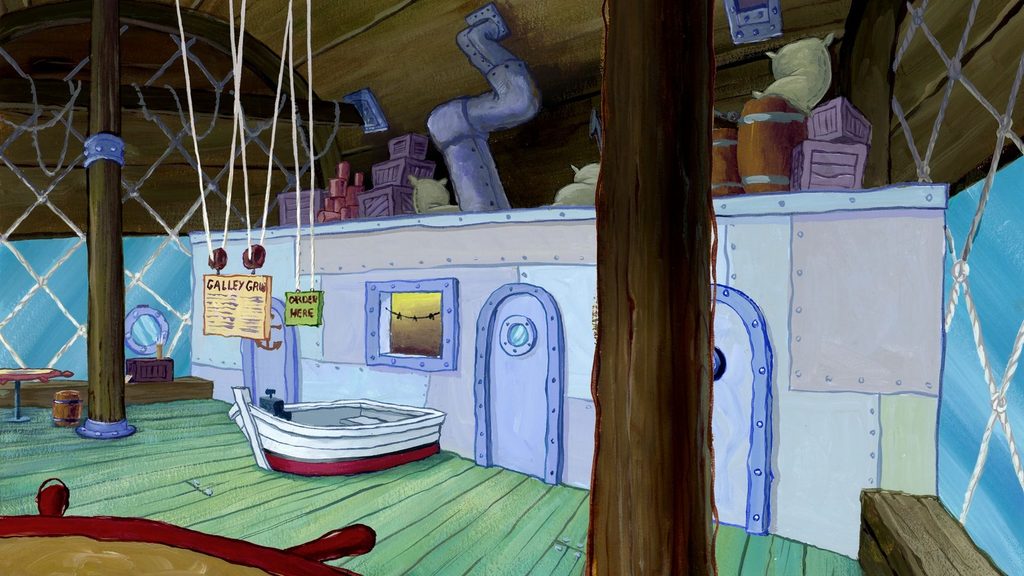
Separate the three claims and the case gets clear. Claim one: Bikini Bottom is named after Bikini Atoll. That one is confirmed, on the record, by the show’s own lead actor.
Claim two: the show’s world was, at an early stage, sketched with the tests somewhere in the background. That is plausible, and now backed by a writer who was in the room, though the idea was scrapped.
Claim three: SpongeBob and his friends are mutants created by fallout, and the series is a coded confession. There is no evidence for that in any episode, document or interview.
What is certain is the part the theory treats as scenery. A real community of 167 people was talked out of its home in 1946 and never got it back. That exile, not the cartoon, is the documented story.
It is the same pattern we found in our fact-check of Disney conspiracy theories: one real detail gives a fan theory its grip, and the grip gets mistaken for proof.
It also leaves a harder question: why a cartoon’s joke name is famous worldwide, while Rongerik and Kili, where the Bikinians ended up, are not.
Verdict: Unresolved as authorial intent; confirmed as a real historical echo. The name is real, the atoll is real, and what Hillenburg himself meant by it died with him in 2018.
Is Bikini Bottom really named after Bikini Atoll?
Yes. Tom Kenny confirmed in 2015 that the town is ‘kind of named after Bikini Atoll’, the Marshall Islands nuclear test site.
How many nuclear tests were held at Bikini Atoll?
23 detonations between 1946 and 1958, including Castle Bravo in 1954, at 15 megatons the largest US test ever.
Are SpongeBob and his friends mutants?
There is no evidence for it. Kenny rejected the idea in 2015, and no episode mentions radiation or the tests.
Did a SpongeBob writer confirm the theory?
In 2024, writer Mr. Lawrence called the atomic-testing idea ‘absolutely true’ as an early concept that was later scrapped.
What happened to the people of Bikini Atoll?
The 167 islanders were moved in 1946 for tests they were told were temporary. Contamination has kept them from resettling permanently.
Join the Conversation
Did the name change how you see the show, or is Bikini Bottom just a good pun that history made heavy? And should a children’s cartoon carry the story of the 167 people who lost that lagoon? Tell us in the comments.
Read Next
- 10 Crazy Scooby-Doo Conspiracy Theories That Will Ruin Your Childhood
- The Dead Internet Theory: Is Most of the Web Actually Bots?
- Adventure Time: The Nuclear Apocalypse and Finn
