
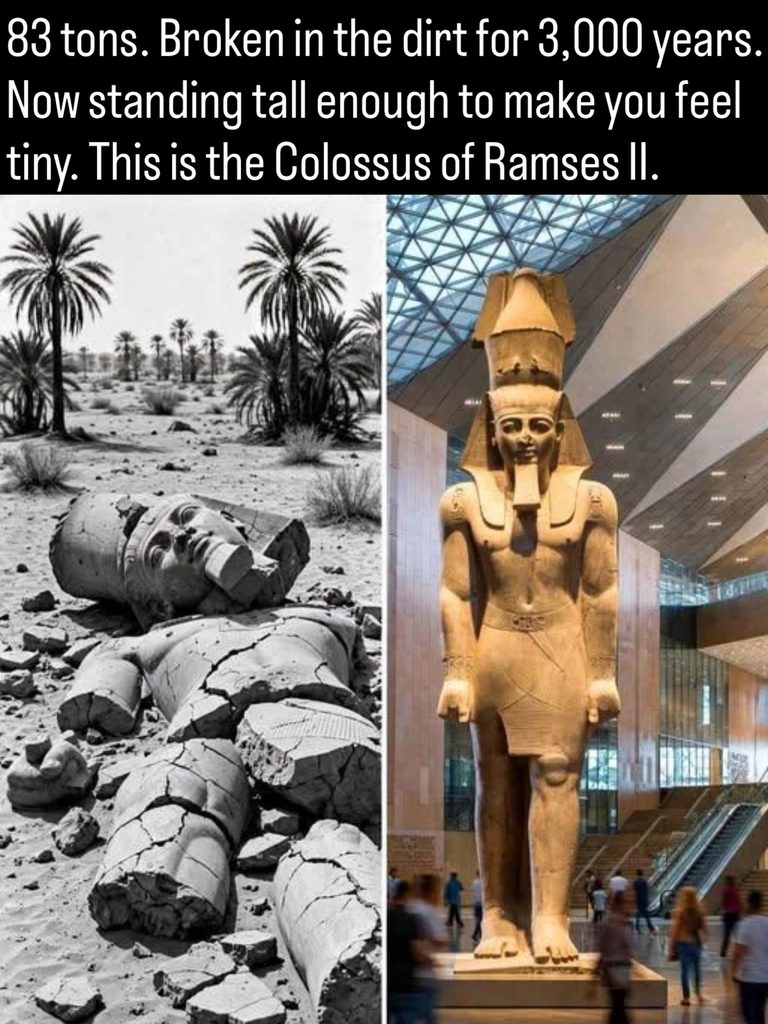
For over three millennia, the shattered face of Ramses II lay half-buried in the dust of ancient Memphis. The statue was broken into six colossal pieces, weighing a staggering 83 tons and standing 11 meters tall.
It was so massive that when it was first rediscovered in 1820, moving it was deemed practically and financially impossible.
Yet today, that same 3,200-year-old pharaoh stands fully reassembled, towering over visitors in the sunlit atrium of the Grand Egyptian Museum (GEM) near the Giza pyramids.
The story of how he got there is not just a tale of ancient engineering, but of modern logistical brilliance, political ambition, and a desperate race to save a monument from the corrosive bite of the modern world.
Quick Facts: The Colossus of Ramses II
- Subject: Pharaoh Ramses II (The Great)
- Material: Red Granite
- Weight: 83 Tons
- Original Location: Temple of Ptah, Memphis, Egypt
- Discovered: 1820 by Giovanni Battista Caviglia
- Current Location: Grand Egyptian Museum (GEM), Giza
The Discovery That Defeated Empires
The colossus was carved from a single block of red granite during the reign of Ramses II (1279–1213 BC), the most powerful pharaoh of the 19th Dynasty.
It was originally erected near the great temple of Ptah at Mit Rahina, the site of the ancient capital city of Memphis. It was designed to intimidate, project the pharaoh’s divine authority, and serve as a physical vessel for his spirit.
When the Italian explorer Giovanni Battista Caviglia—the same archaeologist who excavated the Great Sphinx of Giza—unearthed the statue in 1820, he found it lying on its side, fractured into massive fragments.
Caviglia attempted to gift the statue to an Italian duke, but the nobleman declined, citing the sheer cost of transporting 83 tons of granite across the Mediterranean.
A similar offer was later made to the British Museum by an Egyptian pasha, but that too was refused for the same reason.
For over 130 years, the greatest pharaoh of Egypt remained exactly where he fell, a silent, broken witness to the passage of time.
The Concrete Jungle: Ramses Meets the Modern World
The pharaoh’s long slumber ended in 1955 when the Egyptian government ordered the statue’s fragments to be transported to Cairo.
The move was intended to celebrate the revolution and affirm Egypt’s ancient legacy. The pieces were hauled to the capital and painstakingly reassembled outside the city’s main railway station.
The plaza was promptly renamed Ramses Square, and for the next 50 years, the pharaoh stood as a silent guardian above one of the busiest and most chaotic intersections in the world.
He watched over the bustling traffic, the honking horns, and the millions of pedestrians who passed beneath his towering feet.
But the modern world was slowly killing him.
By the early 2000s, scientists and archaeologists raised a massive alarm. Fifty years of heavy traffic vibrations, diesel exhaust, and toxic pollution were eating away at the ancient granite.
The statue was developing cracks and deteriorating rapidly. If left in the square, the pharaoh would eventually crumble into dust.
The Midnight Rescue and the Custom Cage
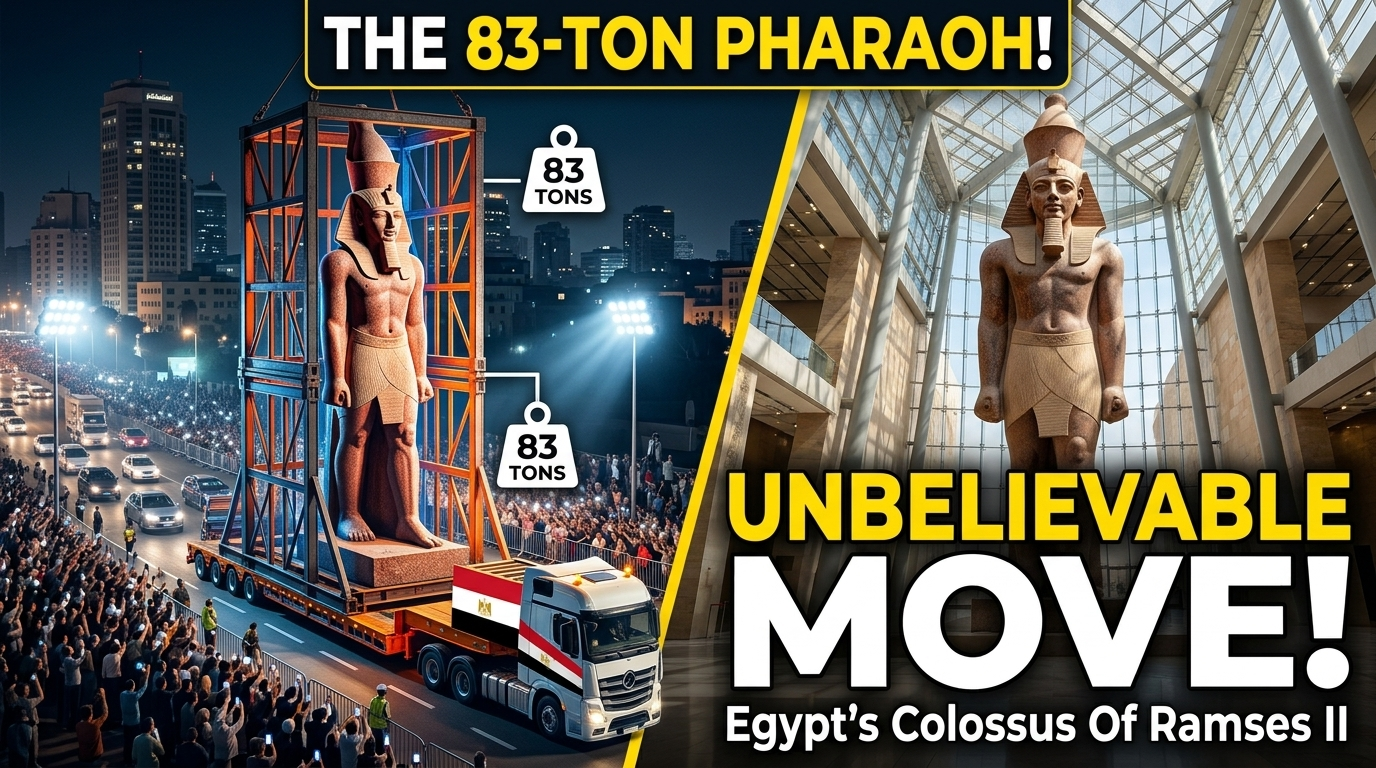
In August 2006, a rescue mission was required. In a highly publicized, elaborate nighttime operation, engineers transported the 83-ton statue out of the city.
To protect the fragile granite from the stress of transportation, engineers built a custom-made iron cage that suspended the statue like a pendulum, allowing it to move freely and absorb vibrations during the journey.
Thousands of onlookers lined the streets to watch the massive statue glide through Cairo under the cover of darkness.
He was moved temporarily to the desert plateau near the Giza pyramids, safely away from the toxic fumes, to await his final resting place.
The Final Journey: A 400-Meter Spectacle
For over a decade, the colossus waited near the pyramids as an army of engineers and architects built the largest archaeological museum in the world: the Grand Egyptian Museum (GEM).
In January 2018, the statue made its fourth and final voyage. The move was a meticulously planned spectacle.
The statue was encased in a specially built metal cage resting on two trailer beds, hauled slowly by a bright orange truck emblazoned with the Egyptian flag.
A marching band and a mounted military guard escorted the colossus on its 400-meter journey from the storage facility to the museum’s soaring entrance atrium.
The operation cost approximately 13.6 million Egyptian pounds (about $770,000 at the time), and it was completed without a single crack. As the statue reached its final destination, the national anthem played. The pharaoh had arrived.
The Verdict: A Triumph of Preservation
The Verdict: Confirmed.
Today, the Colossus of Ramses II is the largest artifact in the Grand Egyptian Museum’s collection. From almost every angle of the Grand Hall, his 11-meter-tall presence is inescapable, offering visitors nothing but awe.
In a poetic tribute to the ancient engineers, the museum was even designed so that on February 21st each year—Ramses II’s birthday—the sun shines through an opening in the wall, illuminating the pharaoh’s face, just as it does at his great temple at Abu Simbel.
The journey of the Colossus of Ramses II is a story of survival against impossible odds. He was broken by time, rejected by empires, and nearly destroyed by the very civilization that sought to honor him.
Yet through a combination of ancient grandeur and modern ingenuity, he has been given a second life.
From the dust of Memphis to the glass-and-steel atrium of the GEM, the 83-ton pharaoh now stands tall enough to make anyone who gazes up at him feel tiny—a fitting tribute to a king who once ruled the world.
Read Next
- The Hall of Records: Did the CIA Find a Hidden Temple Beneath the Sphinx?
- The Island Google Earth Believed In: 6 Phantom Islands That Fooled the World
