
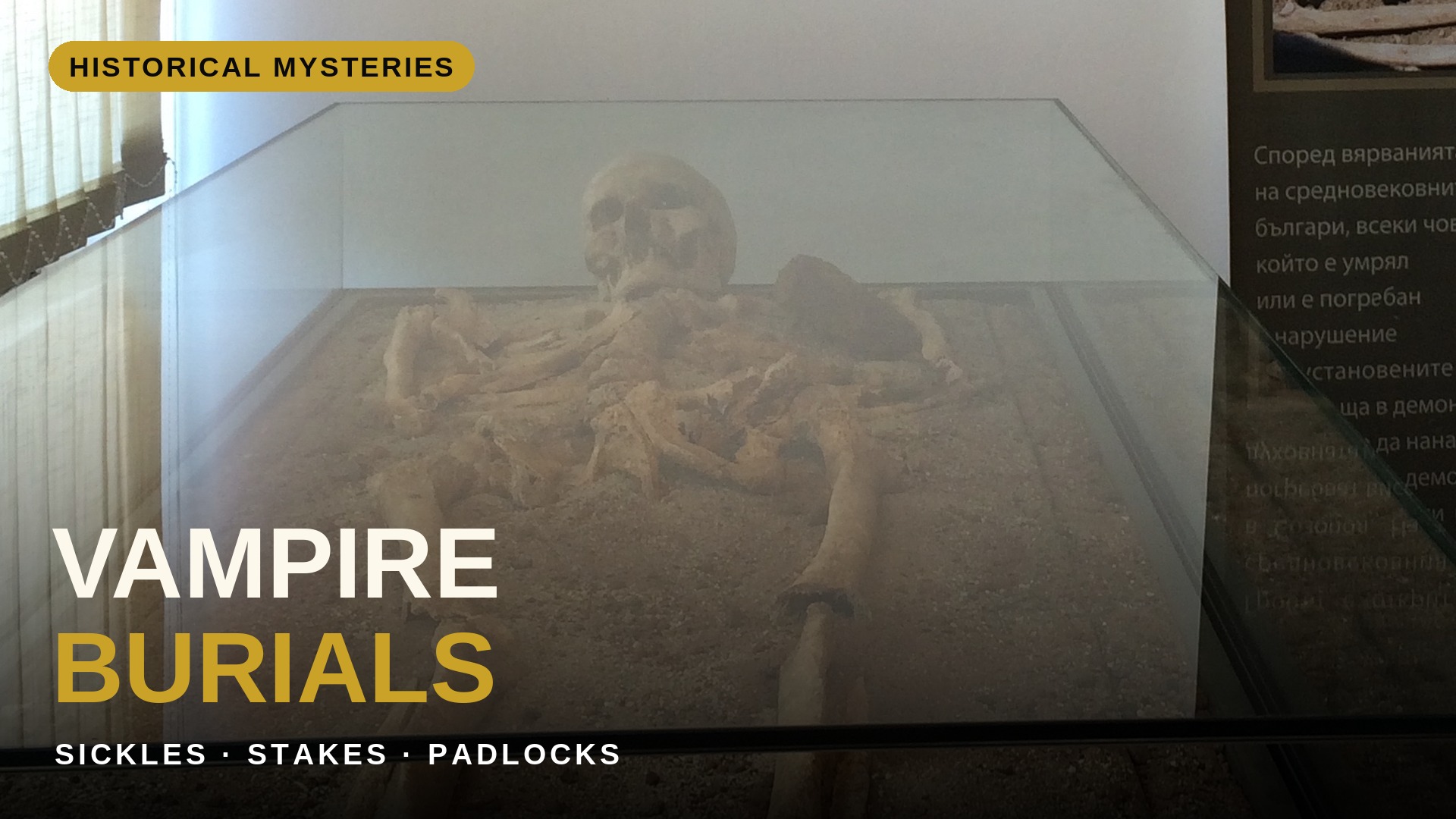
In 2012, archaeologists digging near a church in Sozopol, Bulgaria, lifted a skeleton out of the ground and found an iron rod driven through its chest. Whoever buried that man, roughly 700 years ago, was not taking any chances.
He is one of hundreds. Across Europe, vampire burials keep turning up in old cemeteries: bodies with sickles laid across their throats, stones wedged under their chins, bricks forced into their mouths and padlocks clamped to their toes.
These were not horror stories. They were funerals, carried out by frightened neighbours who believed the dead could climb back out of the grave and kill the living. This is what the graves show, why people did it, and what archaeologists make of it now.
The Discovery in Bulgaria: The Vampire of Sozopol
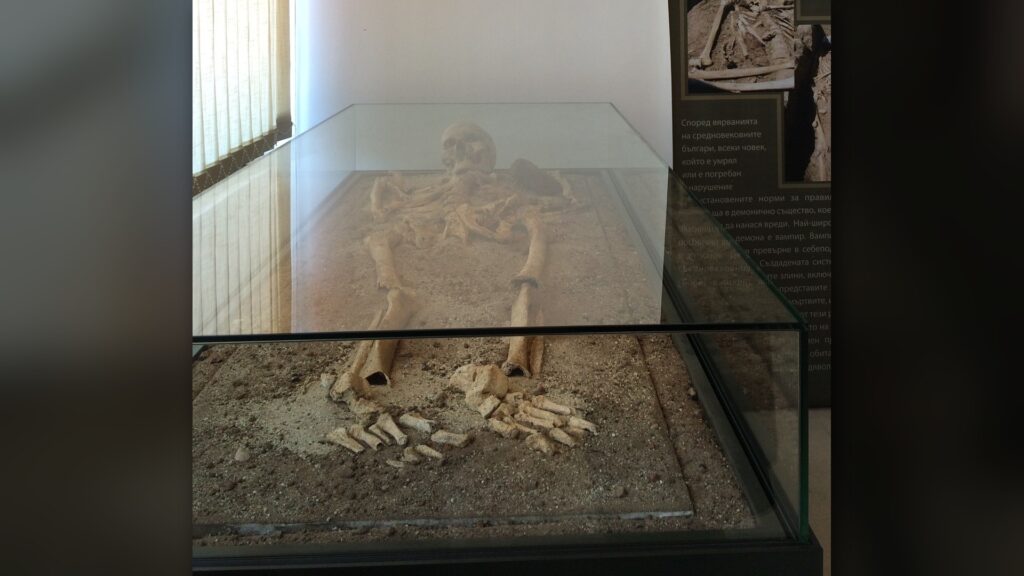
Sozopol is a Black Sea town with a long history, and in 2012 excavations in the necropolis of an old church there uncovered two medieval skeletons. Each had been pierced through the chest with an iron rod before burial.
One of them became famous around the world as the “Vampire of Sozopol.” The skeleton was about 700 years old, and reports at the time described an iron rod, described in some accounts as a piece of a ploughshare, driven through the chest where the heart would have been.
The man’s teeth had also been pulled. In the logic of the time, that mattered too: a vampire that could not bite could not feed.
Bozhidar Dimitrov, then head of Bulgaria’s National History Museum, explained the thinking plainly. Under older pagan beliefs, people judged to have been bad in life were thought likely to return as vampires after death, unless a rod of iron or wood was driven through the chest before they were buried.
The rod did two jobs in that belief. It killed the vampire, and it pinned the body to the ground so it could not rise at midnight and walk.
Local tradition later attached a name to the Sozopol skeleton: Krivich, said to have been a feared ruler of the town’s fortress.
That identification is a story passed down about the grave, not something the bones themselves can prove, and it should be read as legend rather than established fact.
What is certain is the scale of the practice. Dimitrov said more than 100 similar burials had already been found across Bulgaria, and that the custom survived in some villages into the early years of the 20th century.
What is known: the Sozopol burials are real, medieval, and deliberate. What is not known: who the men were, or what each of them had done in life to frighten their neighbours so badly.
The Polish Vampire Burials: Sickles at the Throat
Poland has produced some of the clearest vampire burials ever studied, and some of the most unsettling.
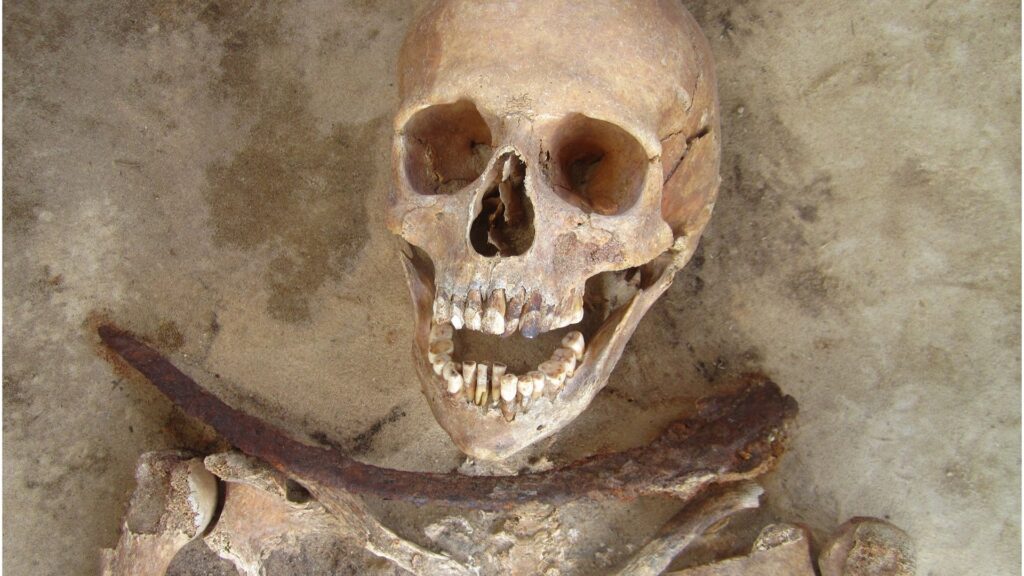
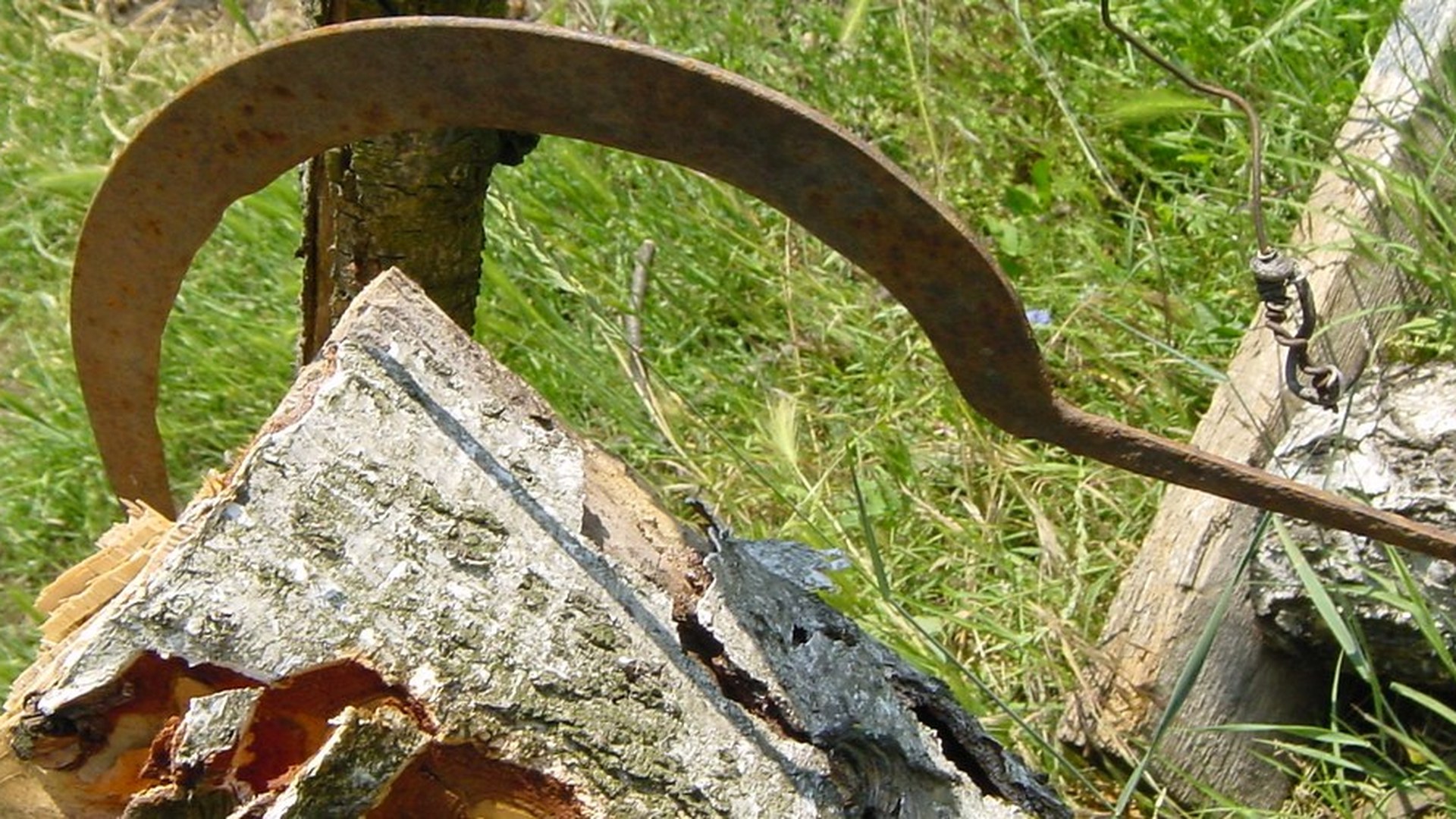
At Drawsko, in northern Poland, archaeologists excavating a 17th- and 18th-century cemetery found six unusual burials among 285 ordinary ones, a discovery published in detail in 2014. Five of the six had an iron sickle laid across the throat or the abdomen.
The sickle was not placed flat as a grave gift. Its edge sat against the neck, so that if the dead person tried to sit up or rise, the blade would cut into, or even sever, the head.
Two of the Drawsko burials also had large stones placed under the chin or against the throat. Researchers have read those stones two ways: to stop the dead from rising, or to stop them from biting and chewing.
One detail surprised the team. Tests showed these people were locals, not outsiders, and they were buried among their neighbours in the normal cemetery, not cast out into separate ground.
The researchers linked the burials to a period of cholera epidemics, when sudden deaths demanded an explanation.
Then, in 2022, a team from Nicolaus Copernicus University in Toruń announced a grave in the village of Pień that combined two protections in one burial. A young woman, buried in the 17th century, had a sickle laid across her neck and a padlock attached to the big toe of her left foot.
Professor Dariusz Poliński, who led the work, said the padlock symbolised the closing of a stage of life and the impossibility of returning. The sickle, he said, was positioned so that a rising corpse would most likely have its head cut off or injured.
She was not buried like an outcast in every respect. She wore a silk cap, a sign of wealth, and her head rested with care.
Later study suggested she was about 17 to 19 years old when she died, sometime between 1620 and 1674, and that the grave may have been reopened and the sickle added afterwards, as if someone decided the first burial had not been safe enough.
A protruding front tooth has been suggested as one reason her neighbours may have feared her. That is a guess, and the researchers present it as one. What the grave proves is fear, not fangs.
How to Stop a Vampire: The Methods in the Graves
Read enough of these burials together and a grim toolkit emerges. Each method answers the same fear in a different way: keep the body in the ground, and stop it feeding if it wakes.
Sickles across the neck
The sickle was a trap as much as a symbol. Laid edge-in across the throat, as at Drawsko and Pień, it turned the corpse’s first movement into its own beheading. Iron also carried protective meaning in folk belief, which made a farm tool an obvious weapon to leave in the grave.
Padlocks on the feet
Padlocks, found at Pień on a woman’s toe and near the feet of a child buried face-down in the same area in 2023, were about locking a life shut. A locked body, in this thinking, could not walk back into the village. The lock was a full stop.
Stones and bricks in the mouth
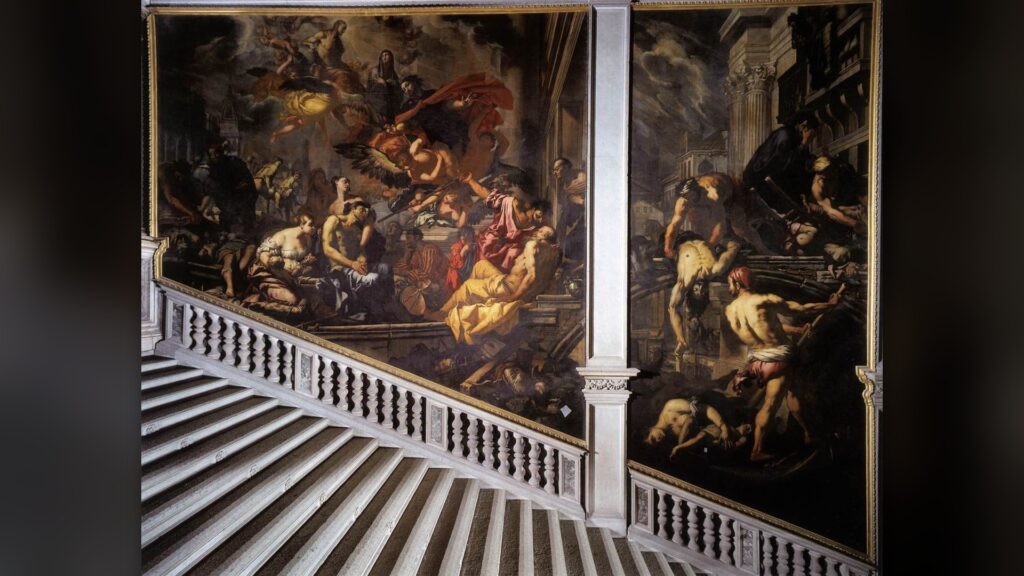
Some communities attacked the mouth, because the mouth was where the vampire fed. Stones were wedged under chins and into jaws in Poland and elsewhere, and coins were sometimes placed in the mouth as well.
The most famous case came from Venice. In 2006, archaeologists excavating a mass plague grave on the island of Lazzaretto Nuovo found the skull of a woman who had died in the plague of 1576, with a brick forced between her jaws.
Forensic archaeologist Matteo Borrini presented the find in 2009 and argued the brick had been placed deliberately, as an exorcism, so the suspected vampire would starve.
Gravediggers who reopened mass graves during epidemics reported corpses that looked as if they had been chewing their burial shrouds. A brick, in that world, was a direct answer.
Staking, decapitation and burial face-down
The rod through the chest at Sozopol belongs to the staking family of methods: pin the body down and it cannot leave. Other burials went further, removing the head or placing it between the legs, so the body could not easily be made whole again.
Face-down burial was simpler and just as pointed. A corpse buried prone would, if it tried to dig or rise, go deeper into the earth instead of up into the air, and in some traditions it was left to bite the ground rather than the living.
None of these methods was rare or local to one village. Variants appear across Bulgaria, Poland, Italy, Greece, and elsewhere in Europe, over several centuries, which tells you how widely the fear itself travelled.
Why Did They Do This? Disease, Decay and Fear
It is easy to laugh at a sickle in a grave. It is harder when you picture the village that put it there: no germ theory, no doctors who could explain an epidemic, and neighbours dying one after another in the same week.
Disease they could not explain
Vampire panics track closely with epidemics. The Drawsko burials were linked by researchers to cholera outbreaks, the Venice brick came from a plague grave, and across Europe tuberculosis, once called consumption, was repeatedly tied to vampire belief.
Tuberculosis explains why suspicion so often fell on the recently dead. One family member would die, then others in the same household would waste away over months, as if something were draining them at night.
In a world without bacteria, a dead relative feeding on the living was a horrifying but logical answer.
These are the same kinds of fears we explore in our look at terrifying death theories and biblical conspiracies: when death arrives without an explanation, people build one.
Decomposition they misread
The second driver was the grave itself. Mass graves were reopened again and again during plagues to add new bodies, so gravediggers regularly saw corpses part-way through decay.
What they saw was alarming if you did not know the science. A decomposing body bloats with gas, which can push dark fluid from the lungs up to the mouth, where it looks like fresh blood.
Skin pulls back, making teeth and nails look longer. The shroud around the mouth can rot away where bacteria are active, leaving a hole that looks chewed.
Put together, a normal corpse could look well-fed, blood-stained and active. Borrini’s work on the Venice case set out exactly this chain: what gravediggers took for a vampire chewing its shroud and spreading plague, modern forensic science reads as ordinary decomposition.
Scapegoats and outsiders
Fear also needed a target. The people singled out were often those already on the edge of a community, or those who had died in ways that felt wrong: too suddenly, too young, by suicide, or early in an epidemic.
That does not mean every deviant burial marks an outsider. At Drawsko the suspected vampires were locals buried among everyone else, and the woman at Pień was buried with a silk cap and some care. A community could fear one of its own dead and still grieve for her.
You will sometimes read that porphyria, a rare blood disorder, explains vampire legends, because it can cause sensitivity to sunlight and receding gums.
Historians and doctors have largely pushed back on that claim: the symptoms do not match the folklore well, and there is little evidence linking porphyria sufferers to vampire accusations. It is a neat theory that the record does not really support.
What Archaeologists Say About Vampire Burials Today
Modern researchers are careful with the word “vampire.” It is the label newspapers love, and often the label the historical community itself would have used, but the graves are usually described in the literature as deviant or anti-vampire burials.
That care matters, because a sickle in a grave does not automatically prove a vampire panic.
Sickles could carry other meanings, including protection, status or older pagan custom, and good archaeology weighs the whole burial before settling on an explanation.
Where several protections appear together, though, the reading is hard to escape. A sickle at the throat plus a padlock on the toe, as at Pień, is not farming equipment left by accident. It is a community insuring itself against a return.
Archaeologists also stress what these graves are not. They are not evidence that vampires existed, and no serious researcher claims otherwise.
They are evidence of something almost as revealing: how ordinary people coped when disease killed faster than knowledge could follow.
Seen that way, vampire burials are a record of grief as much as superstition. Every sickle, stone and padlock marks a burial where the living were frightened, bereaved, and doing the best their beliefs allowed them to do.
If you enjoy cases where the evidence is stranger than the legend, our round-up of things science still can’t explain is a good next stop.
Frequently Asked Questions
What is a vampire burial?
A burial in which the body was deliberately restrained or damaged, for example with a sickle, stake, stone or padlock, because people feared the dead person would return as a vampire.
Where was the Vampire of Sozopol found?
In Sozopol, Bulgaria, in 2012. The roughly 700-year-old skeleton had an iron rod through its chest and its teeth pulled.
Why did the woman at Pień have a padlock on her toe?
Archaeologists say the padlock symbolised a life closed for good, and was meant to make it impossible for her to return from the grave.
Did people really believe in vampires?
Yes. In parts of Europe the belief was strong enough to shape funerals for centuries, and Bulgarian villages were still staking corpses in the early 1900s.
Were these people actually vampires?
No. Archaeologists say the graves show fear of the dead during epidemics, not real vampires. Decomposition and disease were misread as signs of the undead.
Join the Conversation
Which of these vampire burials unsettled you most: the sickle at Pień, the brick in Venice, or the rod at Sozopol? And do you read these graves as pure superstition, or as frightened people doing their best during a plague? Tell us in the comments below.
Read Next
- 6 Terrifying Death Theories and Biblical Conspiracies
- 5 Viral Biblical Conspiracies Science Can’t Explain
- Creepy Photos and Strange Discoveries
- The Human Skin Manuscript: The Book Bound in Flesh
