
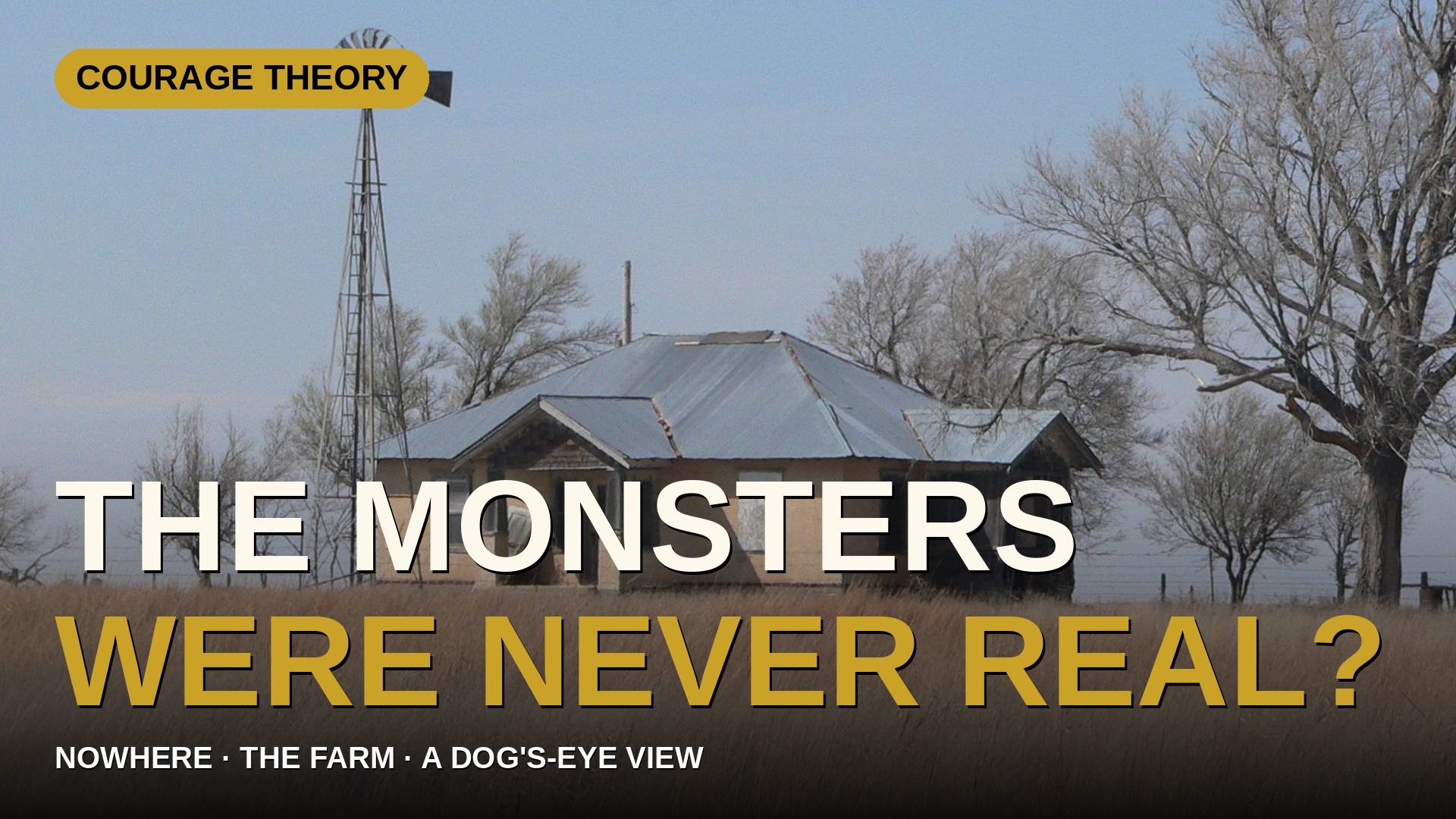
There is a farmhouse in the middle of Nowhere, Kansas, with one dog, two old people and nobody else for miles. Every week, something knocks. Every week, the dog is the only one who seems to understand the danger.
Courage is a small pink dog who is afraid of everything. He lives with Muriel, who is kind, and Eustace, who is not. Monsters, aliens and curses arrive at their door with the regularity of a bus service.
The show that contained all this, created by John R. Dilworth, ran on Cartoon Network from 12 November 1999 to 22 November 2002. Four seasons, 52 episodes, and a reputation out of all proportion to that short run.
Its Wikipedia entry describes it as a comedy horror series. For a children’s cartoon, the horror half is doing heavy lifting.
Because the world of the show is so empty, fans started asking what fills it. What if nothing supernatural ever visits that farm at all? What if the monsters are what the world looks like through a frightened dog’s eyes?
Courage rarely gets to explain any of this in words his owners understand. To Muriel and Eustace he babbles, points and acts out his warnings in frantic charades.
The one witness who always knows is the one nobody can quite hear. That question produced the gentlest Courage theory. The darker ones that followed involve Hell, and a real couple who vanished in 1957 and were never found.
Key Facts
- Created by John R. Dilworth; ran on Cartoon Network from 12 November 1999 to 22 November 2002.
- The pilot, “The Chicken from Outer Space”, aired 18 February 1996 and was nominated for an Academy Award.
- Set in Nowhere, a fictional town in Kansas — not in New Mexico, as viral posts claim.
- William and Margaret Patterson vanished from El Paso on the night of 5–6 March 1957 and were never found.
- The Pattersons left behind a cat named Tommy — not a dog — and Dilworth has never linked them to the show.
The Theory
Reading one: there are no monsters
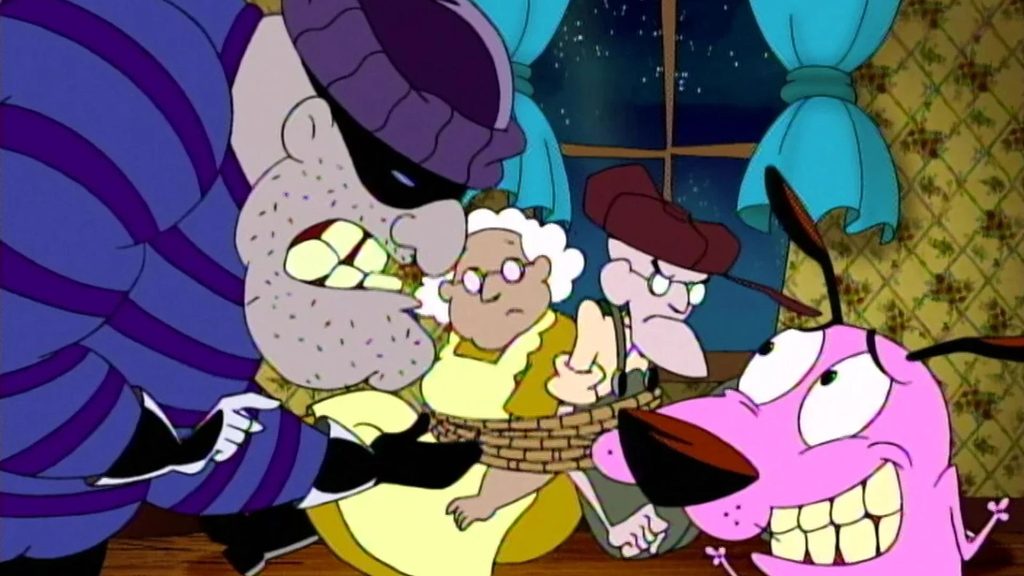
The best-known reading says there are no monsters. Courage was abandoned as a puppy and raised in total isolation on the farm. He has almost never met strangers, so strangers are what terrify him.
Every visitor becomes a monster in his mind. A travelling salesman becomes a ghoul. A vet becomes a torturer. The show, on this reading, is the world as a sheltered dog experiences it: ordinary, and unbearable.
Supporters note how the show is framed. Courage narrates, Courage panics, Courage solves. The camera lives at his height and inside his fear, so of course everything arrives distorted and oversized.
His backstory helps them. In “Remembrance of Courage Past”, viewers learn a deranged vet sent Courage’s parents into space, and Muriel found the puppy alone in an alley.
A dog whose first lesson was that the world takes everything, raised where nobody ever visits — of course, fans say, he would see teeth in every knock at the door.
Reading two: the farm is Hell
The second reading is darker. The family is dead, it says, and the farm is Hell. Courage protects Muriel, read as humanity itself, from Eustace, read as a devil figure: cruel, greedy, masked, and impossible to escape.
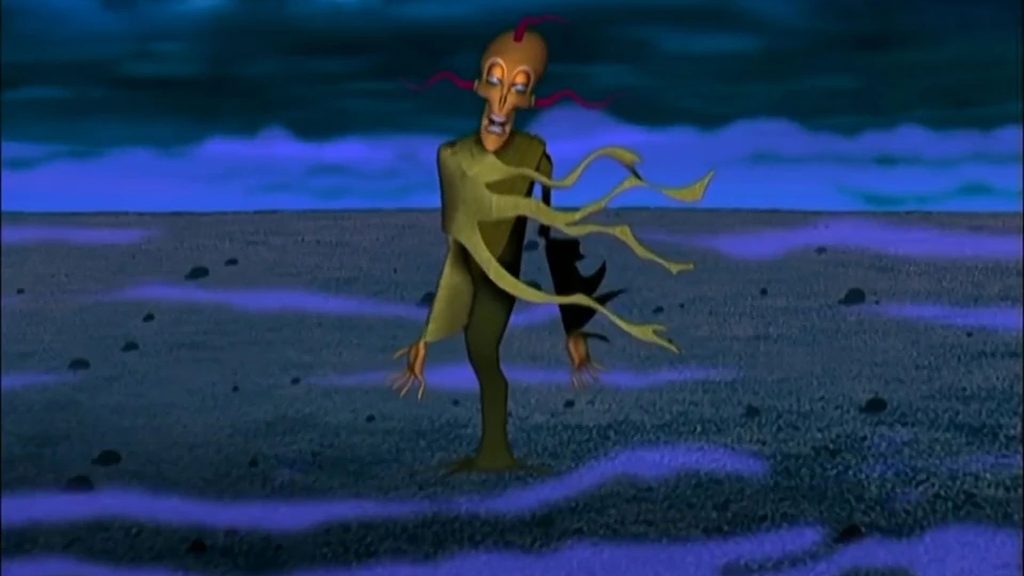
Its favourite prop is Eustace’s green tribal mask, the one he pulls on to terrify Courage while shouting “Ooga Booga Booga!” A farmer amusing himself, say supporters of the Hell reading, or a demon showing his real face.
In that version the weekly monsters are tortures in a loop. Nothing is ever resolved because nothing is meant to be. The farm’s emptiness is not Kansas. It is damnation with a porch.
Reading three: the Patterson case
The third reading claims a true story. It points to William and Margaret Patterson, an El Paso couple who vanished from their Kern Place home on the night of 5 to 6 March 1957, and were never seen again.
The real case is strange enough without the cartoon. William was 52, Margaret 42, and together they ran Patterson Photo Supply, a thriving shop in downtown El Paso. What investigators and friends later described looks like a flight, not a holiday:
- Last seen at their home in the 3000 block of Piedmont Drive, Kern Place, on 5 March 1957.
- The house was left in disarray: dinner dishes unwashed in the sink, clothing laid out on a bed.
- Utilities were never disconnected, mail never stopped, and a fur coat was left waiting at the cleaners.
- Left behind: a Cadillac, a boat in the garage, stock in a boat company, and property in Guaymas, Mexico.
- Margaret’s beloved cat, Tommy, was abandoned; he reappeared months later, malnourished and filthy.
- On 15 March, their accountant received a telegram giving instructions to manage the business and lease the house.
A later letter, postmarked Laredo in May 1957, said the couple were leaving the country for good. Friends reported them missing only on 15 August, five months after they vanished.
The case never closed. The Pattersons were declared dead in 1964, and in 1984 a former caretaker claimed he had found blood in the garage and a piece of scalp on the boat’s propeller. None of it was ever proved.
Investigators also learned William had a 20-year-old mistress in Juárez, Mexico, which fed theories of a planned flight across the border. Other local theories ran to espionage and even alien abduction.
That spread of explanations matters. The Patterson file has been a magnet for speculation for nearly seventy years, long before anyone attached a pink cartoon dog to it.
What the viral version adds
Compare that file with what the cartoon theory actually claims, and the embroidery is easy to spot:
- The viral version gives the Pattersons a dog. They had a cat, Tommy — the detail friends cited most.
- It says the couple reported strange creatures at their home. No such report is in the case record.
- It attaches a photograph of a lonely house near Truth or Consequences, New Mexico, as the “real” farm.
- It states Dilworth based Muriel and Eustace on the Pattersons. He has never said any such thing.
The Pattersons were real, and their disappearance is a genuine unsolved case. But no statement from Dilworth has ever linked them to the show, and the one pet detail the theory needs is backwards.
The Show’s Aesthetic
Where Nowhere actually came from
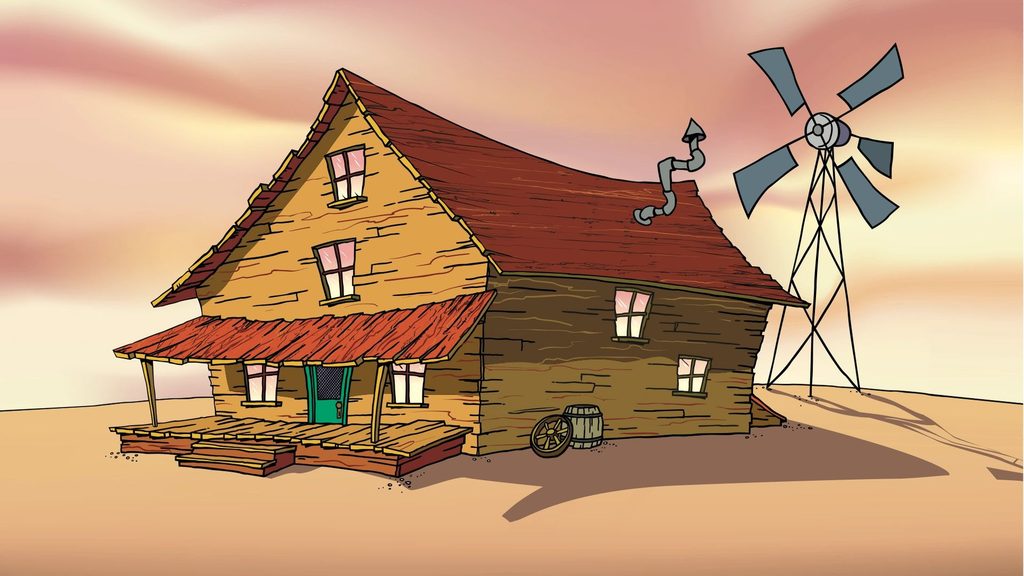
Whatever the intent, the fear is manufactured with real craft. The show’s world is drawn in a deliberately ugly, expressionist style: faces stretch, houses lean, and the colour palette sits permanently at dusk.
Sound does much of the work. Long silences, sudden stingers, warped voices and that famous scream. Episodes hold on empty landscape shots until the emptiness itself starts to feel like a threat.
Dilworth has told the origin story himself. Visiting the farm of his girlfriend’s family out west, he sat on the porch at dusk, watched the wheat ripple like a sea, and saw a ball of light appear in the sky and vanish.
He started writing the alien chicken story the next day. That became “The Chicken from Outer Space”, aired on 18 February 1996 as part of What a Cartoon!
The short was nominated for the Academy Award for Best Animated Short, losing to Wallace & Gromit’s A Close Shave. Dilworth later pitched the series to executives wearing a silver spaceman costume, juggling.
He has also pointed to grounded sources for the farm’s loneliness: that same family farm, and the bleak rural photography of Dorothea Lange. Isolation, in other words, was the subject, not a clue.
The episodes push back
The no-monsters reading also runs into the episodes themselves. Muriel and Eustace see the monsters too — in scenes Courage does not witness and could not invent:
- “King Ramses’ Curse” (7 January 2000): Eustace finds the stolen slab, refuses to return it, and faces the chanting Ramses himself.
- “The Demon in the Mattress” (3 December 1999): Muriel is possessed in her own bed, and Eustace watches it happen.
- “Freaky Fred” (3 December 1999): Muriel’s visiting nephew traps Courage in the bathroom — and Muriel invited him in.
- “A Night at the Katz Motel” (12 November 1999): both owners are captured by Katz and his giant spiders, away from the farm entirely.
- “The Shadow of Courage” (19 November 1999): a dead miser’s shadow torments the whole household, not just the dog.
Damage persists between scenes, visitors leave evidence, and the wider world of Nowhere has its own mayors, scientists and news reports. The strangeness exists when the dog is not looking.
Witnesses inside the world
Other characters treat the supernatural as routine business, which is hard to square with one dog’s imagination:
- Shirley the Medium channels spirits and lays real curses from her caravan — including one on Eustace himself.
- The Computer, in the attic, researches each new horror in a bored, sarcastic voice and is usually right.
- Dr. Vindaloo, Nowhere’s doctor, treats the family’s supernatural injuries with total professional calm.
- Nowhere has a mayor, a police force and television news — all of whom report the same strangeness Courage sees.
If Courage were inventing the monsters, he would also have to be inventing the entire town that keeps confirming them. At some point the simpler explanation is the one on screen: the monsters are real in Nowhere.
The craft behind the fear
The performances sell it. Courage was voiced by Marty Grabstein, Muriel by Thea White, and Eustace first by Lionel Wilson, then by Arthur Anderson from episode 34 onward.
The series was nominated for three Golden Reel Awards for its sound editing and won an Annie Award. The dread fans theorise about was engineered, episode by episode, by people very good at it.
Dilworth directed through his own studio, Stretch Films, which he founded in 1991. Courage grew from an earlier character of his, Hamilton, from a pilot he made for MTV. Nothing about its making was accidental.
The Verdict
So why does the no-monsters theory survive contact with the episodes? Because it is not really a claim about plot. It is a claim about feeling, and the feeling is accurate: this is what anxiety looks like from inside.
It belongs in the same family as the cases in our look at creepy photos that look normal until you look closer: nothing in the frame is fake, yet the longer you stare, the worse it gets.
The Hell reading and the Patterson reading are weaker still. One is symbolism in search of a text. The other borrows a real, unsolved disappearance and a real family’s grief to decorate a cartoon, without a single supporting document.
What remains is a design lesson. Give a children’s show an isolated setting, a frightened narrator and a nightmare art style, and the audience will build the conspiracy themselves. No hidden message is required.
The franchise’s own later word on the subject is telling. In the 2021 crossover film Straight Outta Nowhere: Scooby-Doo! Meets Courage the Cowardly Dog, the monsters are treated as entirely real, and nobody suggests the dog imagined them.
Verdict: Unresolved as authorial intent, with no evidence Dilworth meant any of it. Courage stands as a case study in how a show’s aesthetic alone can generate conspiracy theories.
What is the main Courage the Cowardly Dog theory?
That there are no monsters. Courage, raised in isolation, supposedly perceives ordinary visitors as terrifying creatures because he has never known the outside world.
Were Muriel and Eustace based on a real couple?
There is no evidence for it. Fans cite William and Margaret Patterson, who vanished in El Paso in 1957, but they left behind a cat, and Dilworth has never claimed the link.
Where is Nowhere meant to be?
Nowhere is a fictional town in Kansas. Claims that it copies Truth or Consequences, New Mexico, are fan lore with no confirmation from the creator.
Who created Courage the Cowardly Dog?
John R. Dilworth. His 1996 pilot short, “The Chicken from Outer Space”, was nominated for an Academy Award before the series launched in 1999.
Do the other characters see the monsters?
Yes. Muriel and Eustace react to, flee from and are harmed by the monsters in many episodes, including scenes Courage never witnesses.
Join the Conversation
Did Courage scare you more than any adult horror film, and do you buy the idea that we were watching the world through his fear? Tell us the episode that stayed with you, in the comments.
Read Next
- 10 Crazy Scooby-Doo Conspiracy Theories That Will Ruin Your Childhood
- The Dark Truth Behind Viral Disney Conspiracy Theories
- SpongeBob and the Bikini Atoll Nuclear Mutation Theory
- Adventure Time: The Nuclear Apocalypse and Finn
