
Watch Rugrats closely and a strange pattern appears. The babies talk, plan and explore like tiny adults. The grown-ups around them hear only babbling. One child stands between the two worlds, and she is not a baby.
Angelica Pickles, aged three, understands both sides. She translates for the adults, threatens the babies, and steers half the plots. No other character in the show can do what she does.
So fans asked an obvious, awful question. What if Angelica is the only real child in the room? What if the babies exist because she needs them to?
That question became the most famous Rugrats theory on the internet. It says the playpen is a coping mechanism, and every adventure is a lonely girl talking to children who are not there.
The show she supposedly haunts was a giant. Rugrats premiered on Nickelodeon on 11 August 1991, one of the channel’s first three Nicktoons, alongside Doug and The Ren & Stimpy Show.
Klasky’s own account of the show’s origin is domestic, not tragic. She developed the idea at home with her two infant sons, wondering what babies would say to each other if they could talk.
The series was created by Arlene Klasky, Gábor Csupó and Paul Germain, and ran on Nickelodeon from 1991 to 2004. Its Wikipedia history lists 172 episodes. That is a lot of screen time for children who supposedly never existed.
Key Facts
- Rugrats premiered on Nickelodeon on 11 August 1991 and ran for 172 episodes.
- The theory comes from an anonymous creepypasta posted on 31 October 2011.
- ‘Mother’s Day’ (1997) states Chuckie’s mother died of illness, and that Chuckie lived.
- Dil is born on screen in The Rugrats Movie, released in November 1998.
- Co-creator Arlene Klasky denied the theory on camera in 2016: ‘no, it’s not true.’
The Theory
The original 2011 text
The theory began as a creepypasta, a horror story written to be shared. A version was posted on Creepypasta.com on 31 October 2011, with no named author. It was built to disturb, and it worked.
It opens with a flat statement: ‘The Rugrats really were a figment of Angelica’s demonic and unimaginable imagination.’ Then it assigns each baby a death, with dates:
- Chuckie died in 1986, alongside his mother. That, the story says, is why his father Chas is a nervous wreck.
- Tommy was stillborn in 1988. That is why Stu Pickles builds toys in the basement for a son who never lived.
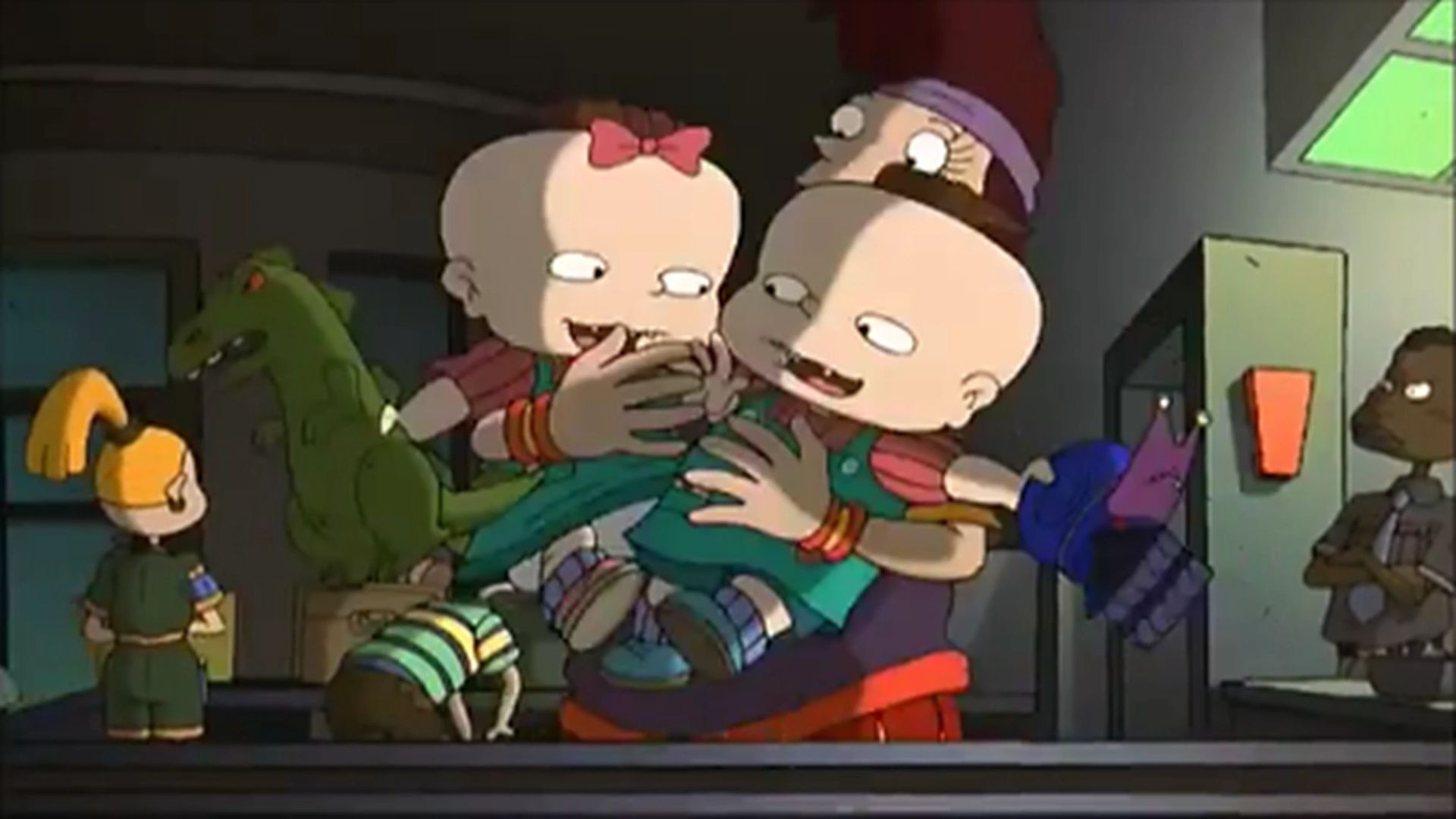
- The DeVilles had an abortion in 1990. Angelica could not know the baby’s sex, so her mind produced twins: Phil and Lil.
- Angelica invents the babies to cope with loss and neglect, in a house where the adults are busy and distant.
Notice what the dates do. None of them comes from the show. They are set dressing, chosen to make fiction read like a leaked case file.
In this reading, the babies are company she controls completely. They speak when she needs them, vanish when she is angry, and never grow beyond her reach.
A darker variant skips the psychology. The babies are dead, it says, and the playpen is purgatory: a bright, safe holding pen where dead children play forever without growing up.
The two babies said to be real
Two babies are treated as real. Susie is a genuine friend who plays along out of kindness. Dil, Tommy’s younger brother, is real too, which is why he never obeys Angelica or speaks like the others.
The original text goes much further with Dil than most retellings admit. It claims Angelica, unable to make this real baby disappear like the others, hit him, causing a brain haemorrhage.
That invented injury then becomes the engine of the sequel claims: guilt, drugs, and a mind clinging to its creations. None of it is in any episode.
Fans point to real features of the show as support. Angelica is the only bridge between babies and adults. The babies never visibly age across thirteen years of episodes. The adults rarely seem to watch them directly.
How the story mutated
Later retellings kept adding rooms to the house. Track the additions and you can watch a horror story being mistaken for research:
- The 2011 original already claims Angelica’s real mother died of a heroin overdose in 1982, just after she was born.
- It says her Cynthia doll was modelled on that dead mother: an unwashed orange dress and messed-up hair.
- It ends with Susie grown up, a psychologist, pitching the show itself to Nickelodeon after Angelica’s death.
- A ‘tweaked’ version then cleaned up the language and dropped the gore, keeping the three deaths intact.
- Later listicles moved the dates again; one version has Angelica dying in 1994, a year the original never used.
- A long Reddit re-examination in r/FanTheories reframed it as psychology, not ghosts: a neglected child building a controllable family.
Each step adds a ‘fact’ no earlier version had, and none of them cites a source. The story even absorbs the spin-off: All Grown Up! becomes the teenage Angelica’s mind deteriorating.
In the original text, that spin-off is explained with narcotics and acid, and it ‘ends’ with Angelica dying of an overdose at 13 when the show was cancelled.
That softer Reddit version is the one most often shared now. The gore fell away in transit, which is exactly why the claim started sounding plausible.
The Counterevidence
Chuckie: the episode that answers it
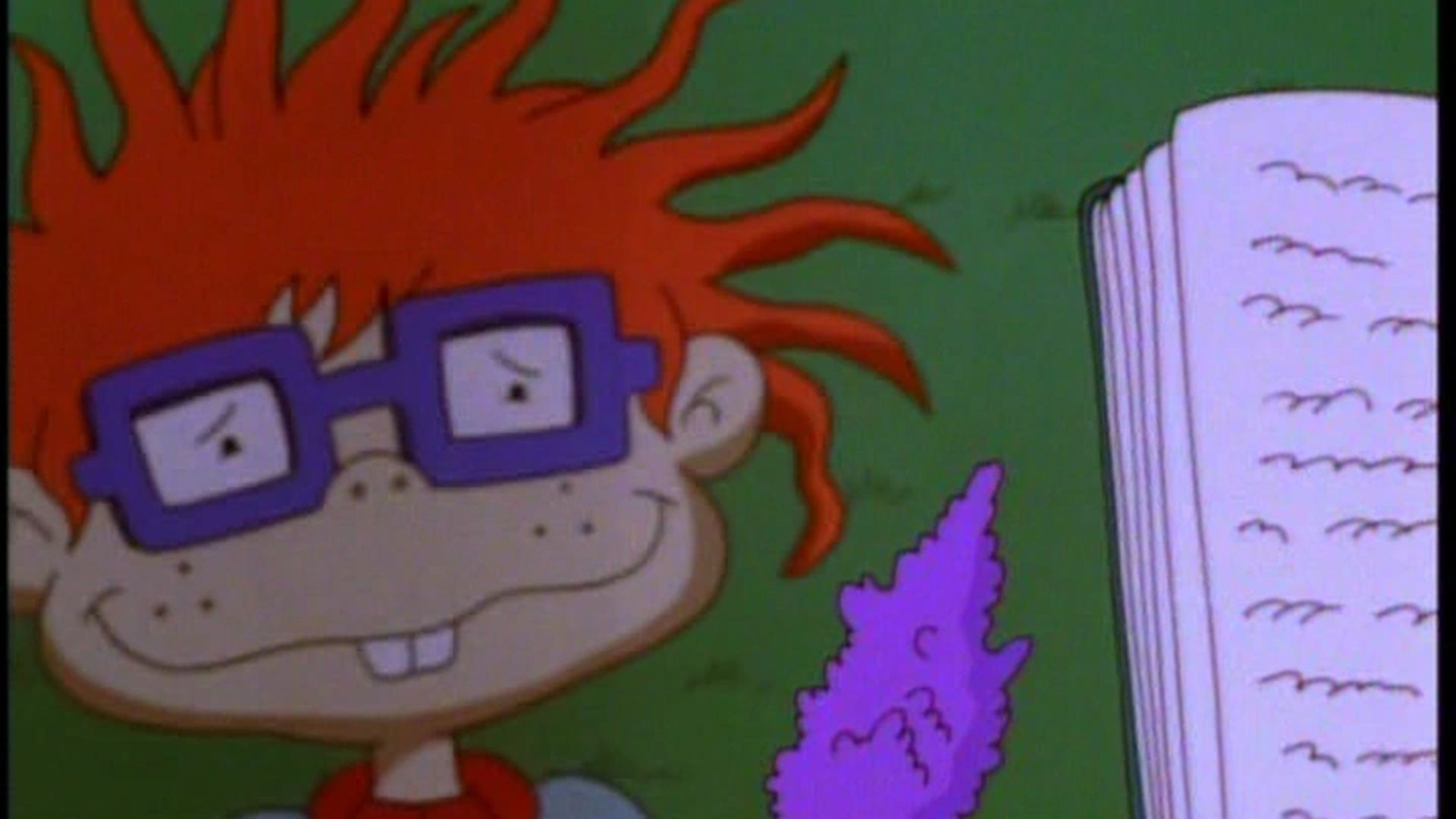
Start with Chuckie, because the show answered that one itself. The episode “Mother’s Day” aired on 6 May 1997, as the 67th episode of the series. It is explicit about what happened to his mother.
The plot is simple and devastating. The babies hunt for the perfect mother for Chuckie, while Chas entrusts Didi with a box of his late wife’s belongings, afraid Chuckie will find it too soon.
Melinda Finster, voiced in flashback by Kim Cattrall, died of a terminal illness shortly after Chuckie was born. She died alone in that sense: Chuckie lived, grew, and played in the garden she planted.
Inside the box is the diary Melinda kept in hospital. Its last entry is a poem for her son, and Chas reads it aloud: ‘When a gentle wind blows, that’s my hand on your face.’
The episode ends with the poem and her photo framed together, and Chuckie telling his friends his mother is in all the good things outside. It is a grief episode, not a ghost story.
The production history cuts deeper. Co-creator Paul Germain had pitched explaining her absence years earlier, offering two options: divorce, or death.
Nickelodeon rejected both, as Germain recalled in 2016: divorce was ‘too heavy’, and death was ‘scary’ and not something children wanted to see. So the show simply never mentioned her.
Germain left the show in 1993, after its first 65 episodes. A new writing team finally made ‘Mother’s Day’ four years later, and he has said he was disappointed it happened without him.
So the ‘mystery’ of Chuckie’s mother was never a hidden plot. It was a network rule, later relaxed. The creepypasta filled a silence the censors had created.
Tommy, the twins, and the babies Angelica never meets
Tommy is just as alive. The series opens on his first birthday, surrounded by family. Adults feed him, carry him, take him to the doctor and react to the chaos he causes, often with Angelica nowhere near.
- Adults handle the babies constantly: feeding, carrying, bathing, doctor’s visits.
- Entire episodes run without Angelica at all, and the babies’ adventures continue.
- When the Carmichael family moves in, Susie plays with Tommy in an episode Angelica never appears in.
- An imaginary friend cannot be met, unintroduced, by strangers who just moved to the street.
- The abortion claim has no source at all: nothing in any episode, interview or production record hints at it.
Phil and Lil are simply twins, held, fed and scolded by two very present parents. The 1990 abortion exists in one place only: the creepypasta.
The films widen the problem. In Rugrats in Paris (2000), the babies travel to France and are handled by crowds of strangers. In Rugrats Go Wild (2003), they meet the Thornberry family.
Eliza Thornberry, whose own gift is talking to animals, converses with the babies directly. A girl from another series entirely can hear children who supposedly exist inside one mind.
The babies do grow up
And the babies do age. Dil is born in The Rugrats Movie in November 1998, changing the cast permanently. All Grown Up!, launched in 2003, shows the whole group roughly a decade older.
Dil’s arrival matters twice over. He is born on screen, in a cinema film, to parents the theory says lost their only son a decade earlier.
All Grown Up! began as the 2001 special ‘All Growed Up’, then became a full series in 2003. The babies as pre-teens is canon, not a symptom.
Finally, a creator said it plainly. Asked by BuzzFeed at San Diego Comic-Con in 2016, Arlene Klasky answered: “A lot of people believe that conspiracy theory. And no, it’s not true.”
Klasky has also said she ends up consoling children online who read the theory and believed it. The denial is not a coy non-answer. It is a creator cleaning up after a horror story.
The Verdict
As a claim about the show, the theory fails almost every test. Its three central deaths are contradicted by canon, invented outright, or both. Its author was writing horror fiction, not leaking production secrets.
It works the way the strongest cartoon theories do, by finding a real structural oddity and building a coffin around it. Fans pulled the same trick on Scooby-Doo, and for the same reason: the oddity is genuinely there.
Angelica really is the only bridge between two worlds. The babies really do live in a kind of suspended time. A show about how babies see the world is, by design, a show narrated by unreliable witnesses.
That ambiguity is a by-product of the format, not a hidden plot. Rugrats is told from inside the playpen. Of course the view from there looks strange to the rest of us.
Klasky has said she ends up consoling children online who have read the theory and believed it. Few fan theories force a creator into that role. This one treats its audience’s childhood as a crime scene.
The franchise has simply carried on without it. A CGI reboot launched in 2021 with the babies alive, loud and entirely unbothered. Nothing in thirty years of Rugrats has ever winked at the creepypasta.
Verdict: Unresolved. The imagination theory is not supported by canon and its creator has denied it outright, but the structural ambiguity that feeds it is real, and it is not going anywhere.
What is the Rugrats theory?
It claims the babies are figments of Angelica’s imagination, invented to cope with loss and neglect. A darker variant says the babies are dead and the playpen is purgatory.
Where did the theory come from?
From an anonymous creepypasta posted online in October 2011. It was written as horror fiction by a fan, not by anyone connected to the show.
Did Chuckie die with his mother?
No. In “Mother’s Day” (1997), Melinda Finster dies of a terminal illness shortly after Chuckie’s birth. Chuckie survives and is raised by his father, Chas.
Have the creators ever confirmed the theory?
No. Co-creator Arlene Klasky denied it on camera in 2016, telling BuzzFeed: “A lot of people believe that conspiracy theory. And no, it’s not true.”
Do the babies ever grow up?
Yes. Dil is born in The Rugrats Movie (1998), and the spin-off All Grown Up! (2003) shows Tommy and his friends roughly ten years older.
Join the Conversation
Did you read the creepypasta as a teenager and never quite shake it? Or does Klasky’s flat denial settle it for you? Tell us which cartoon theory got under your skin, and why, in the comments.
Read Next
- The Dark Truth Behind Viral Disney Conspiracy Theories
- 10 Crazy Scooby-Doo Conspiracy Theories That Will Ruin Your Childhood
- Courage the Cowardly Dog: Were the Monsters Real?
