
On 15 August 1977, a radio telescope in Ohio recorded something it had never recorded before.
For 72 seconds, a powerful signal rose, peaked, and faded from the direction of the constellation Sagittarius. It sat almost exactly on the frequency scientists most expected an alien civilisation to use.
That signal became the Wow! Signal, still the most famous example of unexplained sounds from space ever picked up on Earth. Nearly five decades later, nobody has confirmed where it came from, and it has never been heard again.
It is not the only strange signal in the record. Some turned out to be embarrassingly close to home. Others opened up a whole new field of astronomy. For more cases where the evidence is real but the answer is missing, see our look at things science still can’t explain.
What Was the Wow! Signal? The Most Famous of All Unexplained Sounds From Space
The telescope was called Big Ear. It belonged to Ohio State University and stood near Delaware, Ohio, and in 1977 it was being used to support the search for extraterrestrial intelligence, known as SETI.
Big Ear did not work like a modern dish. It could not be steered to follow one point in the sky.
Instead, it stayed fixed and let the rotation of the Earth carry the sky across its beam. A fixed point in space drifted through that beam in about 72 seconds.
That detail matters. The signal lasted for the full 72-second window, rising and falling exactly as a distant, fixed source should as it crossed the beam.
A code that was not a code
A few days later, astronomer Jerry Ehman was working through the computer printouts by hand. Most of the page was low numbers, the ordinary hiss of background noise.
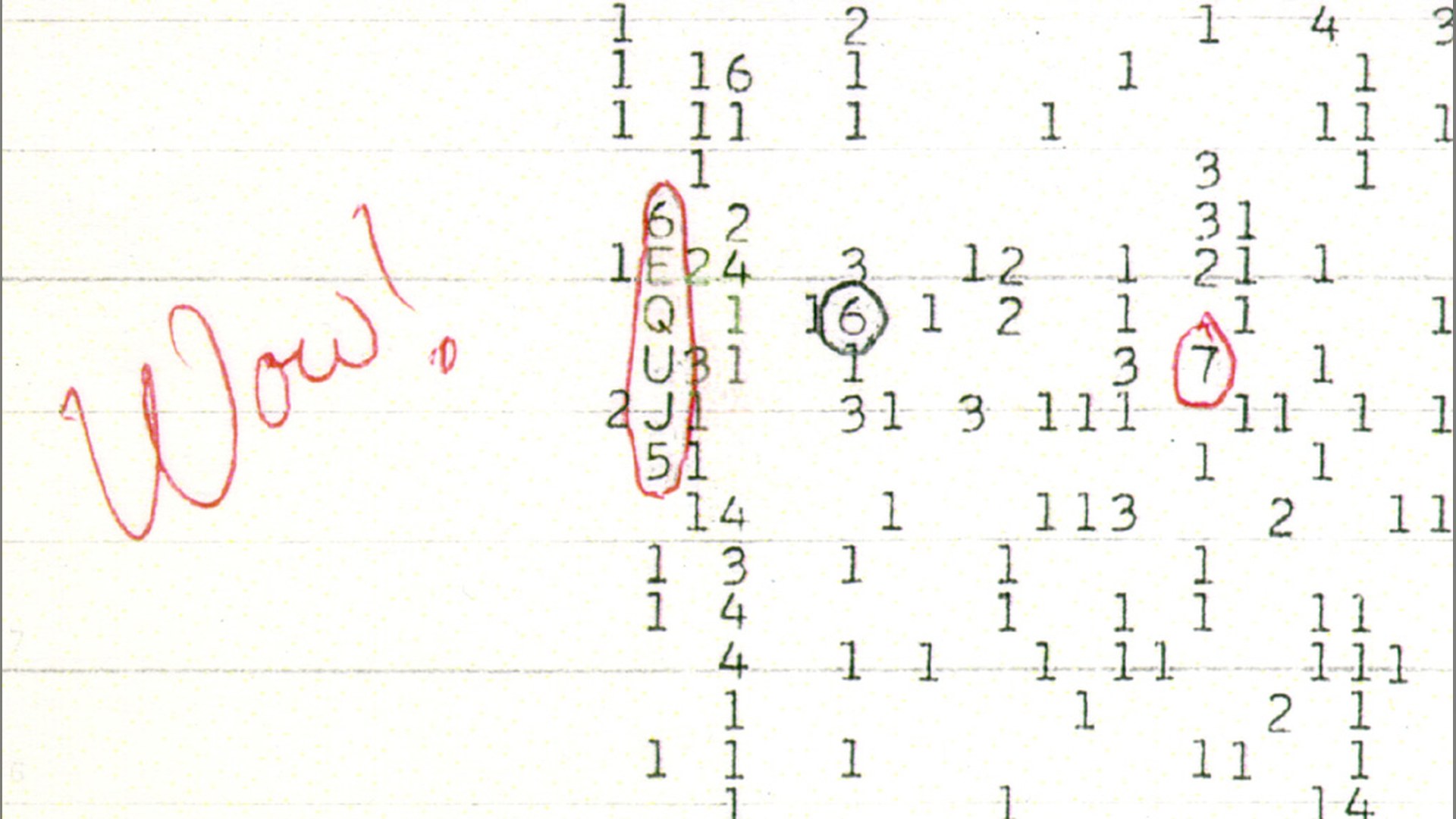
Then he saw a vertical sequence that did not belong there: 6EQUJ5.
Those characters were not a message. They were the telescope’s shorthand for signal strength, recorded in chunks of about 12 seconds.
Numbers covered the weakest readings. Letters took over as the signal grew stronger, and the letter U meant roughly 30 times the level of background noise.
The pattern told a clean story. The signal climbed steadily, peaked, and fell away again in a smooth curve.
Ehman circled the sequence in red pen and wrote one word in the margin: “Wow!” The name stuck, and the original printout is now preserved by the Ohio History Connection.
The frequency that raised eyebrows
The signal was narrowband, squeezed into a channel about 10 kilohertz wide. Natural radio sources in space usually spread their energy over a much wider band.
Its frequency was around 1,420 megahertz. That is the hydrogen line, the frequency at which hydrogen atoms, the most common element in the universe, naturally emit radio energy.
Back in 1959, physicists Giuseppe Cocconi and Philip Morrison had argued that any civilisation trying to be heard would pick exactly that frequency, a landmark every radio astronomer would know. The band around it is also protected, so broadcasters on Earth are not supposed to transmit there.
Known, and unknown
Here is what is known. A strong, narrowband signal really was recorded, on a protected frequency, from the general direction of Sagittarius.
Here is what is unknown. Big Ear had two feed horns, and the signal appeared in only one of them, so its exact position in the sky could never be pinned to a single point.
It also never came back. Ehman and his colleagues looked again many times, and later searches with other telescopes looked too.
No repeat has ever been confirmed. One unrepeated signal, however striking, cannot prove an alien transmission. It also cannot be explained away by pointing at a source nobody has identified.
The Leading Explanations for the Wow! Signal
Over the years, researchers have tested almost every ordinary suspect. Reflections from space debris, a passing aircraft, a secret satellite, and natural radio sources have all been raised.
None has been confirmed. A human source is hard to rule out completely for a one-off event, but the protected frequency, the clean rise and fall, and the lack of a repeat from any known transmitter all count against a simple answer.
One idea got more attention than the rest, because for a while it looked like it might close the case.
The comet hypothesis
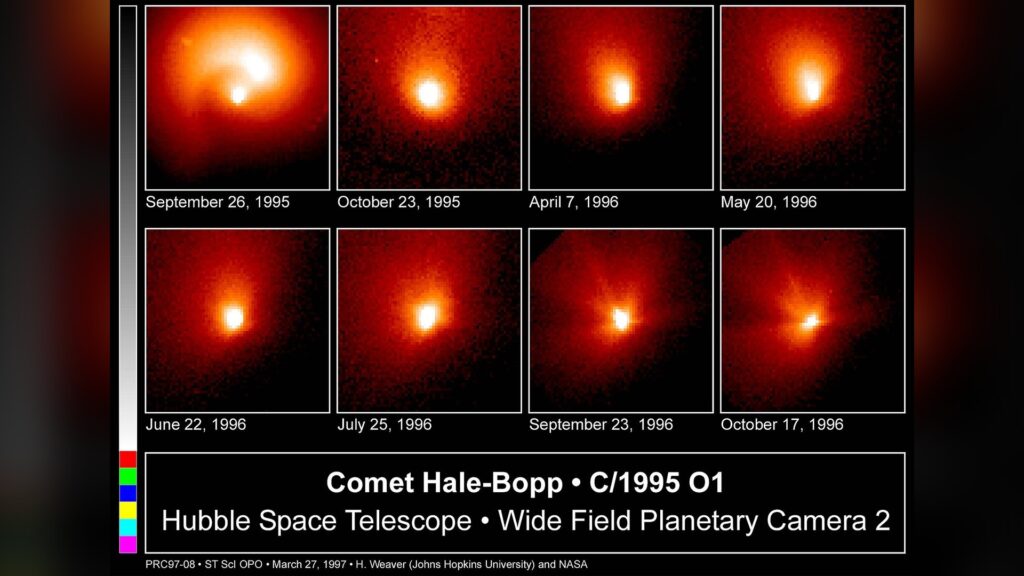
In 2016 and 2017, astronomer Antonio Paris proposed that the signal came from hydrogen gas around comets. His main candidate was 266P/Christensen, a comet that was not discovered until 2006, decades after the signal.
Paris reported detecting 1,420 megahertz emissions when he pointed a radio telescope at the comet in 2017, and argued a large hydrogen cloud around a comet in 1977 could have produced what Big Ear heard. It was a testable claim, and it did not hold up well.
Why the comet idea struggles
Robert Dixon, who directed the Ohio State programme, published a direct rebuttal. Working back from the comet’s orbit, his team found 266P/Christensen was not in Big Ear’s beam at the time of the signal.
The comet was roughly an hour of right ascension away from the signal’s position. Big Ear’s beam was only a few minutes wide, so the comet would have passed through it close to an hour earlier.
Other astronomers raised a second problem. Strong hydrogen-line emission of this kind had never been documented from a comet, and a broad, natural hydrogen cloud does not easily explain a signal confined to such a narrow band.
There is a third problem. A slow-moving comet should have been detectable for days, and it should have shown up in both of Big Ear’s beams, not just one.
Paris stood by his work, but the wider verdict is clear. The comet hypothesis is not accepted as the answer, and the Wow! Signal remains unexplained.
That is the honest position. Unexplained does not mean alien. It means the evidence is too thin, and the event too brief, for anyone to claim a proven cause.
The Perytons: The Space Signals That Came From a Microwave
Not every mystery signal survives investigation. The perytons are the best reminder of that, and they are also the funniest story in radio astronomy.
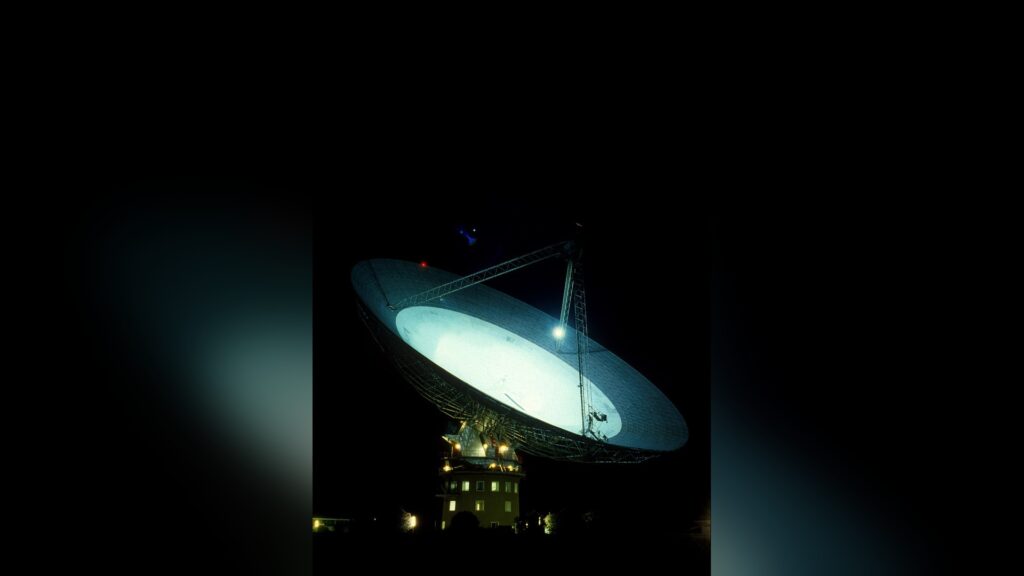
From the late 1990s onward, the Parkes radio telescope in Australia kept recording short, swept radio bursts. They looked a little like signals that had travelled through deep space.
Astronomer Sarah Burke-Spolaor catalogued them in 2011 and named them perytons, after a mythical winged creature. The name was a joke, but the puzzle was real.
The clues were in the timetable
Perytons behaved oddly for something from space. They appeared in all of the telescope’s beams at once, which pointed to a source nearby rather than a single point in the sky.
They also kept office hours, clustering on weekdays during the working day. The breakthrough came in January 2015, after Parkes installed a new interference monitor that caught a matching signal at 2.3 to 2.5 gigahertz, the frequency range of a microwave oven.
Lunch, interrupted
In March 2015, staff at Parkes ran a simple test. They heated mugs of water in the site microwaves while the telescope watched.
A microwave running normally produced nothing. But when the door was opened before the timer finished, while the magnetron was shutting down, it let out a short burst of radio emission.
That burst matched the perytons. After 17 years, the mystery was solved, and the culprit was impatient staff heating their lunch down the corridor.
The case matters for a serious reason. Until perytons were explained, astronomers could not be sure other, similar-looking bursts were not also local interference. Clearing the microwaves out made the real thing easier to trust.
Fast Radio Bursts: Unexplained Sounds From Space That Do Repeat
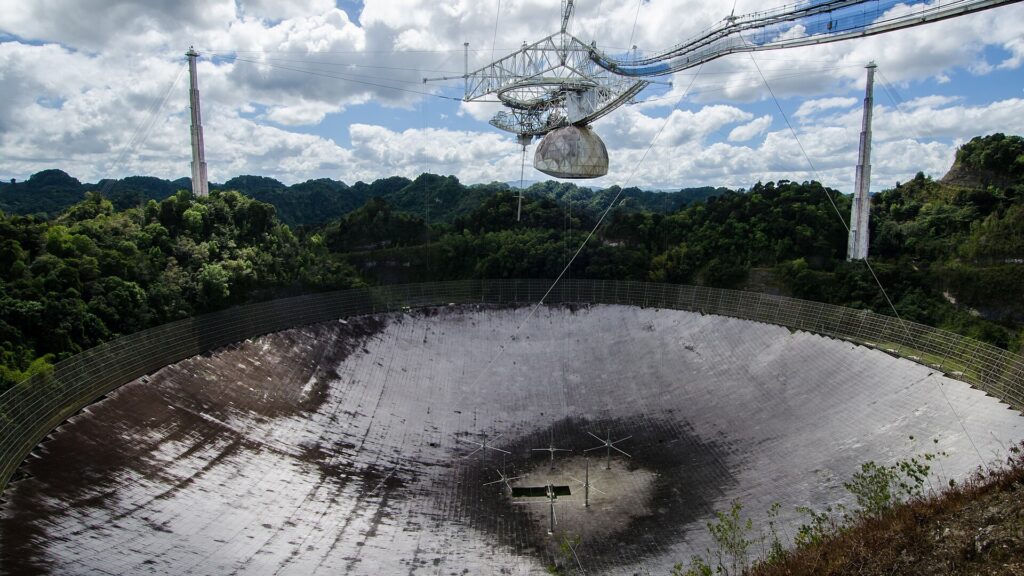
Fast radio bursts, or FRBs, are flashes of radio energy that last a few thousandths of a second. In that blink, one burst can release as much energy as the Sun puts out in days.
The first one found is called the Lorimer burst. It was recorded by the Parkes telescope on 24 July 2001, but nobody noticed it at the time.
Astrophysicist Duncan Lorimer and student David Narkevic found it in 2007, buried in archived pulsar survey data. It had come from far beyond our galaxy, and nothing like it was in the catalogues.
For years, sceptics could fairly ask whether it was another peryton-style accident. Then more bursts appeared, at other telescopes, and one of them did something no peryton could do.
The repeater that changed everything
FRB 121102 was first detected by the Arecibo telescope in Puerto Rico in 2012. In 2016, it was found to be repeating, firing off burst after burst from the same spot in the sky.
A repeating source rules out any one-time explosion that destroys itself. Whatever made those bursts survived making them.
Astronomers then pinned FRB 121102 to a small dwarf galaxy about three billion light-years away. It was proof, in a single case, that at least some of these signals cross deep space to reach us.
In April 2020, telescopes caught a burst from inside our own galaxy. It came from the direction of SGR 1935+2154, a magnetar, which is a neutron star with an extreme magnetic field.
That detection established magnetars as at least one real source of fast radio bursts. It did not explain them all.
What is still open
Hundreds of FRBs have now been catalogued, and most never repeat. Some repeat in patterns, and one, FRB 180916, was found to follow a cycle of about 16.35 days.
Whether repeaters and one-off bursts are the same kind of object seen differently, or two different populations, is still argued over. So is the exact mechanism behind such a clean, violent flash.
The contrast with the Wow! Signal is sharp. FRBs gave scientists repeat performances and locations to study. The Wow! Signal gave them 72 seconds and a word in red ink. For another claim where the evidence needs careful handling, see our investigation into whether humans evolved on Mars.
Saturn’s Radio Voice: A Sound With a Known Source
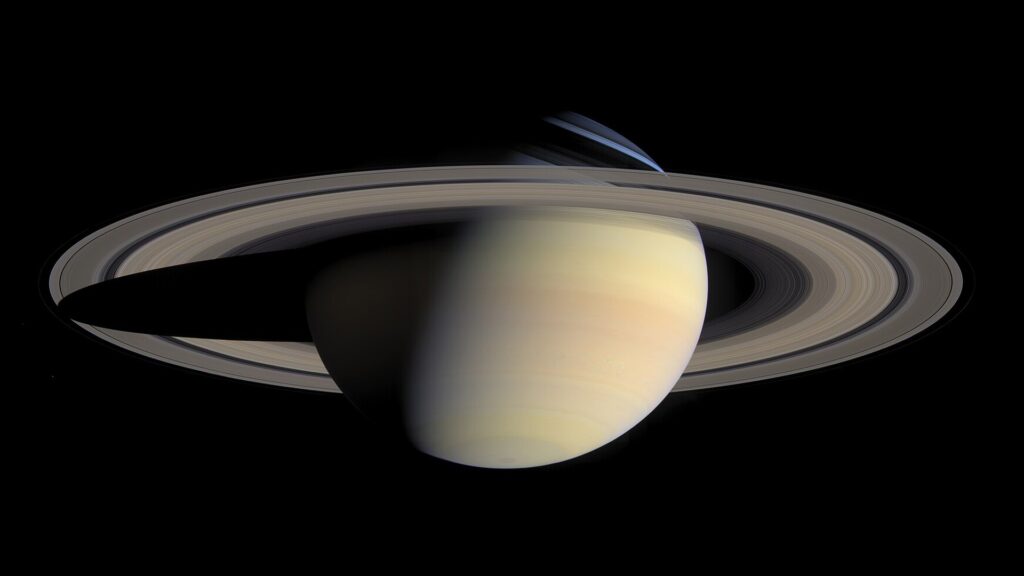
Some of the eeriest audio ever shared online is labelled “the sound of Saturn.” It sounds like a haunted choir, full of rising whistles and low moans.
First, a correction that matters. There is no sound in space in the way we hear sound on Earth, because there is almost no air to carry it.
Nobody pointed a microphone at Saturn. What spacecraft recorded was radio and plasma waves, which scientists then shifted down into the range human ears can hear.
What Cassini actually heard
NASA’s Cassini spacecraft carried a Radio and Plasma Wave Science instrument. It began detecting Saturn’s radio emissions in April 2002, while still about 374 million kilometres from the planet.
Those emissions are called Saturn kilometric radiation. They are generated above Saturn’s poles, in the same regions that produce its auroras, by electrons spiralling along the planet’s magnetic field lines.
Cassini’s instrument had far better resolution than Voyager’s, revealing small sources moving along the field lines. To make the famous recordings, scientists compressed the time and shifted the frequencies down, in one release by a factor of 44. The whistles and falling tones are real structure in the data, not effects added afterwards.
In September 2017, two weeks before Cassini ended its mission by diving into Saturn’s atmosphere, it also recorded plasma waves travelling between Saturn and its moon Enceladus. Sixteen minutes of data were compressed into 28.5 seconds of audio.
Known, and unknown
Saturn’s emissions belong in this article as the control case. The source is identified, the physics is broadly understood, and the recording process is documented.
What is not fully settled is the fine detail of how the emissions are generated. So the categories matter: Saturn is explained but not finished, perytons are solved, FRBs are partly explained, and the Wow! Signal has no accepted explanation at all.
Are We Alone? Why Unexplained Sounds From Space Still Matter
The Wow! Signal is often presented as proof that someone out there tried to call us. The record does not support that claim.
It supports something narrower and, in its own way, stranger. On one night in 1977, a telescope recorded a signal that matched the expected shape of a distant transmission, on the one frequency scientists had agreed to watch, and it never happened again.
Every serious attempt to explain it, from comets to interference, has failed to close the case. Every attempt to find it again has failed too.
That is why it endures. Not because it proves we are not alone, but because it is a clean, documented gap in the record, surrounded by other signals that science did manage to solve.
The microwaves were caught. The bursts were traced to distant galaxies and, in one case, to a magnetar in our own. Saturn’s voice was decoded into auroras and magnetic fields.
The 72 seconds from Sagittarius are still just sitting there, unexplained. Until a signal like it repeats, that is exactly where the story has to stop.
Frequently Asked Questions
Was the Wow! Signal a message from aliens?
There is no proof of that. It carried no decodable message, never repeated, and its source was never identified.
What does 6EQUJ5 mean?
It is not a code. The characters record how the signal’s strength rose and fell, peaking at about 30 times background noise.
Did a comet cause the Wow! Signal?
Probably not. The comet proposed in 2017 was not in the telescope’s beam at the right time, according to the original observatory team.
What are fast radio bursts?
Millisecond flashes of radio energy from deep space. Magnetars explain some of them, but many details are still open.
Can you really hear sounds from Saturn?
Not directly. Spacecraft record radio and plasma waves, and scientists shift them into audible frequencies so we can listen to the data.
Join the Conversation
Do you think the Wow! Signal was a one-off natural event, or the one that got away? Which of these signals would you most want explained?
Tell us in the comments below. The best arguments on this one usually start with the evidence, so bring yours.
Read Next
- Did Humans Evolve on Mars? The Origin Theory Examined
- 10 Things Science Still Can’t Explain (Viral Mysteries)
- Aircraft Disappearances That Are Still Unsolved
