
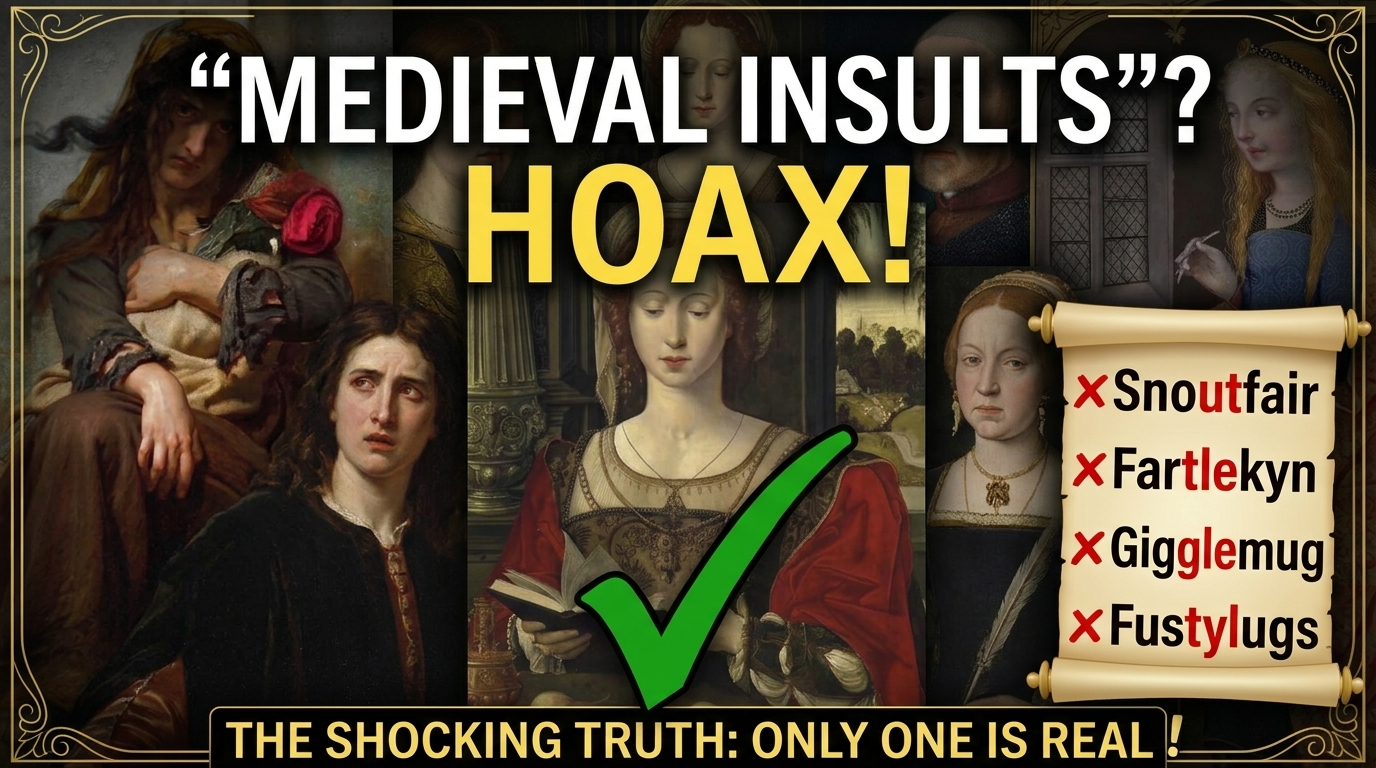
Scroll long enough and you will find it: a solemn Renaissance portrait, a woman mid-page-turn, captioned with a word that sounds like it staggered out of a tavern in 1350. Fustylugs. Snoutfair. Slugfeast. You swipe, you laugh, you share. The promise is always the same: this is how people really insulted each other in the Middle Ages.
We pulled the files. The truth is funnier, and a little stranger.
The Claim
A viral carousel circulating on social media presents eight “medieval insults” (snoutfair, ragabash, swine head, fustylugs, fartlekyn, slugfeast, cumberworld and gigglemug), each paired with a tidy definition and a painting of a poker-faced aristocrat. The implication is clear: these were ordinary words of the medieval street.
To its credit, the post’s own caption warns that viral lists mix genuine old words with later ones. That warning deserves more attention than the slides got. So we tested it.
The Evidence
First, a ground rule. “Medieval” roughly means the years 500 to 1500, and the English of about 1100 to 1500 is called Middle English. After that we are in Tudor and Stuart England, the age of Shakespeare. That is early modern, not medieval. Plenty of “olde” words are old without being medieval-old.
Here is how each word holds up.
Cumberworld: genuine.
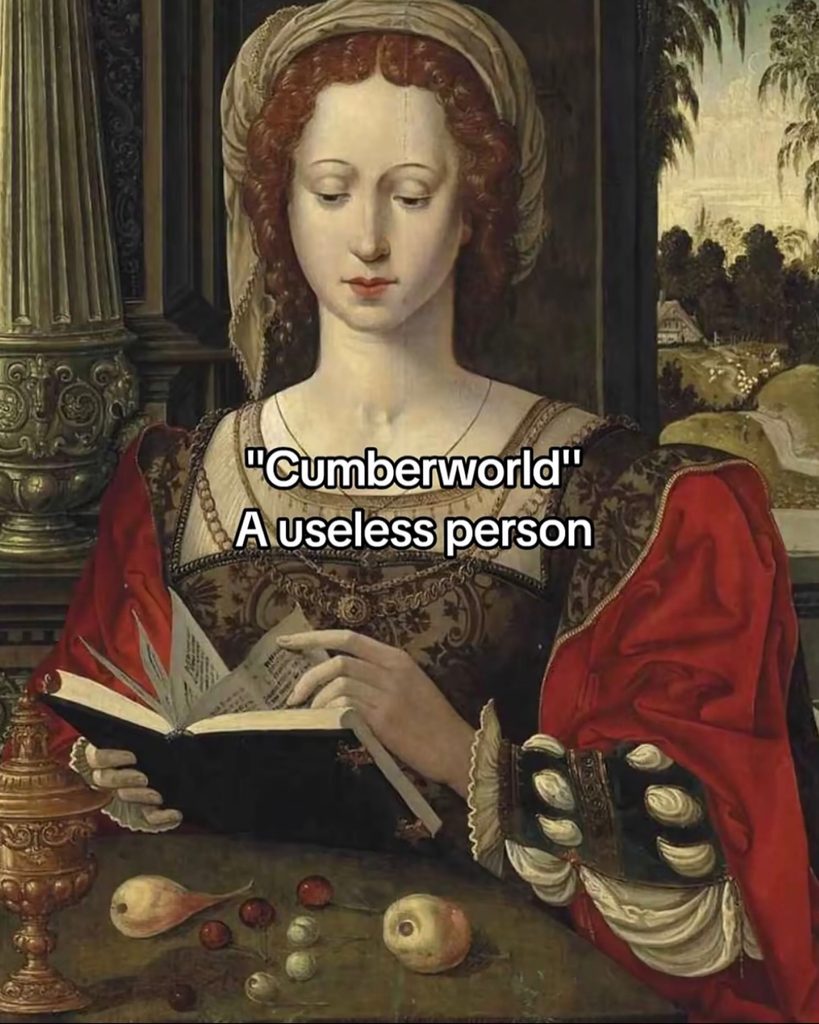
This is the one that survives. In Chaucer’s Troilus and Criseyde, written in the late 1300s, a despairing speaker calls himself a “combre-world,” someone who serves no purpose. The poet Thomas Hoccleve used the same word around 1420. The meme’s definition is accurate: a person or thing that uselessly burdens the world.
Snoutfair: real, but backwards.
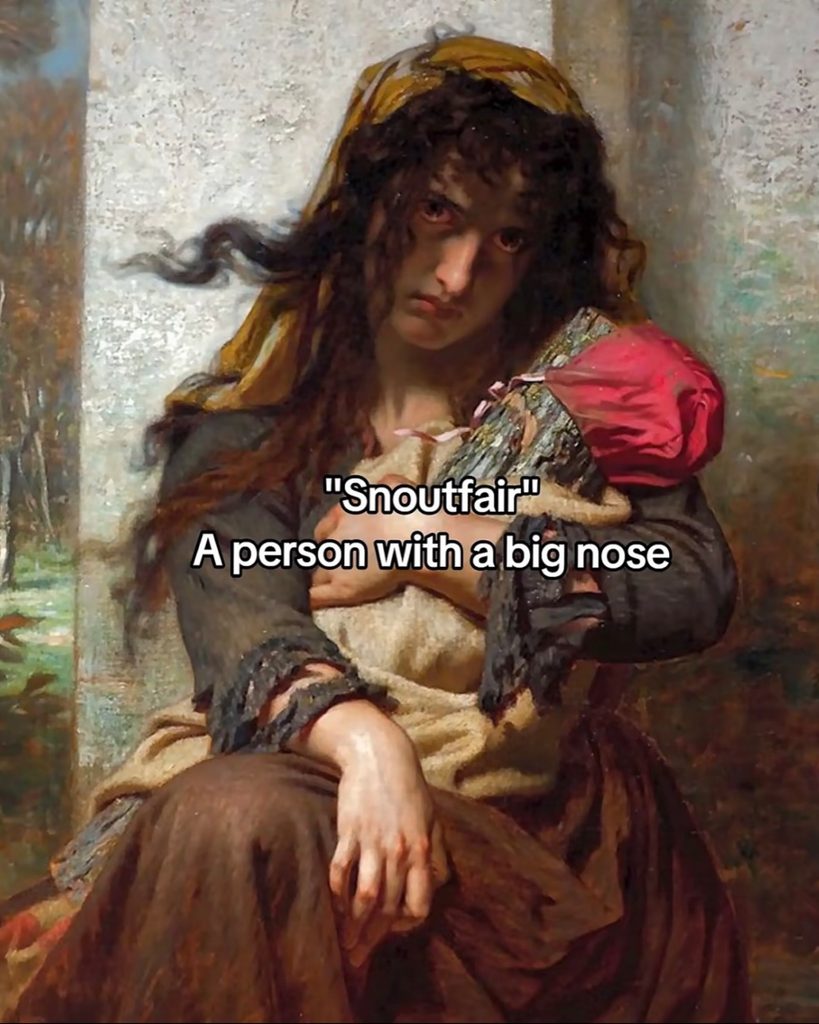
The word turns up in English around 1530, which makes it Tudor, not medieval. And it does not mean a person with a big nose. It meant fair-faced, comely, handsome, usually with a slightly mocking edge. When University of York linguists revived “lost” words in 2017, they offered snoutfair as a word for good-looking. The viral slide flipped a compliment into an insult.
Ragabash: real, but later.
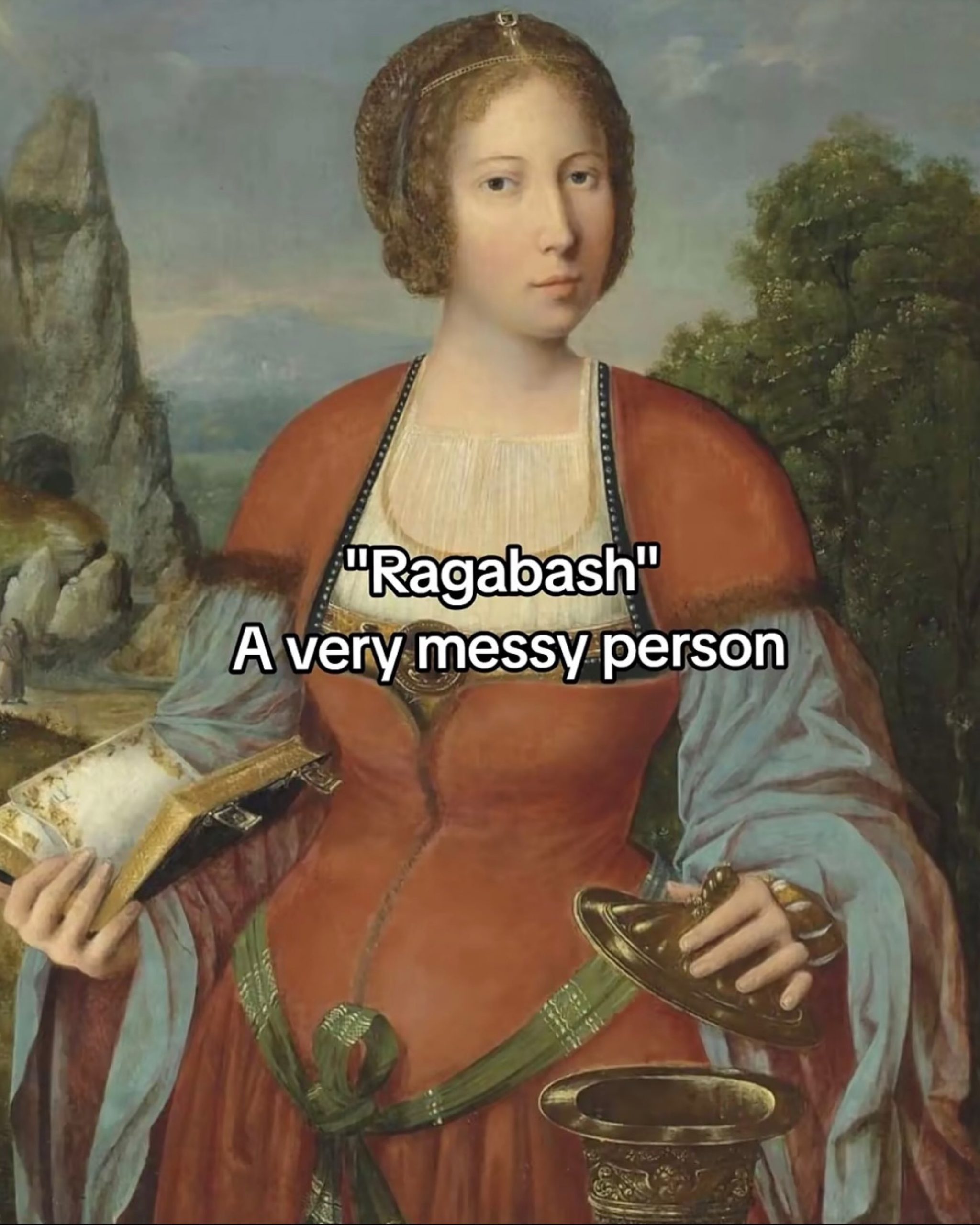
Dictionaries date it to about 1600 and define it as an idle, worthless or ragged fellow. It survived for centuries in Scottish and northern dialect as a word for riff-raff. “Messy” is a loose fit at best.
Fustylugs: real, and meaner than advertised.
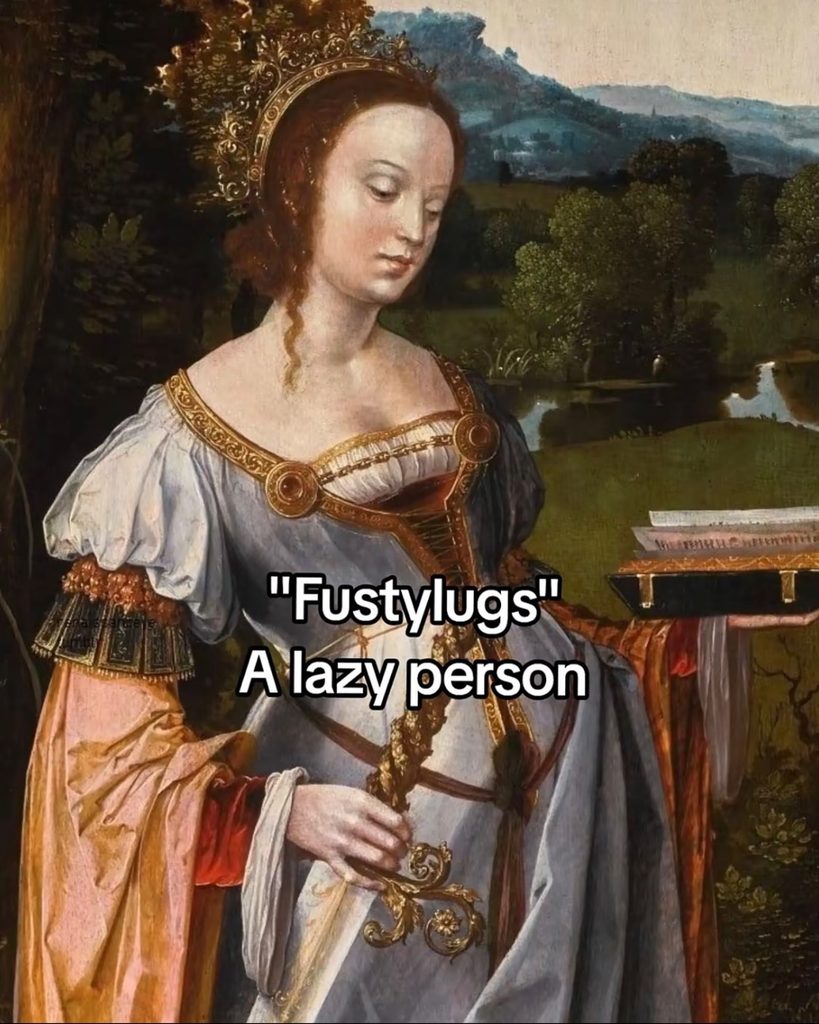
The earliest citation we found is from 1639, and slang dictionaries of the 1690s and 1785 define it as a fat, foul, slovenly woman. Merriam-Webster still lists it as archaic. It does not mean “lazy.” It is seventeenth-century body-shaming that happens to be fun to say.
Gigglemug: Victorian.

Wiktionary traces it to the Victorian era. The root word matters here: “giggle” itself does not appear in English until about 1509, so a gigglemug cannot have existed in the Middle Ages. Even the slide and its own caption disagree on the spelling, which tells you how loosely these lists are copied.
Swine head
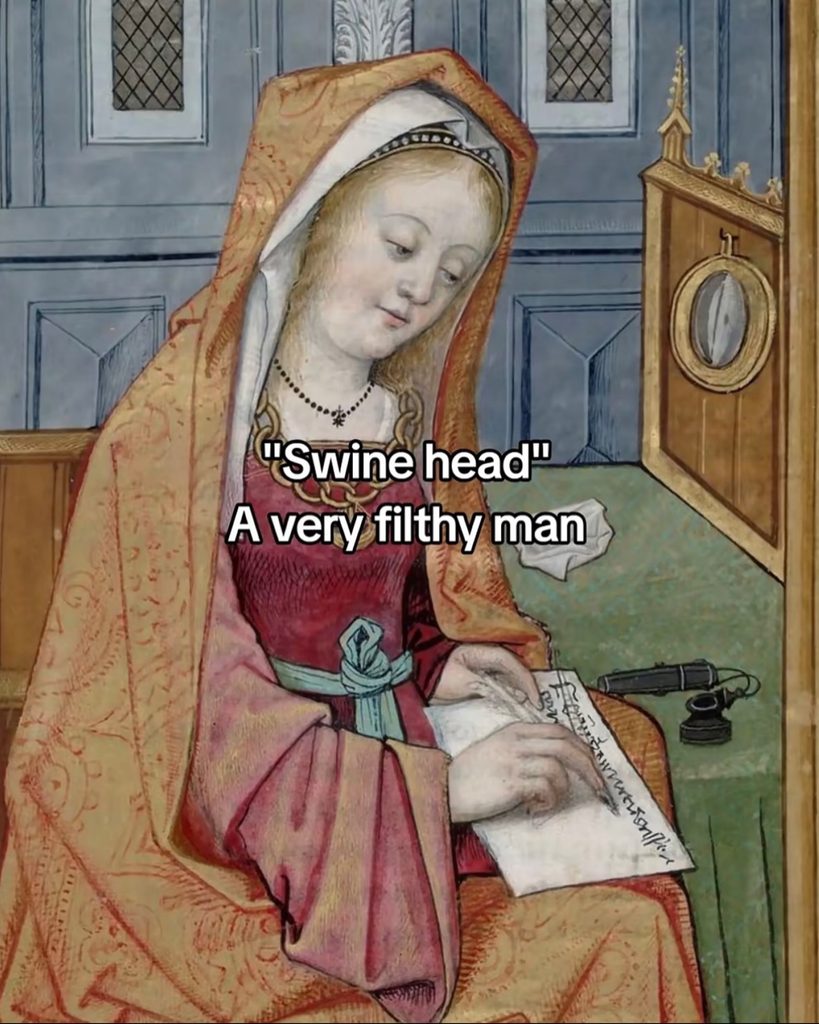
Attested historical English, not a lost medieval slang invention.
The OED records it from around 1405 in Chaucer, used as an insult for a foolish or pig-headed person.It is a real compound of swine + head, but ordinary historical vocabulary.
Slugfeast
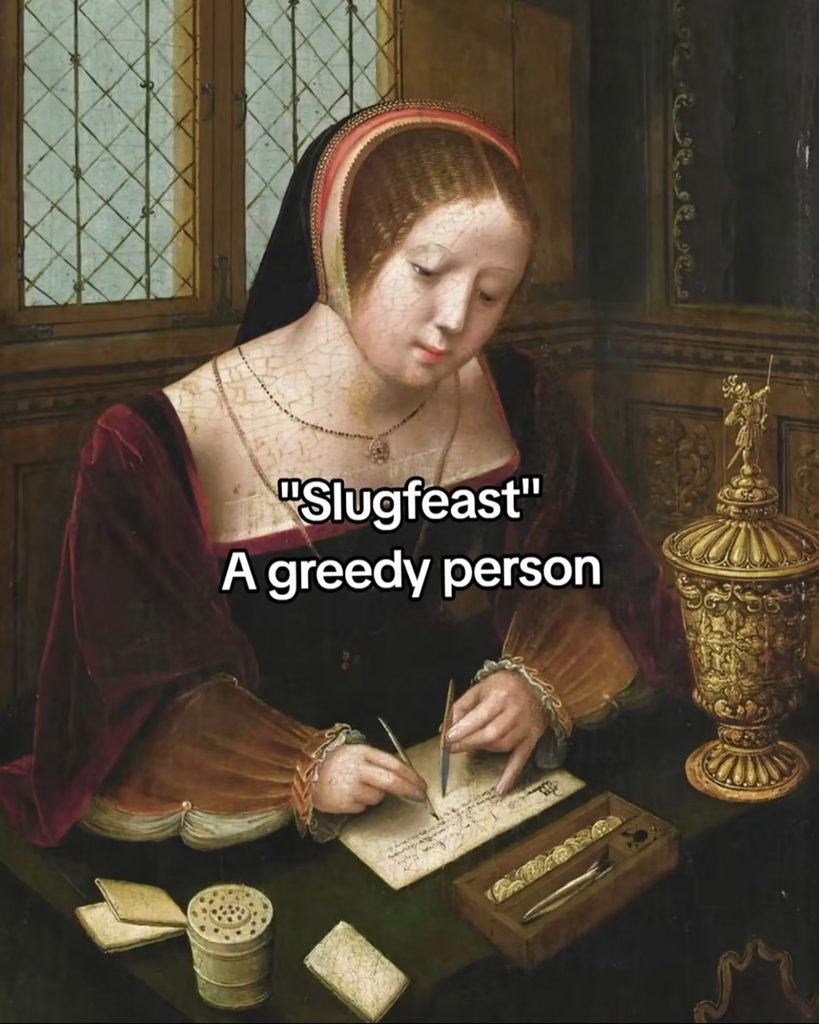
Unattested; no medieval dictionary or corpus supports it as “a greedy person.” It is a modern pseudo-medievalism, distinct from modern slugfest (a hard fight or high-scoring game).
The closest genuine old word is slug-a-bed, meaning someone who lies late.
Fartlekyn
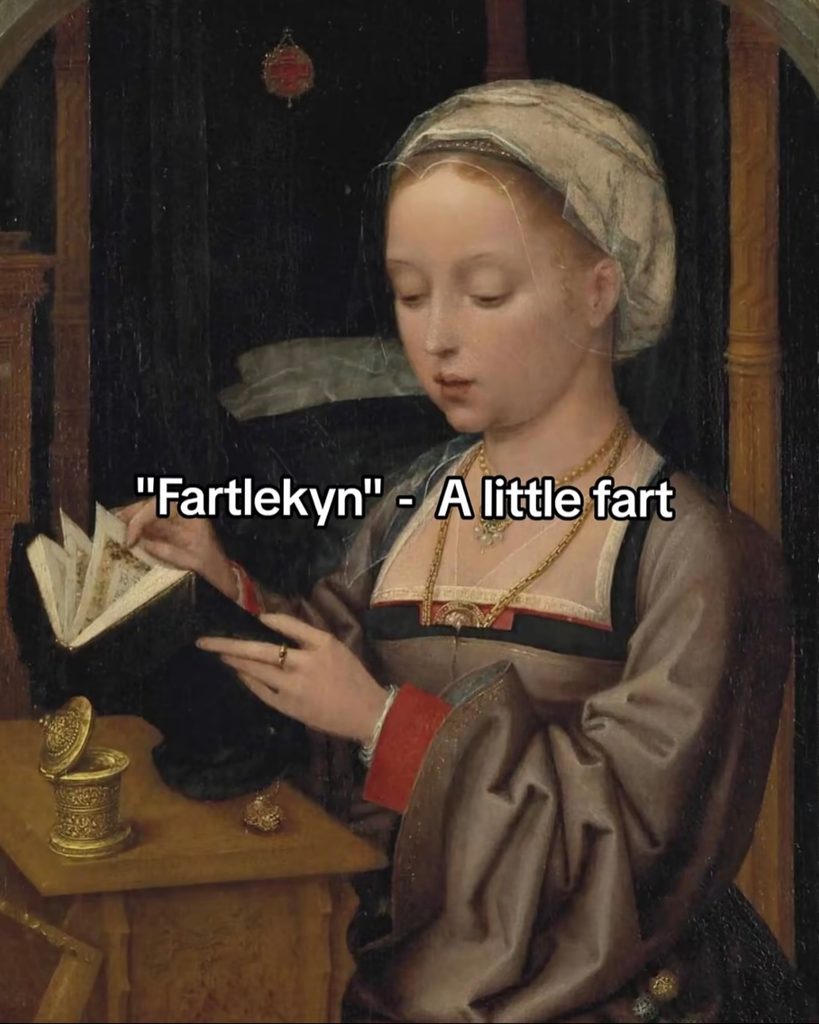
Unattested; no Middle English manuscript or glossary records it as “a little fart.”
Fart is genuinely medieval, but fartlekyn is a viral fabrication. It likely mimics fartlek, the Swedish running term borrowed into English in the 1950s.
The scorecard:
one word confirmed as medieval, four real but later and often with altered meanings, three with no record we could find.
Why These Lists Spread
A painting plus a quirky word feels like evidence. Screenshots shed their sources as they travel. “Medieval” is a prestige label that makes a joke feel like discovery.
Errors replicate faster than corrections. And the real vocabulary is entertaining enough that nobody feels the need to check. It is the same dynamic our Psychology section keeps meeting: claims travel on how they feel, not on what they cite.
What Medieval People Actually Said
The real medieval insult was often a lawsuit. Late medieval English church courts heard defamation cases in which men sued over being called thieves or cheats, attacks on the honesty their livelihoods depended on, while women sued over slurs against their sexual reputation. In the Low Countries, officials were frequent targets of abuse.
In Scotland, poets turned insult into performance: the flyting contest between William Dunbar and Walter Kennedy, staged for the court of James IV in the early 1500s, is a masterclass in trading verbal blows.
These were not cute words on a painting. They were weapons with legal consequences.
The Verdict: Debunked
As a set, the claim fails. The record supports exactly one of the eight words as authentically medieval, and that word, cumberworld, comes with a Chaucer citation.
Four more are real English with real histories, but they belong to the Tudor, Stuart and Victorian eras, and several have meanings the meme got wrong. Three have no paper trail we could find.
The individual words are still wonderful. They are just not the history the caption says they are.
Read Next
- The Green Children of Woolpit: Medieval Mystery, No Answer
- The “Vampire” Burials: Why Our Ancestors Feared the Dead Would Rise
