
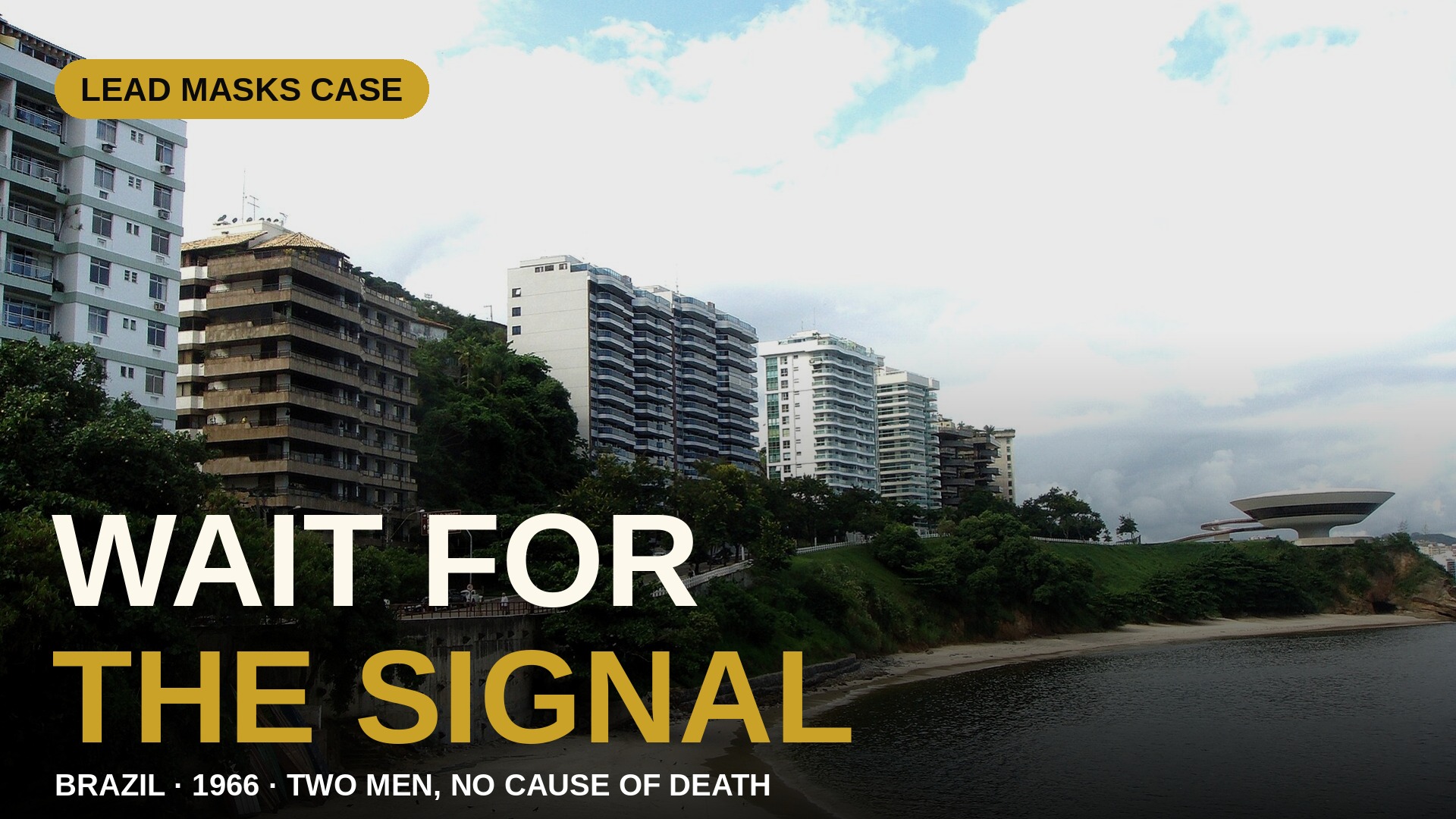
On the afternoon of 20 August 1966, an 18-year-old named Jorge da Costa Alves was flying a kite on Vintém Hill, in Niterói, across the bay from Rio de Janeiro. He came down from the hill and told police he had found two dead men lying in the brush.
What officers found when they reached the spot turned a grim discovery into the lead masks case, one of the strangest unsolved deaths of the twentieth century.
Two men lay side by side on a bed of cut branches and leaves. Both wore formal suits and waterproof coats. Neither had a mark on him.
And over the eyes of each man sat a mask cut from a sheet of lead.
There was no blood, no sign of a struggle, and no obvious cause of death. Nearly sixty years later, there still isn’t one.
Two Technicians From Campos

The dead men were Manoel Pereira da Cruz and Miguel José Viana. Both were electronics technicians from Campos dos Goytacazes, a city roughly 280 kilometres north-east of Niterói, where they repaired radios and televisions.
They were friends as well as workmates, and they shared an interest that mattered later: both belonged to a local spiritualist circle.
Friends described them as “scientific spiritualists” — men who mixed their technical work with experiments aimed at contacting spirits, and possibly something else.
One reported experiment, about two months before their deaths, involved a device the group built that exploded in Cruz’s garden.
In Viana’s workshop, investigators later found a book about spirits with passages highlighted about intense luminosity — a blinding light.
Keep that detail in mind. It is the closest thing this case has to an explanation for the masks.
On the morning of 17 August 1966, the two men told their families they were travelling to Niterói to buy equipment for the shop. They took a bus, bought waterproof coats along the way, and were seen that afternoon in Niterói.
A shopkeeper who sold them a bottle of mineral water later described them as agitated and repeatedly checking the time, as if they were worried about missing an appointment.
They headed up Vintém Hill. Nobody who knew them saw them alive again.
What Police Found on the Hill
The bodies were not recovered until 21 August, the day after Alves reported them. The slope was steep and overgrown, and getting a team up and the bodies down took time.
By then, the men had been dead for days, most likely since the evening of 17 August.
The scene itself was oddly tidy. The men lay on their backs on vegetation that appeared to have been cut and arranged. Their suits were neat.
Their waterproof coats — bought on the trip, with receipts still on them — were with them, even though the weather had been clear.
Beside the bodies, police logged a small set of items: an empty water bottle, a packet containing two towels, a notebook, and some money still in their possession. Nothing about the scene suggested a robbery or a fight.
Then there were the masks. Each was a rough sheet of lead, cut by hand into a shape that covered the eyes, with no eye holes.
They were not goggles and they were not protective eyewear in any normal sense. Lead is the material you use to shield against radiation and intense light.
Whatever the men had gone up that hill to see, they apparently expected it to be bright — or they expected something they believed lead could protect them from.
The Note

The notebook held the detail that made the case famous around the world: a short handwritten note, believed to be in Cruz’s handwriting, written like a set of instructions with times attached.
Translated from the Portuguese, it reads roughly: “16:30 — be at the agreed place. 18:30 — ingest the capsules. After the effect, protect the metals. Await the signal. Mask.”
Translations vary slightly from source to source, and the popular version is often shortened to “Wait for the signal” and “protect your face.”
But the bones of it are consistent in every version: a meeting place, a time, capsules to be swallowed, something to protect, a signal to wait for, and the masks.
Read it plainly and it is a timetable for an experiment. The men planned to be somewhere at half past four. At half past six they planned to swallow capsules.
After the capsules took effect, they were to protect themselves — with metal, with the masks — and wait for a signal.

A mysterious note at the centre of an unsolved case has a way of outliving every other fact. Japan’s Monster with 21 Faces taunted police with letters for years and was never caught either.
But the Brazilian note is stranger in one way: it was not written to taunt anyone. It was written as a checklist, by a man who expected to follow it and come home.
No capsules were ever found at the scene. No packet, no bottle, nothing that showed what the men were supposed to swallow — or whether they swallowed anything at all.
An Autopsy That Could Not Answer
If the note raised the questions, the autopsy should have narrowed them down. It did the opposite.
The post-mortem examinations found no injuries. No wounds, no signs of violence, no trauma that could explain two healthy men dying side by side on a hilltop. On that much, the record is clear.
Toxicology is where the case quietly falls apart, and it is worth being precise, because many retellings are not. You will often read that tests found no poison in the men’s bodies. That is not what happened.
The bodies had spent days on the hill in the Brazilian winter heat before recovery, and the coroner’s office was overloaded. By the time the examinations took place, the internal organs were in no condition to be properly preserved or reliably tested.
Toxic substances were effectively never screened for in a way that could settle the question.
So poisoning was neither confirmed nor ruled out. If the men swallowed capsules on that hill — as their own note instructed — the investigation lost its best chance to find out what was in them.
The cause of death was never determined. Not “unknown but probably natural.” Simply never determined, then or since.
The Investigation Went in Circles

Police attention fell quickly on the men’s spiritualist circle in Campos. If the note was a set of instructions, investigators reasoned, someone may have written the script the two men were following — and that someone might know what the capsules were.

Members of the group were questioned, and accounts of the case describe police interest in a fellow spiritualist who had taken part in the men’s earlier experiments.
Nothing produced a charge. Whatever the group had been doing, the police could not connect any living person to the deaths on the hill.
The story also picked up the kind of detail that attaches itself to cases like this. In later retellings, a local resident was said to have seen an orange, oval-shaped object in the sky over Vintém Hill on the evening the men died.
It was reported after the discovery, never verified, and no official record backs it up — but it cemented the case’s UFO reputation in Brazil.
What is documented is simpler and stranger than any of the additions. The file produced a scene, a note, two masks and an inconclusive autopsy, and then it stopped.
Brazilian newspapers have revived the case on its anniversaries ever since, and it is still routinely described at home as one of the country’s great unsolved mysteries.
That leaves the theories to do the work the investigation could not.
The Theories: A Meeting That Never Happened

The most grounded theory starts with the men’s own circle. Cruz and Viana were part of a spiritualist group that experimented with rituals and, by some accounts, drugs, in an effort to contact spirits or extraterrestrials. Vintém Hill had a local reputation for strange lights in the sky.
On that reading, the hilltop was a rendezvous. The men expected a manifestation — a spirit, a craft, a flash of light — and prepared the way believers prepare: capsules to open the mind, lead masks to shield their eyes from the brilliance, towels and water for the wait.
Something then went badly wrong, and the capsules are the obvious suspect.
An overdose fits the scene in several ways. It explains two men dying at roughly the same time with no injuries.
It explains why they lay down neatly rather than staggering or calling for help. And it matches the note, which is, after all, a plan to ingest something at a set time.
What it cannot do is prove itself. With no toxicology and no capsules recovered, the overdose theory is the best fit for the evidence, not a conclusion drawn from it.
The UFO version takes the same facts and points them upward. The men, believers said, had arranged to meet a craft. The masks were for the light of its arrival.
The signal in the note was the ship. In this telling, whatever they met on the hill killed them — or took something from them — and left two bodies as the receipt.
There is no physical evidence for any of it. No witness saw a craft over Vintém Hill that evening, and nothing at the scene was burned, disturbed or missing. The theory survives because the men’s own beliefs invite it, not because the hill offered proof.
Foul play gets raised in almost every retelling, usually as a failed drug deal or a robbery arranged by whoever gave them their instructions. It struggles with the scene.
The men still had money on them, their belongings were undisturbed, and there was no sign of violence or flight. If a third party killed them, they did it without touching them.
Some accounts claim a large sum the men were carrying for their purchases was never accounted for, which keeps the robbery idea on life support. But a missing-money dispute in a sixty-year-old file is a long way from a murder weapon.
And so the case sits where it has always sat. Two men climbed a hill to keep an appointment described only in their own note.
Like the people who vanished without a trace in cases we have covered before, Cruz and Viana stepped out of their ordinary lives on an ordinary errand — the difference is that these two were found, and being found explained nothing.
Deaths with no cause, no culprit and no closure tend to attract the same gravity. It is why this case is so often shelved next to mysterious whistleblower deaths and other files where the official record simply runs out.
Here, the record did not run out because someone hid it. It ran out because the bodies waited too long on a hill, and the science of 1966 could not catch up.
Verdict: Unresolved. Manoel Pereira da Cruz and Miguel José Viana died on Vintém Hill of causes that were never established.
The note, the capsules and the lead masks point to a planned experiment by two men expecting a signal and a blinding light — but with toxicology never properly done, even the most sensible explanation, an overdose, remains unproven. The signal, whatever it was, never came. Or it came, and it killed them.

Frequently Asked Questions
Were the two men poisoned?
Nobody knows. Their organs were not preserved well enough for reliable toxicology tests, so poisoning could neither be confirmed nor ruled out.
What were the lead masks for?
Most likely to shield their eyes from an intense light they expected to see. Lead blocks radiation and glare, and a book in Viana’s workshop had highlighted passages about “intense luminosity.”
What did the note actually say?
In translation: be at the agreed place at 16:30, ingest capsules at 18:30, then protect the metals, await the signal, and use the mask.
Was anything stolen from the men?
Their belongings and some money were still with the bodies, and there was no sign of a struggle, which makes robbery unlikely.
Has the lead masks case ever been solved?
No. The cause of death was never determined and no one has ever been charged. It remains one of Brazil’s most famous unsolved cases.
Join the Conversation
What was the ‘signal’ they were waiting for? Tell us your theory!
Read Next
- The Monster with 21 Faces
- People Who Vanished Without a Trace
- Mysterious Whistleblower Deaths
- The Lead Masks Case: Two Men Died Waiting for a Signal
