
They all look the same. They all dress the same. Nobody owns anything, nobody is paid, and one bearded elder in red tells everyone what to do.
That is the Smurf village as millions of children met it, and for decades some adults have looked at the same picture and seen something else entirely: a communist society in miniature.
The reading is detailed. Each Smurf is named for his function, Handy, Brainy, Jokey, so the person is the job. Work is done for the village. Meals are shared. Private property barely exists.
Even the name gets recruited. SMURF, the theory claims, stands for Socialist Men Under Red Father, with white-bearded Papa Smurf, dressed in red, standing in for Marx or Moscow.
There is one more exhibit, and it is visual. Papa Smurf sports a full white beard and wears red while every other Smurf wears white. Put him beside a portrait of Karl Marx and the resemblance game begins.
The creator never endorsed any of it. Peyo, the Belgian artist behind the Smurfs, kept his comics resolutely unpolitical. So where did the theory come from, and does any of it hold up?
Key Facts
- The Smurfs debuted on 23 October 1958 in Spirou, inside Peyo’s series Johan et Pirlouit.
- Schtroumpf began as a 1957 dinner-table joke. Peyo forgot the word for salt and invented it on the spot.
- Antoine Buéno’s 2011 book Le Petit Livre Bleu called Smurf society a totalitarian utopia steeped in Stalinism.
- In The Finance Smurf (1992), Peyo’s last album, money enters the village, wrecks it, and is abandoned.
- Peyo, born Pierre Culliford (1928–1992), left no political programme. His family rejected the propaganda reading.
The Theory
The theory’s favourite origin story is a 1998 satirical essay credited to a writer named Marc Schmidt, said to have mapped the Smurfs onto socialism as a joke about European pop culture.
Here is the honest problem: that attribution is repeated everywhere and documented almost nowhere. Later retellings cite each other. Treat the Schmidt essay as the theory’s legend, not its birth certificate.
The village, read as a system
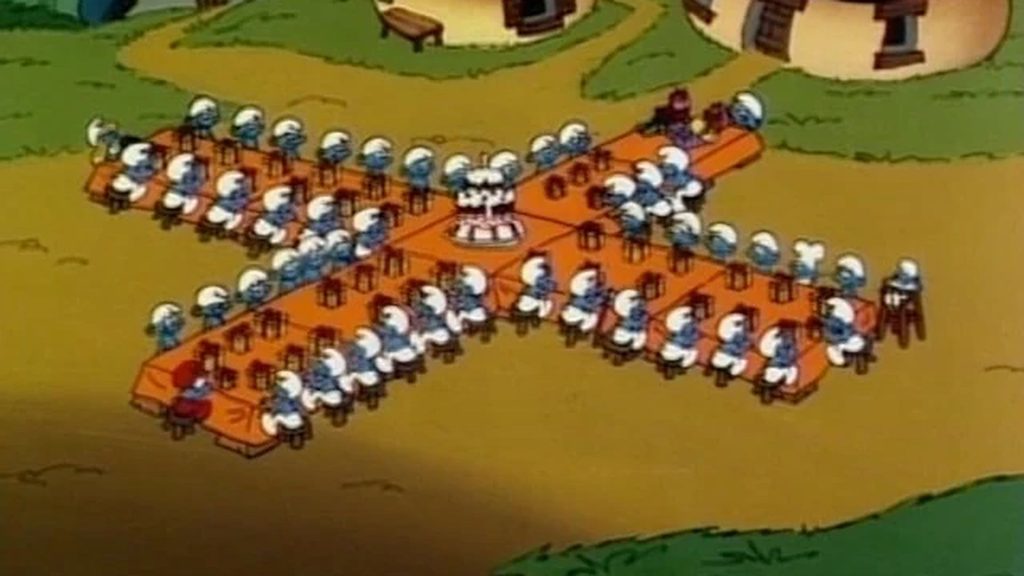
- About 100 Smurfs live in mushroom houses they do not appear to own or rent.
- Meals are communal, work is assigned by need, and nobody receives a wage.
- Most Smurfs look identical. The named ones carry their job as their name.
- Papa Smurf decides disputes, leads rescues and is never voted out.
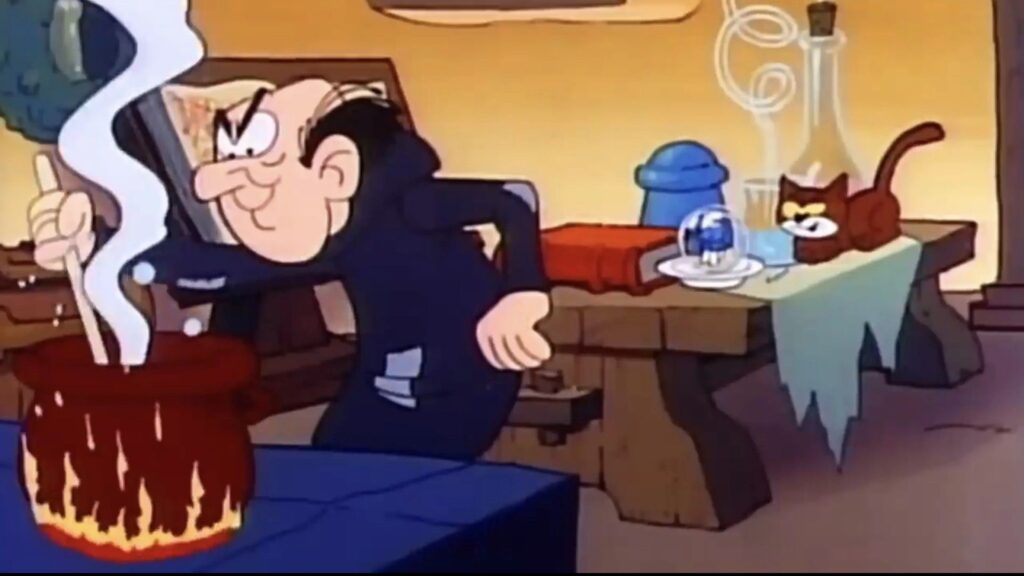
- Gargamel lives alone, hoards ambitions of gold, and schemes from outside.
Smaller details get swept into the case as well. The Smurfs wear Phrygian caps, the headwear of freed slaves in ancient Rome and of revolutionaries in France. Buéno reads even the hats politically.
What is documented is the reading itself, circulating through the 1980s and 1990s, boosted by a 2008 satirical video, and then given hard covers in 2011 by a real, citable author.
Buéno’s book, argument by argument
That author is Antoine Buéno, a lecturer at Sciences Po in Paris. His book Le Petit Livre Bleu called Smurf society an archetype of a totalitarian utopia, steeped in Stalinism.
Buéno’s specifics are sharper than the internet version. About 90 percent of the original 100 Smurfs, he notes, are indistinguishable. The named ones are named for their use to the community.
His cast list is pointed. Papa Smurf, all-powerful and omniscient, resembles Marx or Stalin. Brainy Smurf, bespectacled and forever lecturing, stands in for Trotsky. Gargamel becomes the capitalist threat at the gate.
He went further than economics. In The Black Smurfs, from 1959, a bitten Smurf turns black, loses speech and spreads panic. Buéno read it as a story where purity of blood becomes vital.
He read Smurfette the same way. Gargamel creates her from clay as a spy, and Papa Smurf remakes her blonde and long-lashed. Buéno called that the idealising of a blonde Aryan type.
He also flagged Gargamel himself: a hook-nosed, gold-obsessed loner with a cat named Azraël. In Buéno’s reading, that profile echoes an antisemitic caricature. Peyo’s defenders called the claim grotesque.
Add the structural parallels and the case writes itself. No money. No wages. Collective labour, collective meals, one leader whose word ends every argument, and a greedy outsider at the gate.
That outsider is Gargamel, the wizard who wants to capture Smurfs and turn them into gold. In the political reading he is capitalism itself: acquisitive, solitary and forever scheming.
Why the reading keeps returning
The theory never really died. In July 2025, a Guardian piece asked whether Hollywood had distorted the Smurfs’ communist roots, quoting Buéno on how individuality in the comics always spells disaster.
Philip Oltermann’s piece, published as a new Smurfs film opened, returned to Buéno’s core claim: in the original comics, private property and standing out tend to end in catastrophe for the village.
His example was King Smurf. When one Smurf seeks power for himself, the village slides toward guards, uniforms and civil conflict. Individual ambition, in that story, is the disaster.
Other countries read the village through their own politics. In Cold War America, a moneyless cartoon collective looked suspect by default. In France, Buéno’s provocation landed as an academic game about national treasures.
More recently in Germany, the brand has been fought over from the other direction, with far-right creators misusing Smurf imagery. The rights holder publicly distanced the Smurfs from that content.
It is the same tension that powered 6 Insane Cold War Secrets: CIA Cats to Nuke Near-Misses: a West trained to spot red ideology hiding inside ordinary culture.
The Counterevidence
A name born at a dinner table
Start with the name, because it collapses first. The characters debuted in 1958 as Les Schtroumpfs, in Peyo’s medieval series Johan et Pirlouit, in the Belgian magazine Spirou.
The debut story was La Flûte à six trous, on 23 October 1958. Johan and Pirlouit meet small blue beings in a cursed land, speaking a language where one word, schtroumpf, does almost every job.
Schtroumpf was a dinner-table joke. At a meal in 1957, Peyo forgot the French word for salt and asked fellow artist André Franquin to pass the schtroumpf. They spent the weekend schtroumpfing.
The joke outlived the weekend. Peyo and Franquin kept substituting the word for nouns and verbs for days. When blue characters needed a name a year later, the nonsense word was already waiting.
Smurf is simply the Dutch rendering of that nonsense word. A five-letter English acronym cannot be the origin of a name that began as French gibberish. The backronym is retrofitted, full stop.
Peyo himself
Peyo himself, Pierre Culliford, 1928 to 1992, left no political programme behind the strip. His family has rejected the propaganda reading, and the comics chase slapstick, not doctrine.
His biography explains the village better than ideology does. Born in Brussels in 1928, he lived through the Nazi occupation of Belgium as a teenager, left school, and worked in animation before comics.
He created Johan, his medieval hero, years before the Smurfs stole his series. The little blue side characters were meant as a one-off encounter. Readers demanded them back, and a village had to be built.
His son Thierry, who runs the studio, answered Buéno directly. He called the accusations somewhere between grotesque and not serious, and said his father had no interest in politics at all.
Buéno, notably, agreed on that narrow point. He told reporters Peyo was not politicised, and that any such imagery was unconscious. His book attacked a society on the page, not a manifesto by its author.
The Finance Smurf, beat by beat
The work itself supplies the strongest reply. In The Finance Smurf, Peyo’s final album, published in 1992, a Smurf brings money back from the human world and teaches the village to use it.
- Papa Smurf is injured in a lab explosion, so a Smurf travels to the human world for medicine.
- There he learns money from a human, returns with the cure, and decides to surprise the village.
- Coins are minted with Papa Smurf’s face. Every Smurf starts with a bag of money.
- Baker, Farmer and Handy grow rich. Poet and Jokey grow poor. A bank opens to lend.
- A broken bridge is repaired, then tolled. A cheaper wood deal comes with a bribe.
- Gargamel finds a dropped coin, kidnaps Farmer Smurf, and demands all the gold as ransom.
- The village walks out. Finance Smurf owns everything, alone, and gives it all back.
The details sting. Finance Smurf keeps extra coins for himself at the start. Smurfette’s work goes unpaid. By the end, even Papa Smurf is in debt, and the coins are melted down into musical instruments.
The experiment wrecks the place. Some Smurfs grow rich, most grow poor, a bank opens, tolls appear, and the village abandons the system. Read politically, that is a fable against markets, or for them.
Either way, it is a story Peyo chose to tell, and it shows a creator playing with economics as comedy. The reference record at The Smurfs shows no manifesto anywhere in it.
Individual Smurfs also break ranks constantly in the stories. Jokey plays selfish pranks, Vanity preens, Grouchy opts out of village cheer. The collective is a setting, not a straitjacket.
Even Papa Smurf’s famous red outfit proves little. Red trousers and cap set the village elder apart from a hundred white-clad Smurfs on the page. Design clarity is not a party card.
The Verdict
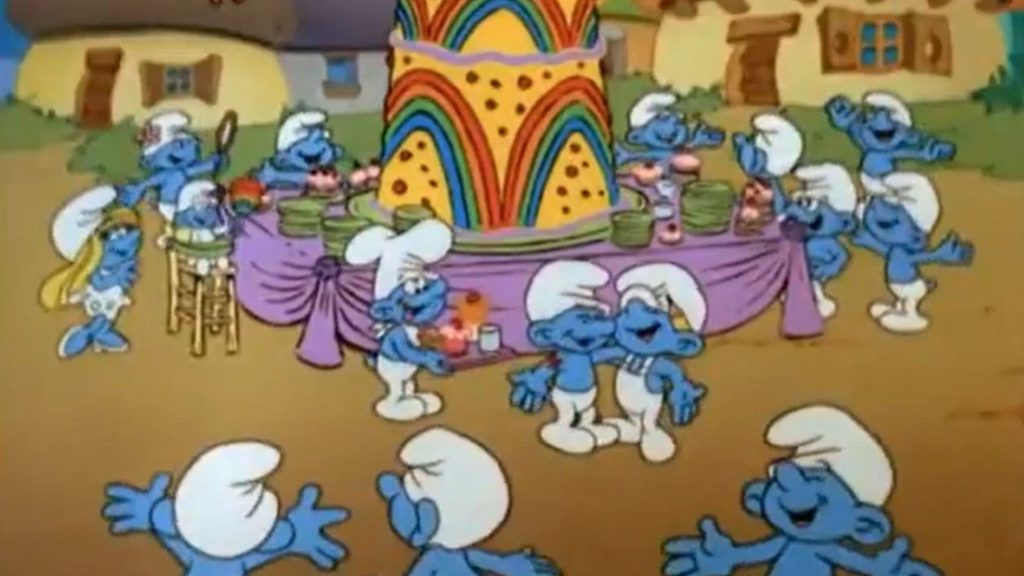
The parallels are real, and nobody should pretend otherwise. A moneyless village of identical workers under one red-clad patriarch will always invite a political reading, in any decade.
But a reading is not a message. The acronym is linguistically impossible, the founding essay is unverifiable, the creator left no agenda, and his last book satirises money itself.
What survives the check, and what does not
- Survives: the village really is collective, moneyless and led by one elder.
- Survives: Buéno really wrote the Stalinism argument, in a 177-page book in 2011.
- Fails: the acronym. Schtroumpf predates the English word Smurf by a year.
- Fails: intent. No letter, interview or note shows Peyo pushing a system.
- Fails: propaganda needs a target audience. These were gag comics in Spirou.
What the theory documents best is its audience. It flourished while the Cold War made collectivism the West’s central fear, and it revives whenever a new Smurfs film gives adults a reason to look back.
Buéno, to his credit, wrote provocation, not proof, and said his book was meant to amuse. The internet dropped the joke’s framing and kept the accusation. That part is on us, not on Peyo.
Consider King Smurf, the 1965 story Buéno himself cites. Papa Smurf leaves, the village votes for a stand-in, and the winner becomes a tiny dictator with guards and a prison within days.
Fans of the theory quote it as a portrait of totalitarianism. Read whole, it is a satire of power itself, aimed at whoever holds it. Peyo was mocking leaders, not recruiting for one.
That distinction is the whole case. A comic can contain collective living, a strong elder and a greedy villain without being a pamphlet, because those are also the ingredients of a fairy tale.
Verdict: Unresolved as a claim about Peyo’s intent, and unsupported as propaganda. The Smurfs communist theory says more about Cold War anxieties than about a Belgian forest village.
Does SMURF really stand for Socialist Men Under Red Father?
No. The name comes from schtroumpf, a nonsense word Peyo invented at a dinner-table in 1957. The acronym was fitted to the English name decades later.
Who first called the Smurfs communist?
Nobody knows for certain. The reading is often credited to a 1998 satirical essay by Marc Schmidt, but that attribution is repeated far more often than it is documented.
What did Antoine Buéno argue in 2011?
In Le Petit Livre Bleu, Buéno called Smurf society a totalitarian utopia steeped in Stalinism. He later stressed the book was a provocation meant to amuse.
Did Peyo intend a political message?
There is no evidence he did. Peyo kept the comics apolitical, and his family has rejected the propaganda reading as baseless.
Do the Smurfs ever use money?
Yes, once, disastrously. In The Finance Smurf (1992), money enters the village, creates rich and poor Smurfs, and is abandoned by the end of the story.
Join the Conversation
A moneyless village, a bearded elder in red, and a name that was never an acronym. Did you spot the political reading as a child, or did the internet hand it to you later? Tell us below.
Read Next
- 6 Insane Cold War Secrets: CIA Cats to Nuke Near-Misses
- The Dark Truth Behind Viral Disney Conspiracy Theories
- Winnie the Pooh: The Mental Disorder Theory
